
预测 2020 年 2 月至 2021 年 1 月期间荷兰的 COVID-19 重症监护入院人数,为政策建议提供参考。
Projecting COVID-19 intensive care admissions for policy advice, the Netherlands, February 2020 to January 2021.
机构信息
National Institute for Public Health and the Environment, Bilthoven, The Netherlands.
National Intensive Care Evaluation (NICE) Foundation, Amsterdam, The Netherlands.
出版信息
Euro Surveill. 2024 Mar;29(10). doi: 10.2807/1560-7917.ES.2024.29.10.2300336.
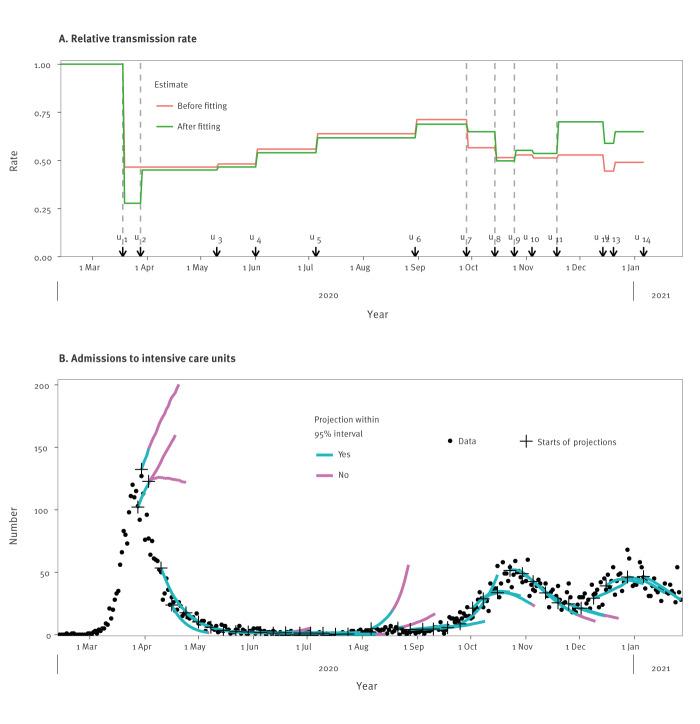
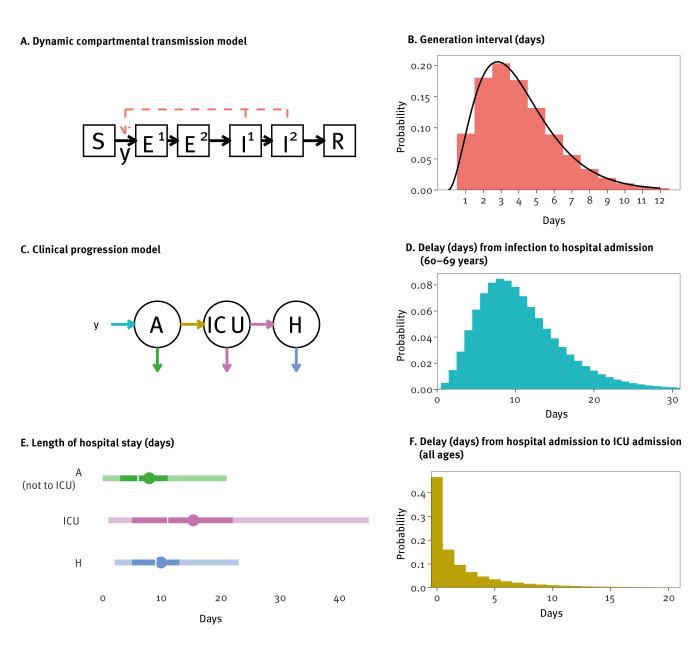
BackgroundModel projections of coronavirus disease 2019 (COVID-19) incidence help policymakers about decisions to implement or lift control measures. During the pandemic, policymakers in the Netherlands were informed on a weekly basis with short-term projections of COVID-19 intensive care unit (ICU) admissions.AimWe aimed at developing a model on ICU admissions and updating a procedure for informing policymakers.MethodThe projections were produced using an age-structured transmission model. A consistent, incremental update procedure integrating all new surveillance and hospital data was conducted weekly. First, up-to-date estimates for most parameter values were obtained through re-analysis of all data sources. Then, estimates were made for changes in the age-specific contact rates in response to policy changes. Finally, a piecewise constant transmission rate was estimated by fitting the model to reported daily ICU admissions, with a changepoint analysis guided by Akaike's Information Criterion.ResultsThe model and update procedure allowed us to make weekly projections. Most 3-week prediction intervals were accurate in covering the later observed numbers of ICU admissions. When projections were too high in March and August 2020 or too low in November 2020, the estimated effectiveness of the policy changes was adequately adapted in the changepoint analysis based on the natural accumulation of incoming data.ConclusionThe model incorporates basic epidemiological principles and most model parameters were estimated per data source. Therefore, it had potential to be adapted to a more complex epidemiological situation with the rise of new variants and the start of vaccination.
背景
模型预测的 2019 冠状病毒病(COVID-19)发病率有助于决策者做出实施或取消控制措施的决策。在大流行期间,荷兰的决策者每周都会收到 COVID-19 重症监护病房(ICU)入院的短期预测。
目的
我们旨在开发一个 ICU 入院预测模型,并更新向决策者提供信息的程序。
方法
该预测使用了一个年龄结构传播模型。每周都会进行一致的、增量式更新程序,整合所有新的监测和医院数据。首先,通过对所有数据源的重新分析,获得大多数参数值的最新估计值。然后,根据政策变化,估计特定年龄组接触率的变化。最后,通过将模型拟合到报告的每日 ICU 入院数据来估计分段常数传播率,并通过赤池信息量准则引导的断点分析。
结果
该模型和更新程序使我们能够进行每周预测。大多数 3 周预测区间都能准确覆盖随后观察到的 ICU 入院人数。当 2020 年 3 月和 8 月的预测过高或 2020 年 11 月的预测过低时,基于传入数据的自然积累,在基于自然积累的变化点分析中,对政策变化效果的估计进行了适当调整。
结论
该模型结合了基本的流行病学原理,并且大多数模型参数都是根据每个数据源进行估计的。因此,它有可能随着新变体的出现和疫苗接种的开始,适应更复杂的流行病学情况。
 Zotero 插件