
BiWO₄/g-C₃N₄ Z型异质结的构建及其在太阳光下与过硫酸盐协同增强光催化降解四环素
Construction of BiWO/g-CN Z-Scheme Heterojunction and Its Enhanced Photocatalytic Degradation of Tetracycline with Persulfate under Solar Light.
作者信息
Li Yukun, Zhang Haiyang, Zhang Dan, Yao Sen, Dong Shuying, Chen Qishi, Fan Fengjuan, Jia Hongyuan, Dong Mingjia
机构信息
School of Energy and Environmental Engineering, Zhongyuan University of Technology, Zhengzhou 450007, China.
Science and Technology Innovation Coordination Service Center of Laiwu District, Jinan 271100, China.
出版信息
Molecules. 2024 Mar 6;29(5):1169. doi: 10.3390/molecules29051169.
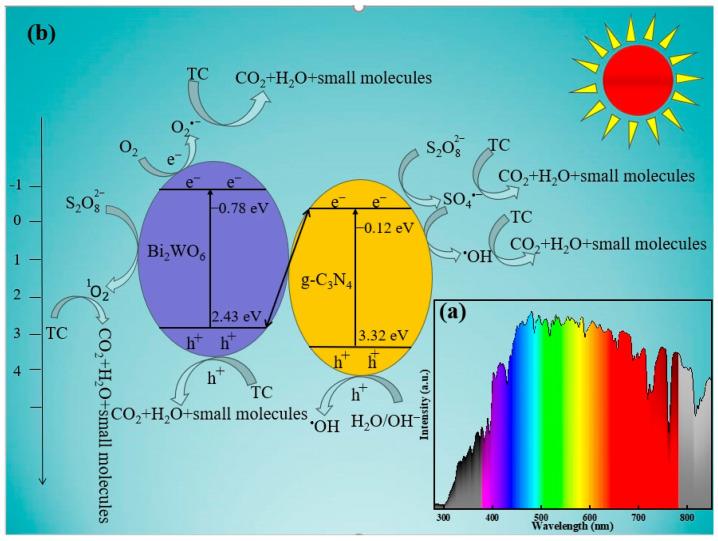
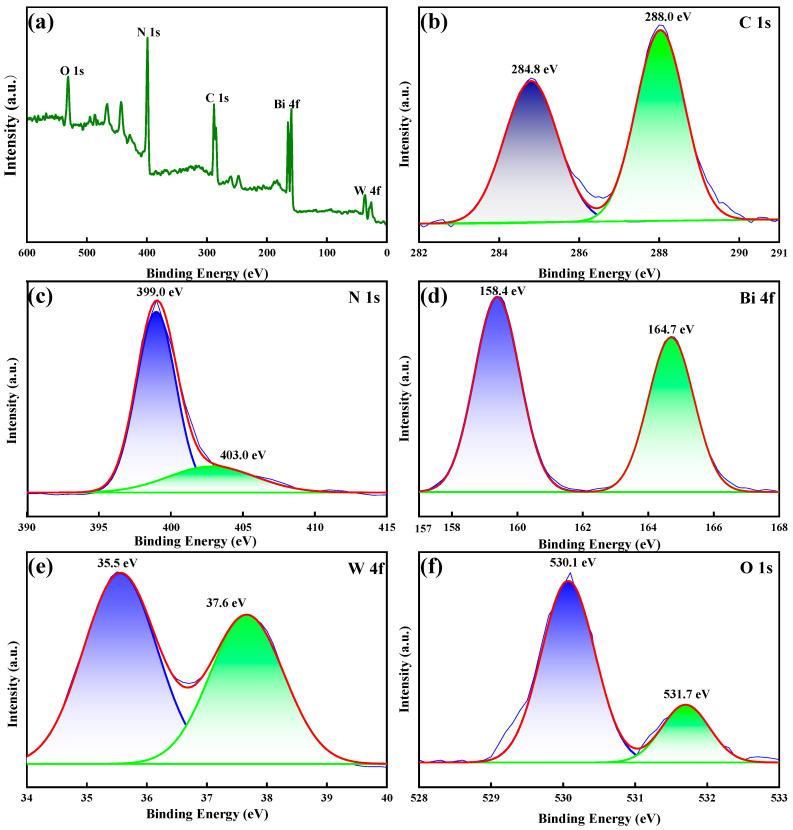
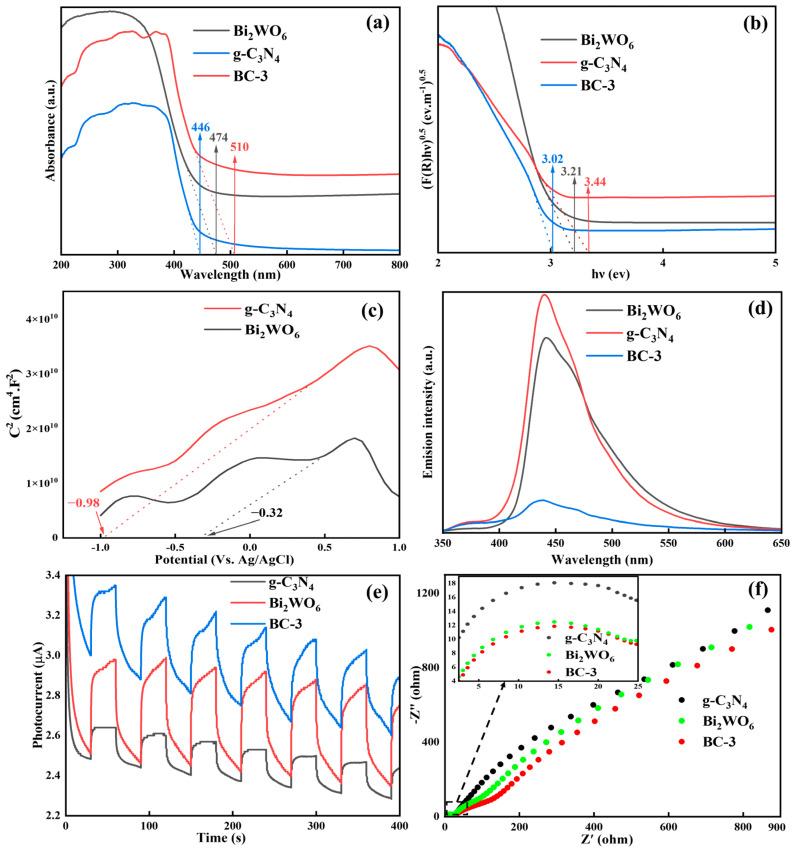
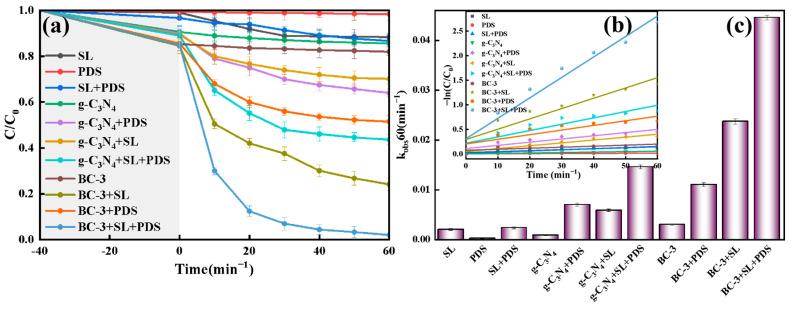
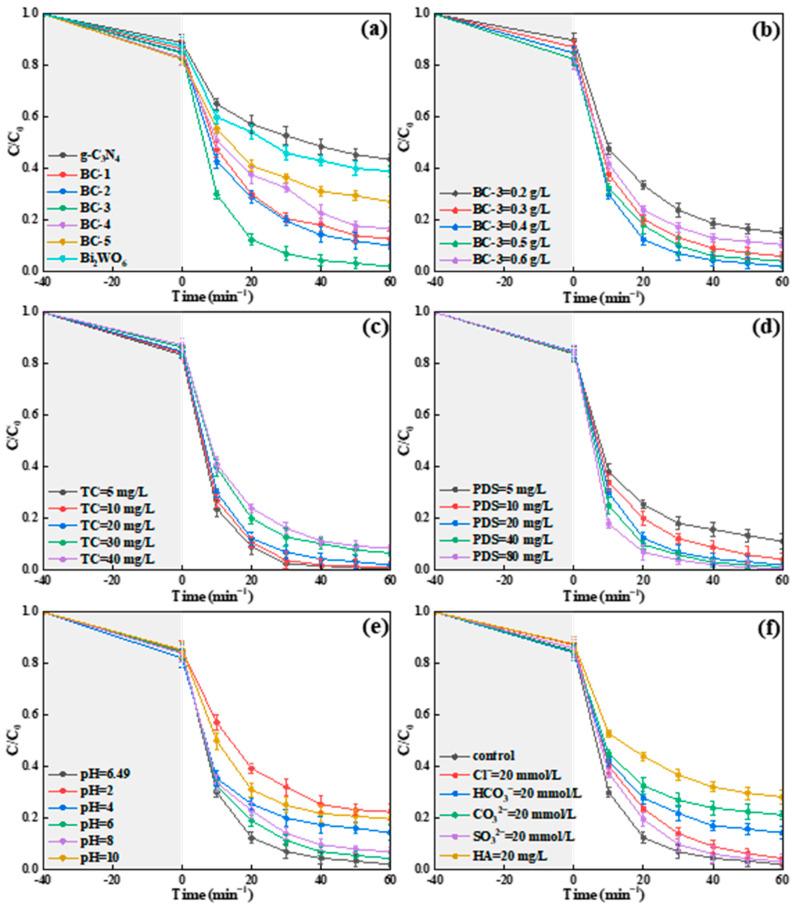
Z-scheme heterojunction BiWO/g-CN was obtained by a novel hydrothermal process; its photocatalysis-persulfate (PDS) activation for tetracycline (TC) removal was explored under solar light (SL). The structure and photoelectrochemistry behavior of fabricated samples were well characterized by FT-IR, XRD, XPS, SEM-EDS, UV-vis DRS, Mott-Schottky, PL, photocurrent response, EIS and BET. The critical experimental factors in TC decomposition were investigated, including the BiWO doping ratio, catalyst dosage, TC concentration, PDS dose, pH, co-existing ion and humic acid (HA). The optimum test conditions were as follows: 0.4 g/L BiWO/g-CN (BC-3), 20 mg/L TC, 20 mg/L PDS and pH = 6.49, and the maximum removal efficiency of TC was 98.0% in 60 min. The decomposition rate in BC-3/SL/PDS system (0.0446 min) was 3.05 times higher than that of the g-CN/SL/PDS system (0.0146 min), which might be caused by the high-efficiency electron transfer inside the Z-scheme BiWO/g-CN heterojunction. Furthermore, the photogenerated hole (h), superoxide (O•), sulfate radical (SO•) and singlet oxygen (O) were confirmed as the key oxidation factors in the BC-3/SL/PDS system for TC degradation by a free radical quenching experiment. Particularly, BC-3 possessed a wide application potential in actual antibiotic wastewater treatment for its superior catalytic performance that emerged in the experiment of co-existing components.
通过一种新型水热法制备了Z型异质结BiWO/g-CN;在太阳光(SL)下探索了其光催化-过硫酸盐(PDS)活化去除四环素(TC)的性能。通过傅里叶变换红外光谱(FT-IR)、X射线衍射(XRD)、X射线光电子能谱(XPS)、扫描电子显微镜-能谱仪(SEM-EDS)、紫外可见漫反射光谱(UV-vis DRS)、莫特-肖特基曲线、光致发光光谱(PL)、光电流响应、电化学阻抗谱(EIS)和比表面积分析(BET)对制备样品的结构和光电化学行为进行了充分表征。研究了TC分解过程中的关键实验因素,包括BiWO掺杂比例、催化剂用量、TC浓度、PDS剂量、pH值、共存离子和腐殖酸(HA)。最佳测试条件如下:0.4 g/L BiWO/g-CN(BC-3)、20 mg/L TC、20 mg/L PDS且pH = 6.49,60分钟内TC的最大去除效率为98.0%。BC-3/SL/PDS体系中的分解速率(0.0446 min)比g-CN/SL/PDS体系(0.0146 min)高3.05倍,这可能是由于Z型BiWO/g-CN异质结内部高效的电子转移所致。此外,通过自由基猝灭实验证实,光生空穴(h)、超氧自由基(O•)、硫酸根自由基(SO•)和单线态氧(O)是BC-3/SL/PDS体系中TC降解的关键氧化因子。特别是,BC-3在共存成分实验中表现出优异的催化性能,在实际抗生素废水处理中具有广阔的应用潜力。




 Zotero 插件