
美国人群钙摄入量趋势:NHANES(1999-2018 年)研究结果。
Trends in Calcium Intake among the US Population: Results from the NHANES (1999-2018).
机构信息
Department of Nutrition and Food Hygiene, Institute of Nutrition, School of Public Health, Fudan University, Shanghai 200032, China.
Department of Public Health Sciences, Penn State College of Medicine, Hershey, PA 17033, USA.
出版信息
Nutrients. 2024 Mar 2;16(5):726. doi: 10.3390/nu16050726.
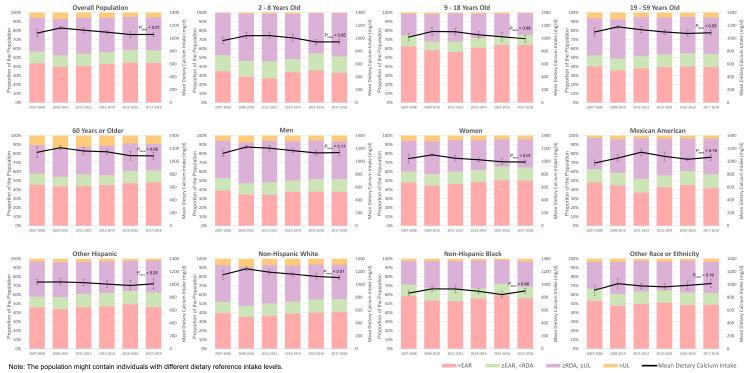
Inadequate calcium intake is common in the US. Trends in calcium intake among the US population have been less studied, especially in more recent years. We used data from the National Health and Nutrition Examination Survey (NHANES) 1999-2000 to 2017-2018 to study trends in calcium derived from diet and dietary supplements among the US population aged 2 years, stratified by sex, age group, race, and ethnicity. Among the 80,880 participants included in our study, a substantial portion consistently lacked sufficient calcium intake, even when considering calcium from supplements. Concerning trends were observed over the more recent ten years (2009-2018), with decreased dietary calcium intake and no significant improvement in the prevalence of dietary calcium intake < Estimated Average Requirement (EAR) or the prevalence of taking calcium-containing dietary supplements among them. Decreasing trends in dietary calcium intake were more concerning among men, children, and non-Hispanic Whites. Attention should be given to subgroups with higher calcium intake requirements (e.g., 9-18 years and 60+ years), and subgroups with low levels of dietary calcium and a low prevalence of obtaining calcium from dietary supplements (e.g., the non-Hispanic Black subgroup). Concerning trends of calcium intake were observed among the US population from 2009 to 2018. Tailored guidance on dietary choices and dietary supplement use is required to change consumers' behaviors.
美国的钙摄入量不足较为常见。然而,人们对美国人群的钙摄入量趋势的研究较少,尤其是在最近几年。我们使用了美国国家健康和营养检查调查(NHANES)1999-2000 年至 2017-2018 年的数据,研究了美国 2 岁及以上人群中饮食和膳食补充剂来源的钙摄入量趋势,按性别、年龄组、种族和民族进行了分层。在我们的研究中,纳入了 80880 名参与者,其中相当一部分人始终存在钙摄入量不足的情况,即使考虑到了补充剂中的钙。在最近的十年(2009-2018 年)中观察到了与钙摄入量相关的趋势,饮食中的钙摄入量减少,而饮食中钙摄入量低于估计平均需求量(EAR)的比例或服用含钙膳食补充剂的比例并没有显著改善。饮食中钙摄入量的下降趋势在男性、儿童和非西班牙裔白人中更为明显。应关注钙摄入量需求较高的亚组(如 9-18 岁和 60 岁以上)以及饮食中钙含量低且膳食补充剂中钙获取率低的亚组(如非西班牙裔黑人亚组)。我们观察到了 2009 年至 2018 年美国人群中钙摄入量的相关趋势。需要制定针对饮食选择和膳食补充剂使用的具体指导意见,以改变消费者的行为。


 Zotero 插件