
模仿双链断裂的AsiDNA™诱饵通过DNA-PK/p53/p21依赖的G1/S期阻滞保护正常组织免受辐射毒性。
The AsiDNA™ decoy mimicking DSBs protects the normal tissue from radiation toxicity through a DNA-PK/p53/p21-dependent G1/S arrest.
作者信息
Sesink Anouk, Becerra Margaux, Ruan Jia-Ling, Leboucher Sophie, Dubail Maxime, Heinrich Sophie, Jdey Wael, Petersson Kristoffer, Fouillade Charles, Berthault Nathalie, Dutreix Marie, Girard Pierre-Marie
机构信息
Institut Curie, Université PSL, CNRS UMR3347, INSERM U1021, 91405 Orsay, France.
Université Paris-Saclay, CNRS UMR 3347, INSERM U1021, 91405 Orsay, France.
出版信息
NAR Cancer. 2024 Mar 12;6(1):zcae011. doi: 10.1093/narcan/zcae011. eCollection 2024 Mar.
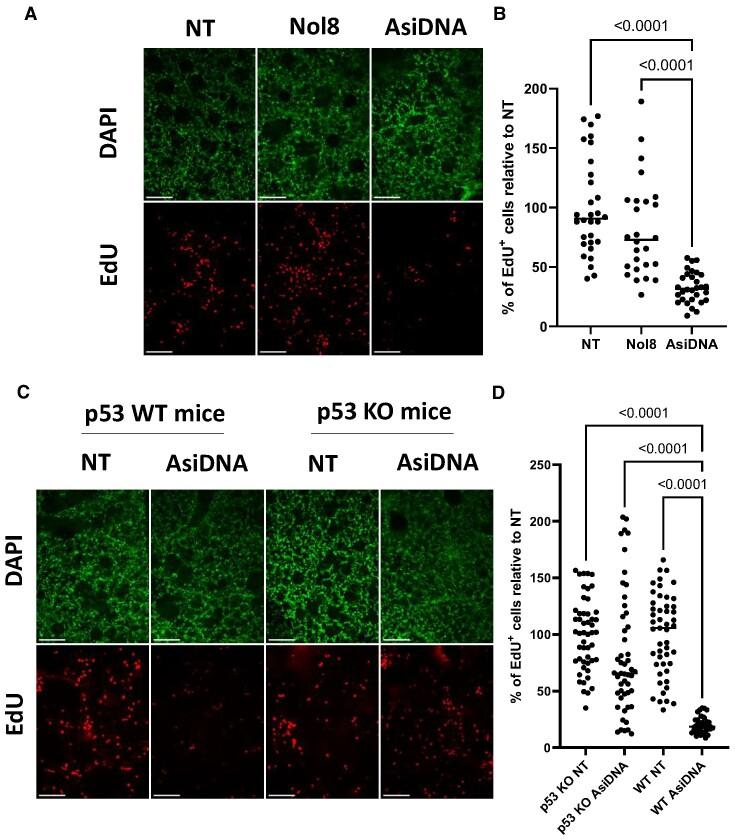
AsiDNA™, a cholesterol-coupled oligonucleotide mimicking double-stranded DNA breaks, was developed to sensitize tumour cells to radio- and chemotherapy. This drug acts as a decoy hijacking the DNA damage response. Previous studies have demonstrated that standalone AsiDNA™ administration is well tolerated with no additional adverse effects when combined with chemo- and/or radiotherapy. The lack of normal tissue complication encouraged further examination into the role of AsiDNA™ in normal cells. This research demonstrates the radioprotective properties of AsiDNA™. In vitro, AsiDNA™ induces a DNA-PK/p53/p21-dependent G1/S arrest in normal epithelial cells and fibroblasts that is absent in p53 deficient and proficient tumour cells. This cell cycle arrest improved survival after irradiation only in p53 proficient normal cells. Combined administration of AsiDNA™ with conventional radiotherapy in mouse models of late and early radiation toxicity resulted in decreased onset of lung fibrosis and increased intestinal crypt survival. Similar results were observed following FLASH radiotherapy in standalone or combined with AsiDNA™. Mechanisms comparable to those identified were detected both , in the intestine and ex vivo, in precision cut lung slices. Collectively, the results suggest that AsiDNA™ can partially protect healthy tissues from radiation toxicity by triggering a G1/S arrest in normal cells.
AsiDNA™是一种模拟双链DNA断裂的胆固醇偶联寡核苷酸,旨在使肿瘤细胞对放疗和化疗敏感。这种药物作为一种诱饵,劫持DNA损伤反应。先前的研究表明,单独使用AsiDNA™耐受性良好,与化疗和/或放疗联合使用时不会产生额外的不良反应。正常组织无并发症这一情况促使人们进一步研究AsiDNA™在正常细胞中的作用。这项研究证明了AsiDNA™的辐射防护特性。在体外,AsiDNA™在正常上皮细胞和成纤维细胞中诱导DNA-PK/p53/p21依赖性的G1/S期阻滞,而在p53缺陷和功能正常的肿瘤细胞中则不存在这种阻滞。这种细胞周期阻滞仅在p53功能正常的正常细胞中提高了辐射后的存活率。在晚期和早期辐射毒性小鼠模型中,将AsiDNA™与传统放疗联合使用,可减少肺纤维化的发生,并提高肠隐窝的存活率。在单独进行FLASH放疗或与AsiDNA™联合放疗后也观察到了类似结果。在肠道和离体的精密切割肺切片中均检测到了与上述机制类似的机制。总体而言,结果表明AsiDNA™可通过触发正常细胞中的G1/S期阻滞来部分保护健康组织免受辐射毒性。



 Zotero 插件