
COVID-19大流行之前及期间虚拟临终关怀与医疗保健结果的关联:一项基于人群的研究。
Association of virtual end-of-life care with healthcare outcomes before and during the COVID-19 pandemic: A population-based study.
作者信息
Lapp John M, Stukel Thérèse A, Chung Hannah, Bell Chaim M, Bhatia R Sacha, Detsky Allan S, Downar James, Isenberg Sarina R, Lee Douglas S, Stall Nathan, Tanuseputro Peter, Quinn Kieran L
机构信息
Department of Medicine, Sinai Health System, Toronto, Canada.
Northern Ontario School of Medicine University, Sudbury, Canada.
出版信息
PLOS Digit Health. 2024 Mar 13;3(3):e0000463. doi: 10.1371/journal.pdig.0000463. eCollection 2024 Mar.
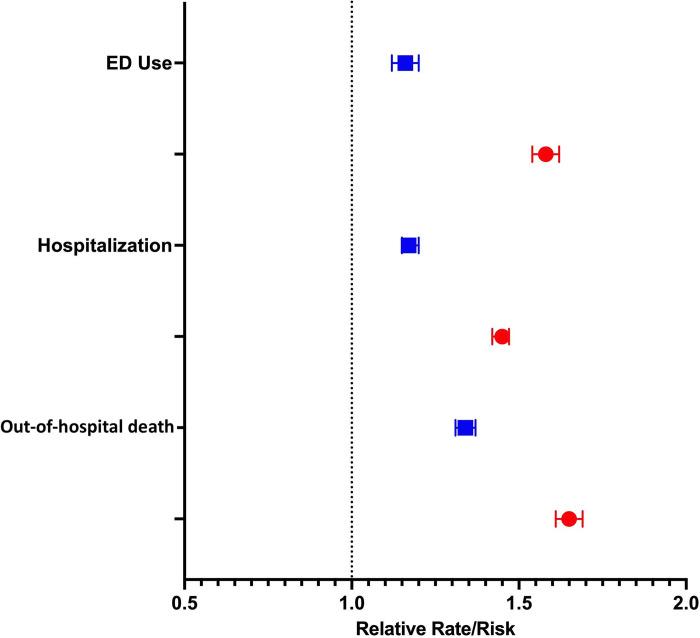
The use of virtual care for people at the end-of-life significantly increased during the COVID-19 pandemic, but its association with acute healthcare use and location of death is unknown. The objective of this study was to measure the association between the use of virtual end-of-life care with acute healthcare use and an out-of-hospital death before vs. after the introduction of specialized fee codes that enabled broader delivery of virtual care during the COVID-19 pandemic. This was a population-based cohort study of 323,995 adults in their last 90 days of life between January 25, 2018 and December 31, 2021 using health administrative data in Ontario, Canada. Primary outcomes were acute healthcare use (emergency department, hospitalization) and location of death (in or out-of-hospital). Prior to March 14, 2020, 13,974 (8%) people received at least 1 virtual end-of-life care visit, which was associated with a 16% higher rate of emergency department use (adjusted Rate Ratio [aRR] 1.16, 95%CI 1.12 to 1.20), a 17% higher rate of hospitalization (aRR 1.17, 95%CI 1.15 to 1.20), and a 34% higher risk of an out-of-hospital death (aRR 1.34, 95%CI 1.31 to 1.37) compared to people who did not receive virtual end-of-life care. After March 14, 2020, 104,165 (71%) people received at least 1 virtual end-of-life care visit, which was associated with a 58% higher rate of an emergency department visit (aRR 1.58, 95%CI 1.54 to 1.62), a 45% higher rate of hospitalization (aRR 1.45, 95%CI 1.42 to 1.47), and a 65% higher risk of an out-of-hospital death (aRR 1.65, 95%CI 1.61 to 1.69) compared to people who did not receive virtual end-of-life care. The use of virtual end-of-life care was associated with higher acute healthcare use in the last 90 days of life and a higher likelihood of dying out-of-hospital, and these rates increased during the pandemic.
在新冠疫情期间,为临终患者提供的虚拟护理服务使用量显著增加,但其与急性医疗服务使用及死亡地点之间的关联尚不清楚。本研究的目的是衡量在新冠疫情期间引入专门收费代码以实现更广泛的虚拟护理服务之前和之后,虚拟临终护理服务的使用与急性医疗服务使用及院外死亡之间的关联。这是一项基于人群的队列研究,研究对象为2018年1月25日至2021年12月31日期间在加拿大安大略省处于生命最后90天的323,995名成年人,使用的是健康管理数据。主要结局指标为急性医疗服务使用情况(急诊科就诊、住院)和死亡地点(院内或院外)。在2020年3月14日之前,13,974名(8%)患者至少接受了1次虚拟临终护理服务就诊,与未接受虚拟临终护理服务的患者相比,其急诊科就诊率高16%(调整率比[aRR]为1.16,95%置信区间[CI]为1.12至1.20),住院率高17%(aRR为1.17,95%CI为1.15至1.20),院外死亡风险高34%(aRR为1.34,95%CI为1.31至1.37)。在2020年3月14日之后,104,165名(71%)患者至少接受了1次虚拟临终护理服务就诊,与未接受虚拟临终护理服务的患者相比,其急诊科就诊率高58%(aRR为1.58,95%CI为1.54至1.62),住院率高45%(aRR为1.45,95%CI为1.42至1.47),院外死亡风险高65%(aRR为1.65,95%CI为1.61至1.69)。虚拟临终护理服务的使用与生命最后90天内更高的急性医疗服务使用量以及更高的院外死亡可能性相关,且这些比率在疫情期间有所上升。

 Zotero 插件