
有齿鲸类动物绝经期的进化。
The evolution of menopause in toothed whales.
机构信息
Centre for Research in Animal Behaviour, Department of Psychology, University of Exeter, Exeter, UK.
Department of Biology, University of York, York, UK.
出版信息
Nature. 2024 Mar;627(8004):579-585. doi: 10.1038/s41586-024-07159-9. Epub 2024 Mar 13.
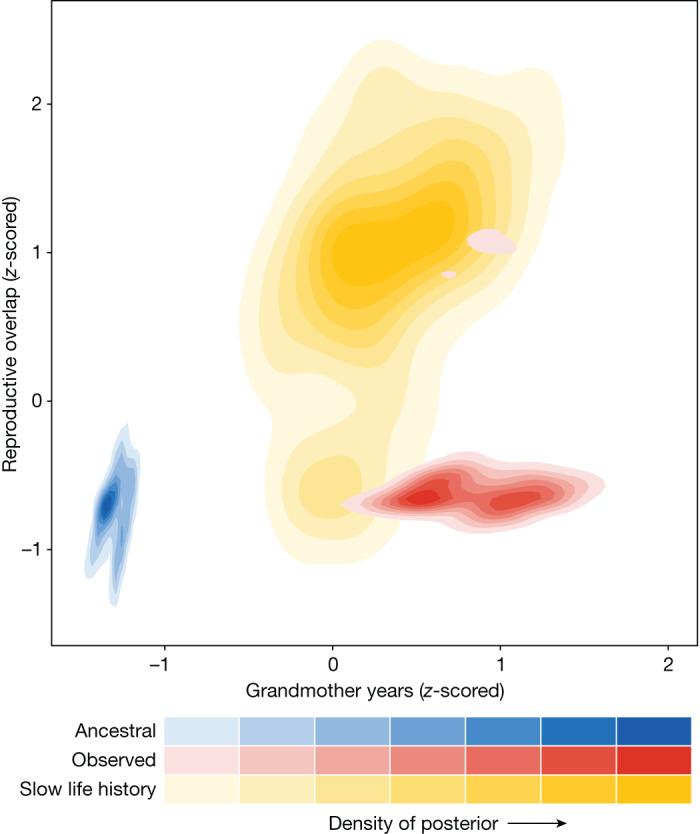
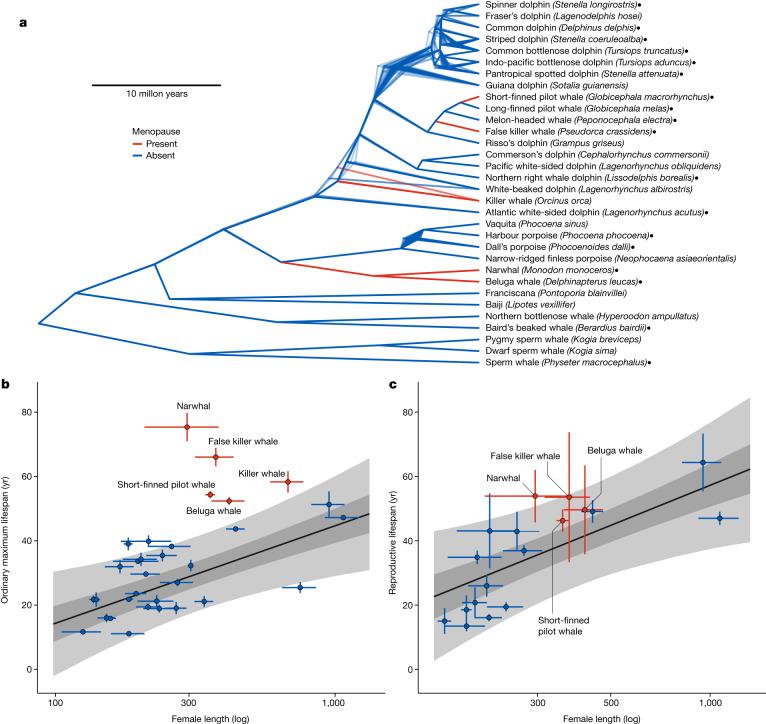
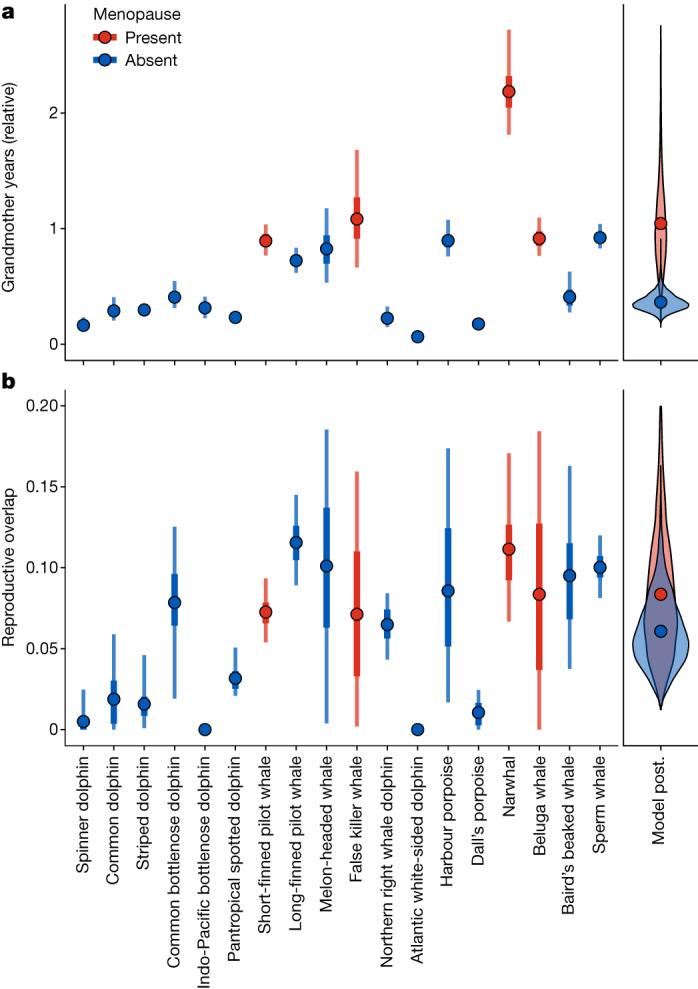
Understanding how and why menopause has evolved is a long-standing challenge across disciplines. Females can typically maximize their reproductive success by reproducing for the whole of their adult life. In humans, however, women cease reproduction several decades before the end of their natural lifespan. Although progress has been made in understanding the adaptive value of menopause in humans, the generality of these findings remains unclear. Toothed whales are the only mammal taxon in which menopause has evolved several times, providing a unique opportunity to test the theories of how and why menopause evolves in a comparative context. Here, we assemble and analyse a comparative database to test competing evolutionary hypotheses. We find that menopause evolved in toothed whales by females extending their lifespan without increasing their reproductive lifespan, as predicted by the 'live-long' hypotheses. We further show that menopause results in females increasing their opportunity for intergenerational help by increasing their lifespan overlap with their grandoffspring and offspring without increasing their reproductive overlap with their daughters. Our results provide an informative comparison for the evolution of human life history and demonstrate that the same pathway that led to menopause in humans can also explain the evolution of menopause in toothed whales.
了解绝经是如何以及为何进化的,是跨学科领域长期存在的挑战。女性通常可以通过在整个成年期生育来最大限度地提高其生殖成功率。然而,在人类中,女性在其自然寿命结束前几十年就停止了生育。尽管在理解人类绝经的适应价值方面已经取得了进展,但这些发现的普遍性仍不清楚。有齿鲸是唯一经历过多次绝经进化的哺乳动物类群,这为在比较的背景下检验绝经进化的方式和原因的理论提供了独特的机会。在这里,我们收集和分析了一个比较数据库,以检验相互竞争的进化假设。我们发现,正如“长寿”假说所预测的那样,有齿鲸的绝经是通过雌性延长寿命而不增加生殖寿命进化而来的。我们进一步表明,绝经使雌性通过增加与孙代和后代的寿命重叠而增加了代际帮助的机会,而不增加与女儿的生殖重叠。我们的研究结果为人类生活史的进化提供了一个有启发性的比较,并表明导致人类绝经的相同途径也可以解释有齿鲸绝经的进化。
 Zotero 插件