
两个觅食-园艺人群绝经后血脂水平升高。
Higher blood lipid levels after the transition to menopause in two forager-horticulturalist populations.
作者信息
Getz M J, Aronoff J E, Jenkins C L, Ghafoor S, Vazquez J, Appel N T, Gatz M, Cummings D K, Hooper P L, Beheim B, Buetow K H, Finch C E, Thomas G S, Stieglitz J, Gurven M, Kaplan H, Trumble B C
机构信息
Center for Evolution and Medicine, Arizona State University, Life Sciences C, 427 East Tyler Mall, Tempe, AZ 85281, USA.
Institute of Human Origins, Arizona State University, Walton Center for Planetary Health, 777 East University Drive, Second Floor #200L1, Tempe, AZ 85287, USA.
出版信息
Evol Med Public Health. 2025 Jul 20;13(1):201-214. doi: 10.1093/emph/eoaf020. eCollection 2025.
BACKGROUND
Reproduction affects health and longevity among females across the life course. While significant focus has been devoted to the role of menarche, menopause remains understudied. Most menopause research is conducted in industrialized populations, where the risk of cardiovascular diseases increases progressively during the menopausal transition.
METHODOLOGY
We worked with the Tsimane, Indigenous Bolivian forager-farmers with physically active lifestyles, and the Moseten, genetically and culturally related horticulturalists experiencing greater market integration. We assessed relationships between menopause status and lipid biomarkers (HDL, LDL, non-HDL, total cholesterol, triglycerides, and apolipoprotein-B). Using linear mixed-effects models, in an all-age sample of n = 1,121 women (15-92 years) we found positive associations between menopausal status and most lipid levels.
RESULTS
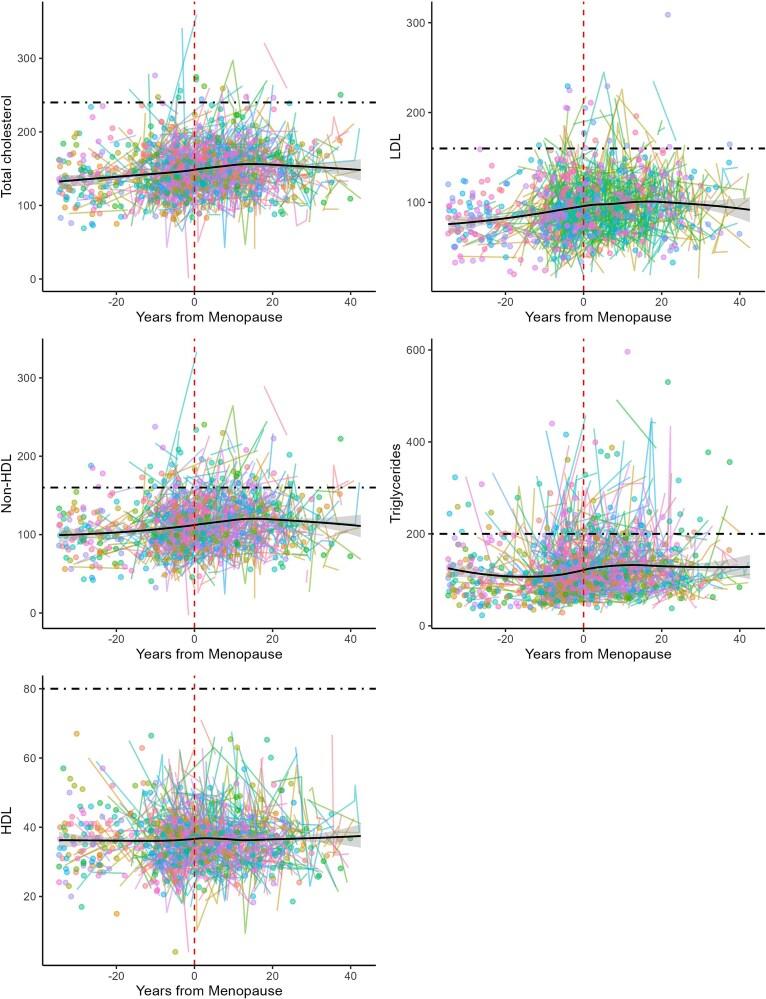
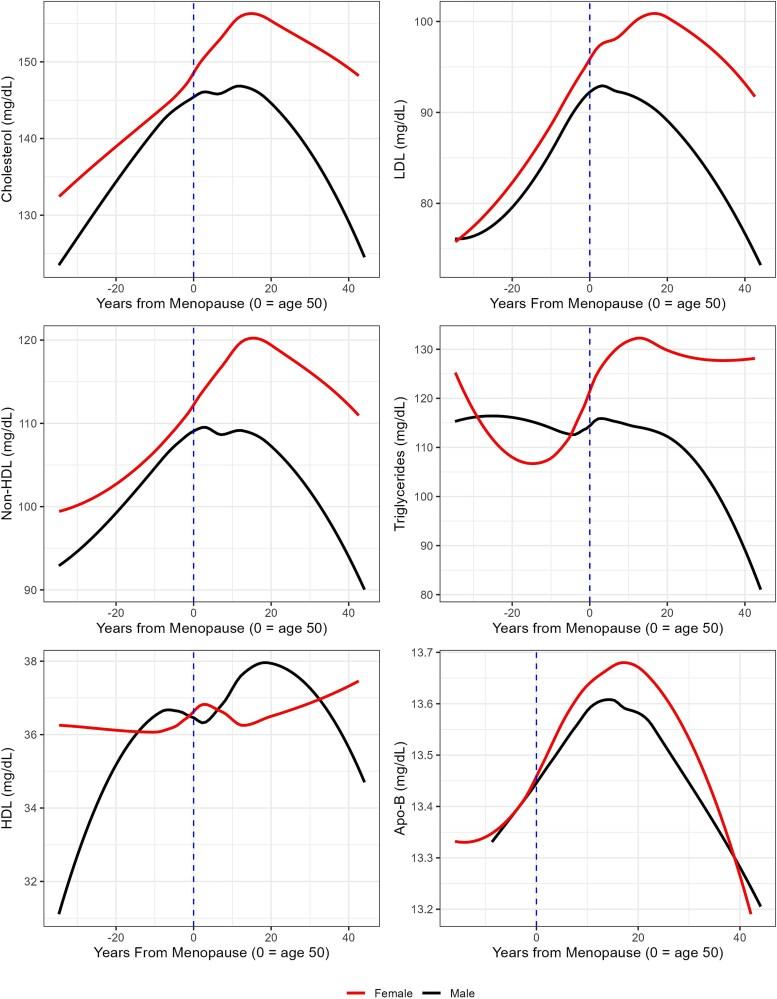
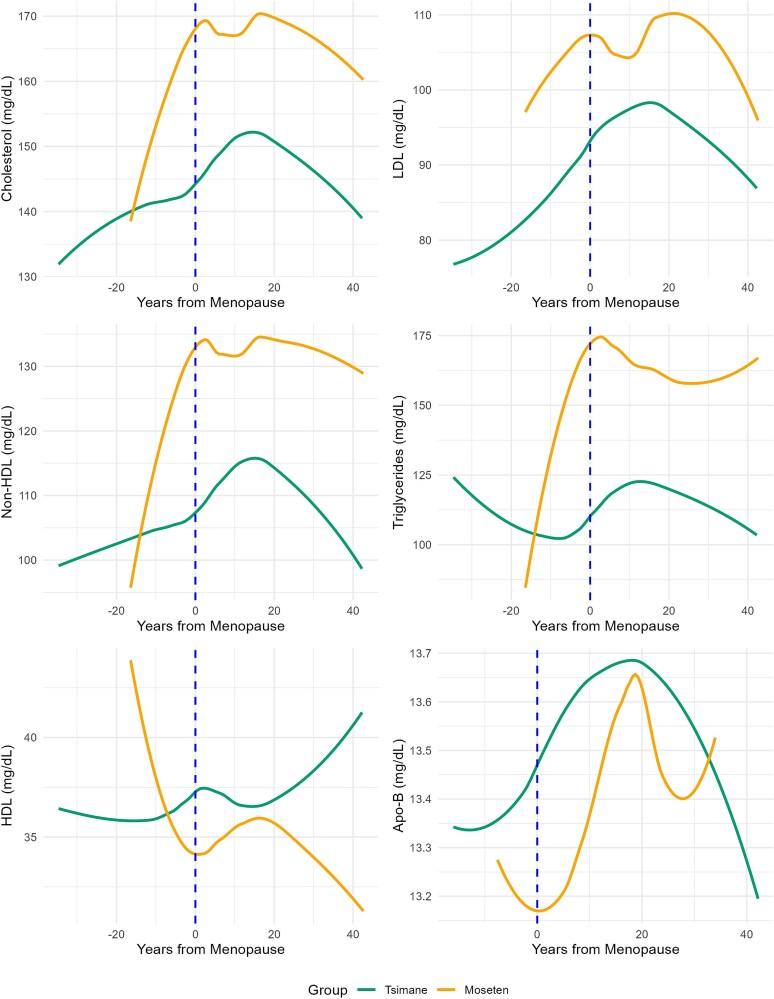
Menopause was associated with 5.0% higher total cholesterol (b = 7.038 mg/dL, = .001), 9.4% higher LDL (b = 5.147 mg/dL, = .017), 5.9% higher non-HDL cholesterol (b = 8.071 mg/dL, < .001), 11.3% higher triglycerides (b = 19.119 mg/dL, < .001), and 1.5% higher apolipoprotein-B (b = 0.248 mg/dL, = .001), controlling for age, body mass index (BMI), year of data collection, and population. In contrast, HDL did not vary with menopause status.
CONCLUSIONS
After controlling for age, BMI, and year of data collection, post-menopausal lipid profiles among the Tsimane across six biomarkers are 2-7 times lower than those documented in U.S./U.K. populations. These results support existing literature that documents distinct shifts in lipid profiles during and after the menopause transition in industrialized populations. Further, our results suggest lipids increase post-menopause similarly to those of industrialized populations, despite the differential diet, physical activity, fertility, and hormone exposure in industrialized environments.
LAY SUMMARY
Menopause is a relatively rare life history trait primarily studied in industrial populations. We examined relationships between menopause and cardiovascular disease risk biomarkers in two forager-horticulturalist populations. We found positive associations between menopause and total cholesterol, HDL, LDL, non-HDL, triglycerides, and apolipoprotein-B, suggesting lipid increases post-menopause are a human universal.
背景
生殖会影响女性一生的健康和寿命。虽然初潮的作用受到了极大关注,但更年期仍未得到充分研究。大多数更年期研究是在工业化人群中进行的,在这些人群中,心血管疾病的风险在更年期过渡期间会逐渐增加。
方法
我们与提斯曼人(玻利维亚的土著觅食农民,生活方式积极活跃)以及莫塞滕人(与提斯曼人在基因和文化上相关的园艺种植者,与市场的融合度更高)合作。我们评估了更年期状态与脂质生物标志物(高密度脂蛋白、低密度脂蛋白、非高密度脂蛋白、总胆固醇、甘油三酯和载脂蛋白B)之间的关系。使用线性混合效应模型,在一个n = 1121名女性(15 - 92岁)的全年龄样本中,我们发现更年期状态与大多数脂质水平呈正相关。
结果
在控制了年龄、体重指数(BMI)、数据收集年份和人群因素后,更年期与总胆固醇升高5.0%(b = 7.038mg/dL,p = 0.001)、低密度脂蛋白升高9.4%(b = 5.147mg/dL,p = 0.017)、非高密度脂蛋白胆固醇升高5.9%(b = 8.071mg/dL < 0.001)、甘油三酯升高11.3%(b = 19.119mg/dL < 0.001)以及载脂蛋白B升高1.5%(b = 0.248mg/dL,p = 0.001)相关。相比之下,高密度脂蛋白并未随更年期状态而变化。
结论
在控制了年龄、BMI和数据收集年份后,提斯曼人中绝经后六种生物标志物的脂质谱比美国/英国人群中记录的低2 - 7倍。这些结果支持了现有文献,即工业化人群在更年期过渡期间及之后脂质谱会发生明显变化。此外,我们的结果表明,尽管工业化环境中的饮食、身体活动、生育能力和激素暴露存在差异,但绝经后脂质升高的情况与工业化人群相似。
简要概述
更年期是一种相对罕见的生活史特征,主要在工业化人群中进行研究。我们研究了两个觅食 - 园艺种植者群体中更年期与心血管疾病风险生物标志物之间的关系。我们发现更年期与总胆固醇、高密度脂蛋白、低密度脂蛋白、非高密度脂蛋白、甘油三酯和载脂蛋白B呈正相关,这表明绝经后脂质升高是一种普遍现象。
 Zotero 插件