
肠易激综合征患者以腹泻为主的胃肠道症状、生物心理社会因素和就医行为的性别差异。
Gender differences in gastrointestinal, biopsychosocial and healthcare-seeking behaviors in Chinese patients with irritable bowel syndrome predominant with diarrhea.
机构信息
Department of Gastroenterology, Peking Union Medical College Hospital, Chinese Academy of Medical Sciences and Peking Union Medical College, No. 1 Shuaifuyuan, Wangfujing, Dongcheng District, Beijing, 100730, China.
Department of Gastroenterology, Tongji Hospital, Tongji Medical College, Huazhong University of Science & Technology, Wuhan, Hubei Province, China.
出版信息
BMC Gastroenterol. 2024 Mar 13;24(1):102. doi: 10.1186/s12876-024-03153-7.
BACKGROUND
Evidences of comparison of sex difference in Chinese irritable bowel syndrome (IBS) patients were few. We aim to compare gender difference in the biopsychosocial characteristics of Chinese patients of IBS predominant with diarrhea (IBS-D).
METHODS
IBS-D patients meeting Rome III criteria were enrolled. We administered IBS symptom questionnaires, evaluation of psychological status (HAMD and HAMA scales) and IBS quality of life (IBS-QOL), dietary habits, healthcare seeking behaviors, and compared biopsychosocial characteristics between male and female patients.
RESULTS
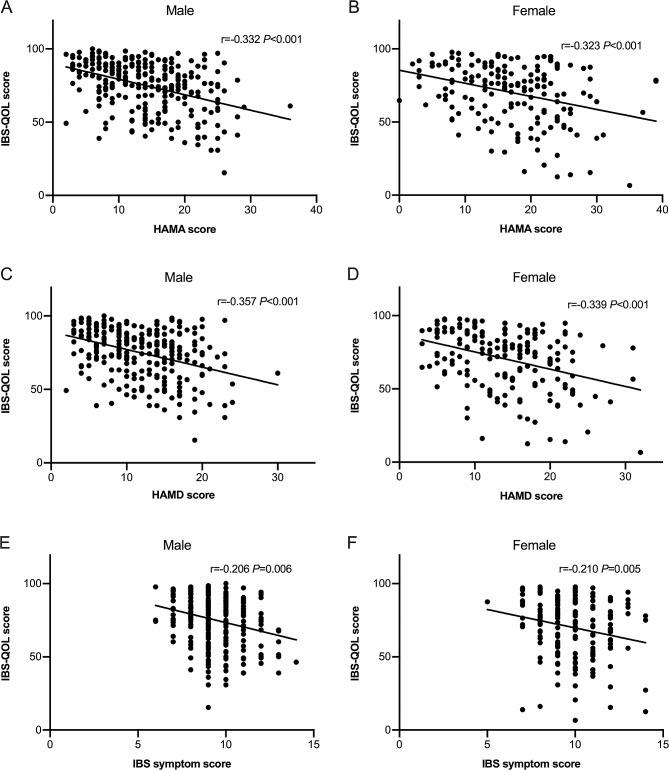
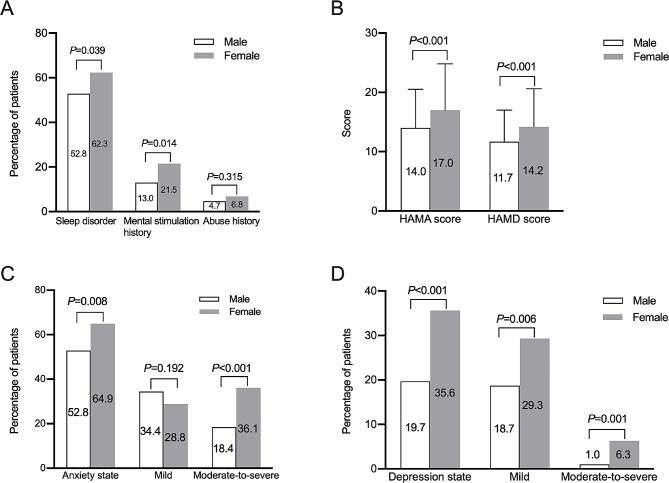
Four hundred and ninety patients were enrolled including 299 males and 191 females. More female patients reported abdominal pain associated with defecation (84.3% vs. 74.9%, P = 0.014) while males reported more abdominal discomfort (39.8% vs. 26.7%, P = 0.003). Females had higher IBS symptom score (9.7 ± 1.7 vs. 9.4 ± 1.4, P = 0.025) and more of females had severe abdominal pain/discomfort (17.8% vs. 12.4%, P = 0.013) while there were no significant differences of other bowel symptoms. Females reported higher incidence of comorbid anxiety state (64.9% vs. 52.8%, P = 0.008) and depression state (35.6% vs. 19.7%, P < 0.001) than males. Female patients also had lower IBS-QOL score (70.2 ± 20.4 vs. 75.1 ± 16.8, P = 0.028) and more frequent consultations, as well as less response for dietary modification than males.
CONCLUSIONS
Chinese female patients with IBS-D had more prominent psychosocial disorders compared to male patients and their abdominal symptoms had minor differences.
背景
中国肠易激综合征(IBS)患者的性别差异比较证据较少。本研究旨在比较以腹泻为主的中国 IBS 患者(IBS-D)的生物-心理-社会特征的性别差异。
方法
纳入符合 Rome III 标准的 IBS-D 患者。我们采用 IBS 症状问卷、心理状态评估(HAMD 和 HAMA 量表)和 IBS 生活质量(IBS-QOL)、饮食习惯、医疗寻求行为,并比较男女患者的生物-心理-社会特征。
结果
共纳入 490 例患者,其中男 299 例,女 191 例。更多女性患者报告腹痛伴排便(84.3% vs. 74.9%,P=0.014),而男性患者报告更多腹部不适(39.8% vs. 26.7%,P=0.003)。女性 IBS 症状评分更高(9.7±1.7 vs. 9.4±1.4,P=0.025),更多女性患者有严重腹痛/不适(17.8% vs. 12.4%,P=0.013),但其他肠症状无显著差异。女性报告合并焦虑状态的发生率更高(64.9% vs. 52.8%,P=0.008)和抑郁状态(35.6% vs. 19.7%,P<0.001)比男性。女性患者的 IBS-QOL 评分也更低(70.2±20.4 vs. 75.1±16.8,P=0.028),更频繁就诊,以及对饮食调整的反应不如男性。
结论
与男性患者相比,中国 IBS-D 女性患者的心理社会障碍更为明显,而她们的腹部症状差异较小。


 Zotero 插件