
针对大学生的个性化昼夜节律保健教育措施——“有耳可听的,就应当听”。
Personalising circadian hygiene educational initiatives aimed at university students-"He who has ears to hear, let him hear".
机构信息
Department of Medicine, University of Padova, Padova, Italy.
Chronobiology Section, Faculty of Health and Medical Sciences, University of Surrey, Guildford, UK.
出版信息
J Sleep Res. 2024 Dec;33(6):e14194. doi: 10.1111/jsr.14194. Epub 2024 Mar 14.
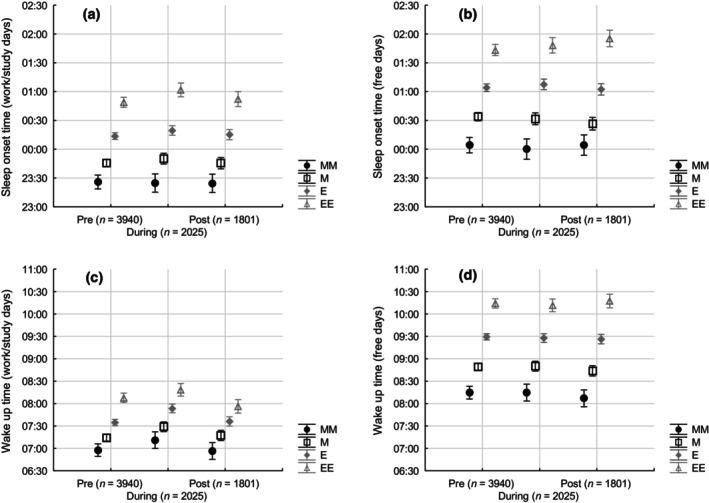
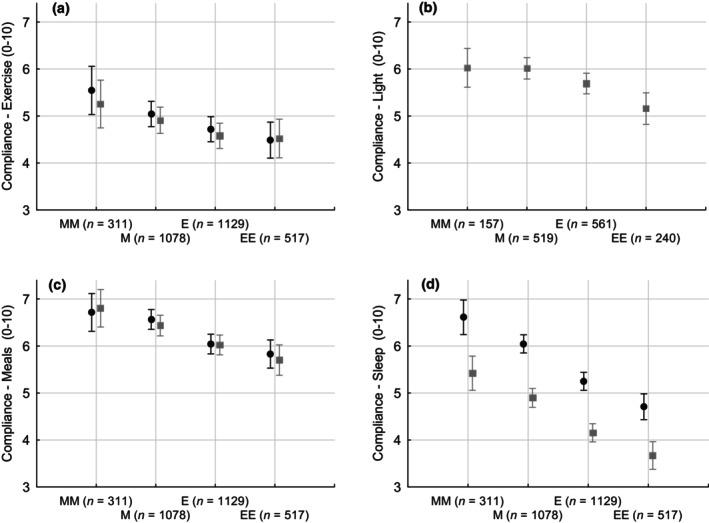
The aim of the present study was to characterise "early drop-outs" (n = 3185) out of a group of university students (n = 7766) engaged in an ongoing circadian education initiative, to evaluate its efficacy and direct its developments. The initiative is aimed at improving sleep timing/quality through one of two sets of circadian hygiene advice covering the timing of sleep, meals, exercise and light exposure, and it has already been shown to have a positive effect on sleep timing. This second, interim analysis confirmed the high prevalence of disturbed night sleep and social jetlag amongst students at Padova University. Three-thousand, one-hundred and eighty-five (41.0%) students were early drop-outs. These were more commonly males (46.4 versus 37.6%; χ = 58, p < 0.0001), had later sleep-wake habits, more daytime sleepiness and worse night sleep quality. Chronotype distribution was also different, with a slight but significantly higher proportion of extremely evening/evening types amongst early drop-outs (χ = 10, p < 0.05). These results suggest that the more evening the student, the lower their likelihood of choosing/being able to follow circadian advice.
本研究旨在描述参与持续昼夜节律教育计划的一组大学生(n=7766)中“早期退出者”(n=3185)的特征,评估其效果并指导其发展。该计划旨在通过两套昼夜节律卫生建议来改善睡眠时间/质量,其中包括睡眠、用餐、运动和光照的时间安排,并且已经显示出对睡眠时间的积极影响。这项第二次中期分析证实了帕多瓦大学学生中夜间睡眠紊乱和社交时差的高发率。3185 名(41.0%)学生是早期退出者。这些学生更常见于男性(46.4 比 37.6%;χ=58,p<0.0001),他们的睡眠-觉醒习惯较晚,白天嗜睡更多,夜间睡眠质量更差。昼夜类型分布也不同,早期退出者中极晚型/晚型的比例略高但有统计学意义(χ=10,p<0.05)。这些结果表明,学生越晚,他们选择/能够遵循昼夜节律建议的可能性就越低。
 Zotero 插件