
从“青春期”到成年期果蝇的睡眠时机
Sleep timing in flies from "adolescence" to adulthood.
作者信息
Domenie Esther D, Cusumano Paola, Montagnese Sara, Costa Rodolfo
机构信息
Department of Medicine, University of Padova, Padova, Italy.
Department of Biology, University of Padova, Padova, Italy.
出版信息
Fly (Austin). 2025 Dec;19(1):2448022. doi: 10.1080/19336934.2024.2448022. Epub 2024 Dec 30.
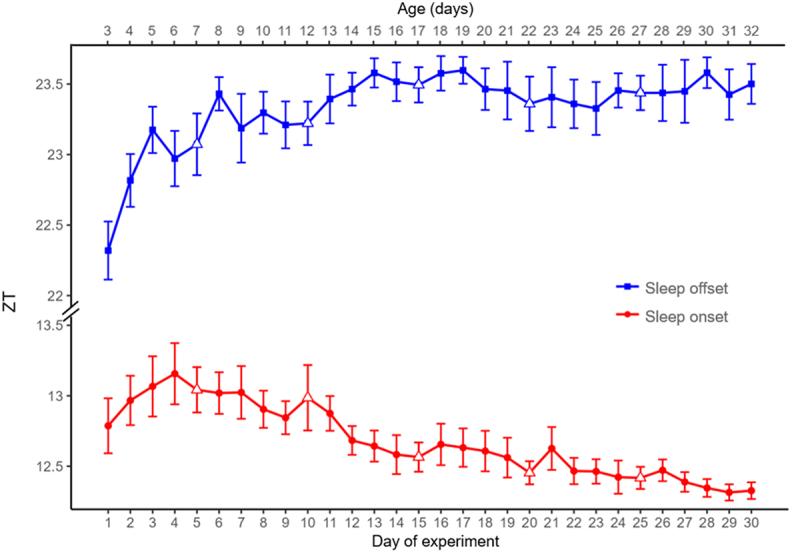
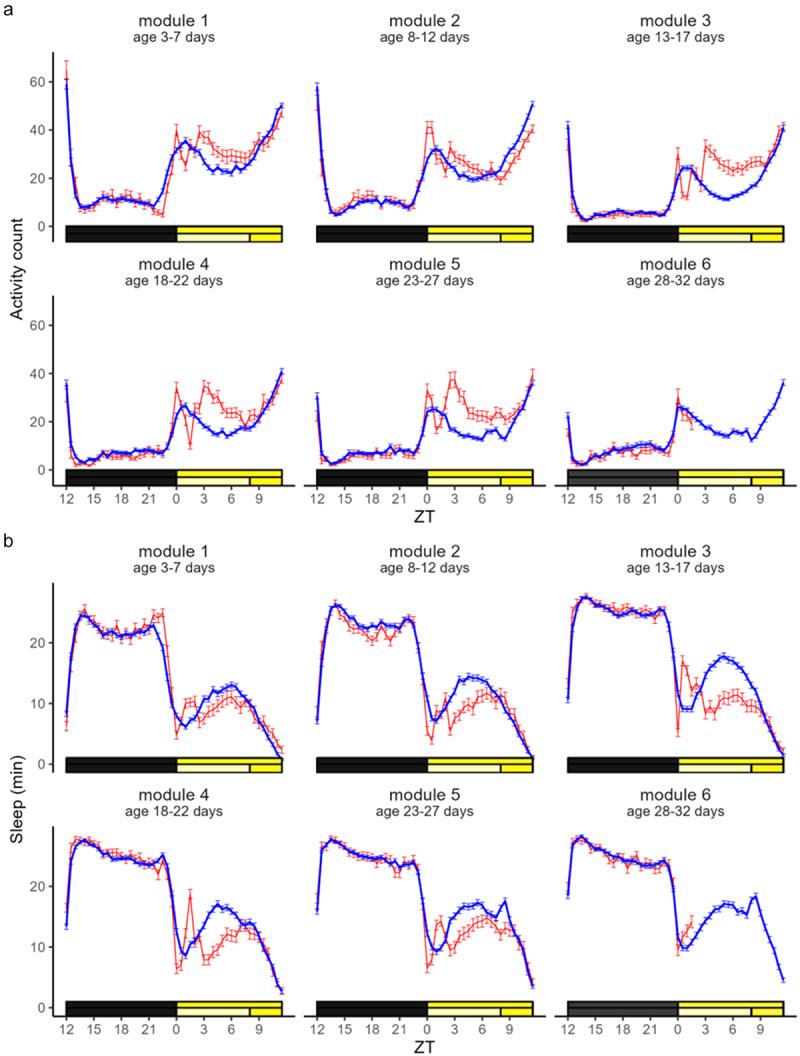
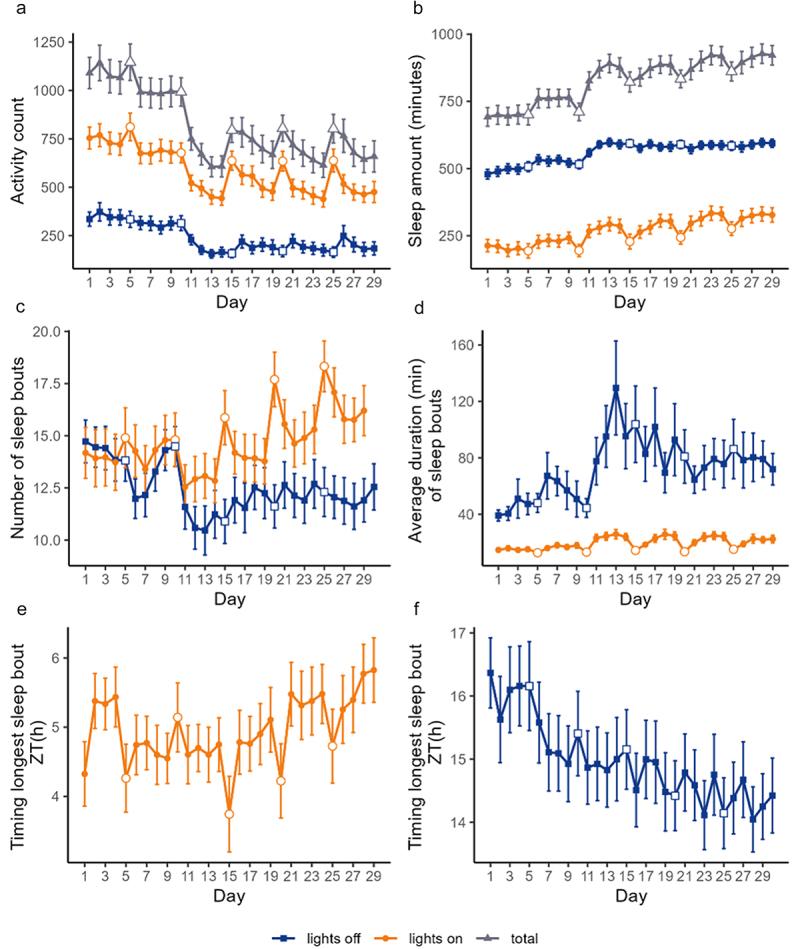
The aim of the present study was to assess sleep timing in at different ages, within the setting of an enforced schedule of varying light-dark stimuli, simulating light exposure variations between four typical office and one spent outside by a human, for a total of 30 days. Locomotor activity recording started when male flies were 3 days old. Flies exhibited a bimodal activity pattern, with a morning and an evening peak, and clear anticipation of the and transitions. From experimental day 10 (i.e. 12-day-old flies) onwards, a decrease in activity counts/increase in sleep amount were observed. On , a rise in activity counts and a reduction in sleep amount during the interval was observed and was also present, albeit less obvious, on the subsequent during the interval. A progressive delay in sleep onset was observed in the first days of the experiment, peaking on day 4 (i.e. 6-day-old flies), after which sleep onset timing gradually advanced. A delay in sleep offset was also observed for the first 13 days of the experiment, after which sleep offset stabilized. In conclusion, 'adolescent' flies exhibited changes in sleep timing that were reminiscent of those of human adolescents.
本研究的目的是在强制设定不同明暗刺激时间表的环境下,评估不同年龄果蝇的睡眠时间,模拟人类在四种典型办公环境和一种户外环境下的光照变化,为期共30天。当雄蝇3日龄时开始记录其运动活动。果蝇表现出双峰活动模式,有一个早晨高峰和一个傍晚高峰,并且能清晰地预期明暗转换。从实验第10天(即12日龄果蝇)起,观察到活动计数减少/睡眠量增加。在[具体日期未给出],观察到在[具体时间段未给出]间隔期间活动计数增加和睡眠量减少,并且在随后的[具体日期未给出]的[具体时间段未给出]间隔期间也存在,尽管不太明显。在实验的最初几天观察到睡眠开始逐渐延迟,在第4天(即6日龄果蝇)达到峰值,之后睡眠开始时间逐渐提前。在实验的前13天也观察到睡眠结束延迟,之后睡眠结束稳定下来。总之,“青少年”果蝇表现出的睡眠时间变化让人联想到人类青少年的睡眠变化。

 Zotero 插件