
[达雷妥尤单抗用于新诊断多发性骨髓瘤自体造血干细胞移植后的维持治疗]
[Daratumumab maintenance after autologous hematopoietic stem cell transplantation for newly diagnosed multiple myeloma].
作者信息
Ma Y, Xiao X B, Chen X L, Yuan S Z, Lu Y, Zhao S H, Chen J L, Shi G N, Wang Y Q, Cheng N N, Feng P, Ding M S, Huang W R
机构信息
Department of Lymphoma & Plasma Cell Disease, Senior Department of Hematology, the Fifth Medical Center of PLA General Hospital, Beijing 100071, China.
出版信息
Zhonghua Xue Ye Xue Za Zhi. 2023 Dec 14;44(12):1016-1021. doi: 10.3760/cma.j.issn.0253-2727.2023.12.008.
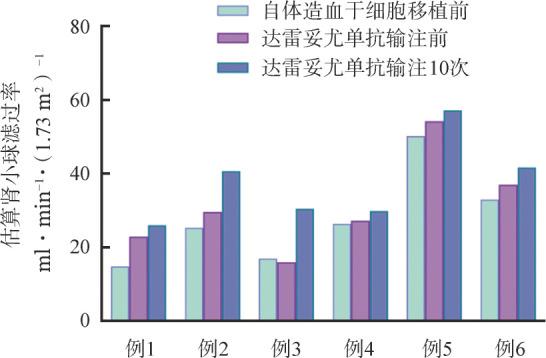
This study aimed to evaluate the efficacy and safety of daratumumab as a maintenance treatment after autologous hematopoietic stem cell transplantation (auto-HSCT) in patients with newly diagnosed multiple myeloma (NDMM) . The clinical data, hematological and renal response, and safety of 15 post-transplant patients with NDMM who had received daratumumab maintenance between May 1, 2022 and June 30, 2023 were retrospectively analyzed. Fifteen patients (11 males and 4 females) with a median age of 58 (41-72) years were included. Thirteen patients did not receive daratumumab during induction therapy and auto-HSCT, 6 patients had renal impairment, and nine patients had high-risk cytogenetics. The median infusion of daratumumab was 12 (6-17) times, and the median duration of maintenance was 6 (1.5-12) months. The treatment efficacy was evaluated in all 15 patients, and daratumumab maintenance therapy increased the rate of stringent complete response from 40% to 60%. The renal response rate and median estimated glomerular filtration rate of six patients with RI-NDMM were also improved. During daratumumab maintenance therapy, the most common hematological grade 3 adverse event (AE) was lymphopenia [4 of 15 patients (26.67%) ], whereas the most common nonhematologic AEs were infusion-related reactions [7 of 15 patients (46.67%) ] and grade 3 pneumonia [5 of 15 patients (33.33%) ]. The five patients with pneumonia were daratumumab naive [5 of 13 patients (38.46%) ], with a median of 8 (6-10) infusions. Among them, the chest computed tomography of three patients showed interstitial infiltrates, and treatment with methylprednisolone was effective. With a median follow-up of 12 months, the 1-year overall survival rate was 93.33%, and only one patient died (which was not related to daratumumab treatment) . Daratumumab was safe and effective as a maintenance agent for post-auto-HSCT patients with NDMM, and AEs were controllable. The most common nonhematologic AE was grade 3 pneumonia, and a less dose-intense maintenance regimen for the first 8 weeks could reduce the incidence of pneumonia.
本研究旨在评估达雷妥尤单抗作为新诊断多发性骨髓瘤(NDMM)患者自体造血干细胞移植(auto-HSCT)后维持治疗的疗效和安全性。回顾性分析了2022年5月1日至2023年6月30日期间接受达雷妥尤单抗维持治疗的15例移植后NDMM患者的临床资料、血液学和肾脏反应以及安全性。纳入15例患者(11例男性和4例女性),中位年龄58(41 - 72)岁。13例患者在诱导治疗和auto-HSCT期间未接受达雷妥尤单抗,6例患者有肾功能损害,9例患者有高危细胞遗传学特征。达雷妥尤单抗的中位输注次数为12(6 - 17)次,中位维持时间为6(1.5 - 12)个月。对所有15例患者评估了治疗效果,达雷妥尤单抗维持治疗使严格完全缓解率从40%提高到60%。6例RI-NDMM患者的肾脏反应率和中位估计肾小球滤过率也有所改善。在达雷妥尤单抗维持治疗期间,最常见的血液学3级不良事件(AE)是淋巴细胞减少[15例患者中有4例(26.67%)],而最常见的非血液学AE是输注相关反应[15例患者中有7例(46.67%)]和3级肺炎[15例患者中有5例(33.33%)]。5例肺炎患者未接受过达雷妥尤单抗治疗[13例患者中有5例(38.46%)],中位输注次数为8(6 - 10)次。其中3例患者的胸部计算机断层扫描显示间质浸润,甲泼尼龙治疗有效。中位随访12个月,1年总生存率为93.33%,仅1例患者死亡(与达雷妥尤单抗治疗无关)。达雷妥尤单抗作为auto-HSCT后NDMM患者的维持药物是安全有效的,AE可控。最常见的非血液学AE是3级肺炎,前8周采用剂量强度较低的维持方案可降低肺炎的发生率。
 Zotero 插件