
一种将新的营养传感器纳入 mTORC1 途径的进化机制。
An evolutionary mechanism to assimilate new nutrient sensors into the mTORC1 pathway.
机构信息
Whitehead Institute for Biomedical Research and Massachusetts Institute of Technology, Department of Biology, 455 Main Street, Cambridge, MA, USA.
Department of Biology, Massachusetts Institute of Technology, 77 Massachusetts Avenue, Cambridge, MA, USA.
出版信息
Nat Commun. 2024 Mar 21;15(1):2517. doi: 10.1038/s41467-024-46680-3.
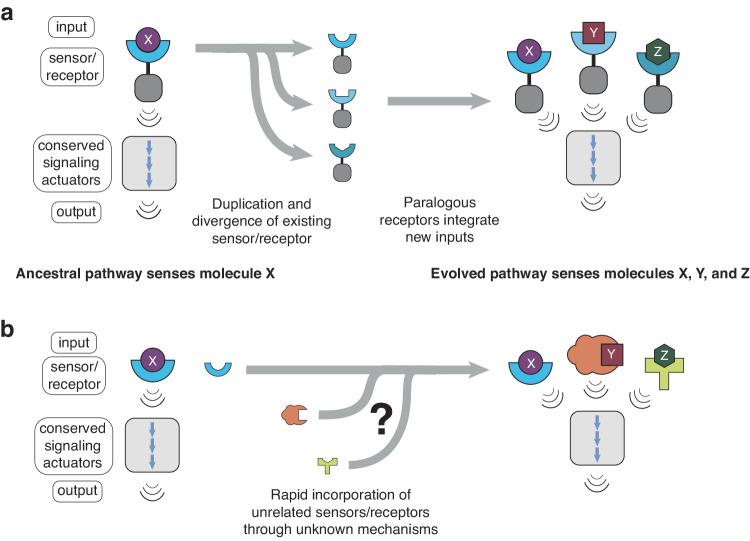
Animals sense and respond to nutrient availability in their environments, a task coordinated in part by the mTOR complex 1 (mTORC1) pathway. mTORC1 regulates growth in response to nutrients and, in mammals, senses specific amino acids through specialized sensors that bind the GATOR1/2 signaling hub. Given that animals can occupy diverse niches, we hypothesized that the pathway might evolve distinct sensors in different metazoan phyla. Whether such customization occurs, and how the mTORC1 pathway might capture new inputs, is unknown. Here, we identify the Drosophila melanogaster protein Unmet expectations (CG11596) as a species-restricted methionine sensor that directly binds the fly GATOR2 complex in a fashion antagonized by S-adenosylmethionine (SAM). We find that in Dipterans GATOR2 rapidly evolved the capacity to bind Unmet and to thereby repurpose a previously independent methyltransferase as a SAM sensor. Thus, the modular architecture of the mTORC1 pathway allows it to co-opt preexisting enzymes to expand its nutrient sensing capabilities, revealing a mechanism for conferring evolvability on an otherwise conserved system.
动物能够感知和响应其环境中的营养可用性,这一任务部分由 mTOR 复合物 1(mTORC1)途径协调。mTORC1 响应营养物质调节生长,在哺乳动物中,通过专门的传感器感知特定的氨基酸,这些传感器与 GATOR1/2 信号枢纽结合。鉴于动物可以占据不同的生态位,我们假设该途径可能在不同的后生动物门中进化出不同的传感器。这种定制是否发生,以及 mTORC1 途径如何捕获新的输入,目前尚不清楚。在这里,我们确定果蝇蛋白 Unmet expectations(CG11596)是一种物种特异性的蛋氨酸传感器,它以 SAM 拮抗的方式直接与果蝇 GATOR2 复合物结合。我们发现,在双翅目昆虫中,GATOR2 迅速进化出与 Unmet 结合的能力,从而将以前独立的甲基转移酶重新用作 SAM 传感器。因此,mTORC1 途径的模块化结构允许其共利用现有的酶来扩展其营养感应能力,揭示了一种赋予保守系统进化能力的机制。



 Zotero 插件