
纺织物类型、纺织物重量和洗涤剂用量对顶装式洗衣机微纤维排放的影响
The Influence of Textile Type, Textile Weight, and Detergent Dosage on Microfiber Emissions from Top-Loading Washing Machines.
作者信息
Julapong Pongsiri, Srichonphaisarn Palot, Meekoch Thidarat, Tabelin Carlito Baltazar, Juntarasakul Onchanok, Phengsaart Theerayut
机构信息
Department of Mining and Petroleum Engineering, Faculty of Engineering, Chulalongkorn University, Bangkok 10330, Thailand.
Department of Mining and Materials Engineering, Faculty of Engineering, Prince of Songkla University, Songkhla 90110, Thailand.
出版信息
Toxics. 2024 Mar 12;12(3):210. doi: 10.3390/toxics12030210.
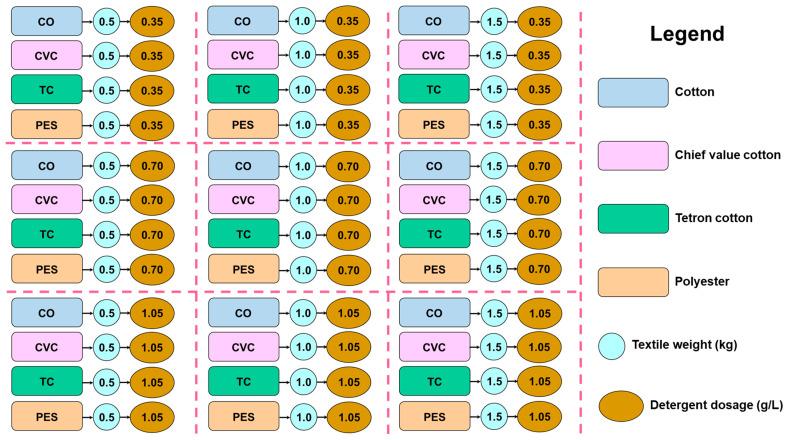
The use of washing machines to wash textiles gradually breaks down synthetic fibers like polyethylene terephthalate (PET) or polyester (PES) in diverse clothing materials, a process that is growing in notoriety because it generates microplastics (MPs). In this study, we investigated the emission of microfibers, including both microplastic fibers (MPFs) and natural fibers (MFs), from top-loading washing machines. Our investigation focused on four popular textiles with prevalent weave structures (plain, satin, and twill): (i) PES, (ii) tetron cotton (TC), (iii) chief value cotton (CVC), and (iv) cotton (CO) fabrics. This study also examined the effects of textile weight and detergent dosage on MF emissions. After washing, MFs were collected through filtration, and their concentrations were determined using micro-Fourier Transform Interferometry (μFTIR). The results showed varying concentrations of MFs in the washing effluent depending on the type of textile. Specifically, CVC exhibited the highest emission at 4022 particles/L, followed by TC, PES, and CO at 2844 particles/L, 2382 particles/L, and 2279 particles/L, respectively. The hydrophobic nature of PES makes this type of textile prone to rapid degradation in detergent-rich environments, leading to high MF emissions. Additionally, the mechanical properties of textiles, such as tensile and bending strengths, may play a crucial role in the generation of MFs in washing machines. Textiles made of CO with twill weaves demonstrated superior strength and correlated with lower emissions of MFs. In comparison, textiles made of CVC and satin weave exhibited lower mechanical properties, which could explain their high emissions of MFs. Finally, the MF emissions of textiles composed of PES and TC, which are plain weaved, could be attributed to their intermediate mechanical properties compared with those of CVC and CO.
使用洗衣机洗涤纺织品会逐渐分解各种服装材料中的合成纤维,如聚对苯二甲酸乙二酯(PET)或聚酯(PES),这一过程因会产生微塑料(MPs)而声名狼藉。在本研究中,我们调查了上开式洗衣机中微纤维的排放情况,包括微塑料纤维(MPFs)和天然纤维(MFs)。我们的研究重点是四种具有常见编织结构(平纹、缎纹和斜纹)的流行纺织品:(i)聚酯纤维(PES),(ii)特卫强棉(TC),(iii)涤棉混纺(CVC),以及(iv)纯棉(CO)织物。本研究还考察了织物重量和洗涤剂用量对微纤维排放的影响。洗涤后,通过过滤收集微纤维,并使用微傅里叶变换干涉仪(μFTIR)测定其浓度。结果表明,根据织物类型不同,洗涤废水中微纤维的浓度也有所不同。具体而言,涤棉混纺(CVC)的排放量最高,为4022颗/升,其次是特卫强棉(TC)、聚酯纤维(PES)和纯棉(CO),分别为2844颗/升、2382颗/升和2279颗/升。聚酯纤维(PES)的疏水性使得这种类型的织物在富含洗涤剂的环境中容易快速降解,导致微纤维排放量较高。此外,织物的机械性能,如拉伸强度和弯曲强度,可能在洗衣机中微纤维的产生过程中起关键作用。采用斜纹编织的纯棉(CO)织物表现出优异的强度,且与较低的微纤维排放量相关。相比之下,涤棉混纺(CVC)和缎纹编织的织物机械性能较低,这可以解释它们较高的微纤维排放量。最后,平纹编织的聚酯纤维(PES)和特卫强棉(TC)织物的微纤维排放量可归因于其与涤棉混纺(CVC)和纯棉(CO)相比的中等机械性能。




 Zotero 插件