
《表观遗传学时代的胃癌》
Gastric Cancer in the Era of Epigenetics.
机构信息
Department of General Surgery, University Hospital of Larissa, University of Thessaly, Biopolis Campus, 41110 Larissa, Greece.
Department of Pathology, Faculty of Medicine, School of Health Sciences, University of Thessaly, Biopolis Campus, 41110 Larissa, Greece.
出版信息
Int J Mol Sci. 2024 Mar 16;25(6):3381. doi: 10.3390/ijms25063381.
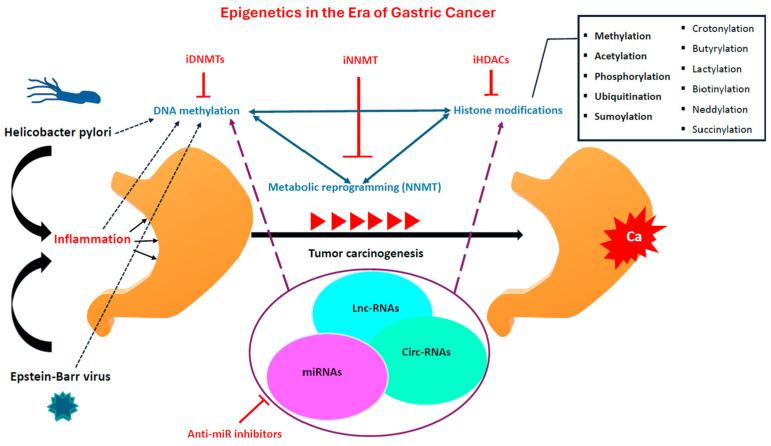
Gastric cancer (GC) remains a significant contributor to cancer-related mortality. Novel high-throughput techniques have enlightened the epigenetic mechanisms governing gene-expression regulation. Epigenetic characteristics contribute to molecular taxonomy and give rise to cancer-specific epigenetic patterns. (Hp) infection has an impact on aberrant DNA methylation either through its pathogenic CagA protein or by inducing chronic inflammation. The hypomethylation of specific repetitive elements generates an epigenetic field effect early in tumorigenesis. Epstein-Barr virus (EBV) infection triggers DNA methylation by dysregulating DNA methyltransferases (DNMT) enzyme activity, while persistent Hp-EBV co-infection leads to aggressive tumor behavior. Distinct histone modifications are also responsible for oncogene upregulation and tumor-suppressor gene silencing in gastric carcinomas. While histone methylation and acetylation processes have been extensively studied, other less prevalent alterations contribute to the development and migration of gastric cancer via a complex network of interactions. Enzymes, such as Nicotinamide N-methyltransferase (NNMT), which is involved in tumor's metabolic reprogramming, interact with methyltransferases and modify gene expression. Non-coding RNA molecules, including long non-coding RNAs, circular RNAs, and miRNAs serve as epigenetic regulators contributing to GC development, metastasis, poor outcomes and therapy resistance. Serum RNA molecules hold the potential to serve as non-invasive biomarkers for diagnostic, prognostic or therapeutic applications. Gastric fluids represent a valuable source to identify potential biomarkers with diagnostic use in terms of liquid biopsy. Ongoing clinical trials are currently evaluating the efficacy of next-generation epigenetic drugs, displaying promising outcomes. Various approaches including multiple miRNA inhibitors or targeted nanoparticles carrying epigenetic drugs are being designed to enhance existing treatment efficacy and overcome treatment resistance.
胃癌(GC)仍然是癌症相关死亡率的主要原因。新型高通量技术揭示了调控基因表达调控的表观遗传机制。表观遗传特征有助于分子分类,并产生癌症特异性的表观遗传模式。(Hp)感染通过其致病的 CagA 蛋白或通过诱导慢性炎症,对异常 DNA 甲基化产生影响。特定重复元件的低甲基化在肿瘤发生的早期产生表观遗传场效应。 Epstein-Barr 病毒(EBV)感染通过失调 DNA 甲基转移酶(DNMT)酶活性引发 DNA 甲基化,而持续的 Hp-EBV 共同感染导致侵袭性肿瘤行为。组蛋白修饰的改变也负责胃腺癌中癌基因的上调和肿瘤抑制基因的沉默。虽然组蛋白甲基化和乙酰化过程已经得到了广泛的研究,但其他不太常见的改变通过复杂的相互作用网络,导致胃癌的发展和迁移。参与肿瘤代谢重编程的酶,如 Nicotinamide N-methyltransferase(NNMT),与甲基转移酶相互作用并修饰基因表达。非编码 RNA 分子,包括长非编码 RNA、环状 RNA 和 miRNA,作为表观遗传调节剂参与 GC 的发展、转移、不良预后和治疗耐药性。血清 RNA 分子有可能成为用于诊断、预后或治疗应用的非侵入性生物标志物。胃液是一种有价值的资源,可以识别具有液体活检诊断用途的潜在生物标志物。目前正在进行的临床试验正在评估下一代表观遗传药物的疗效,显示出有希望的结果。各种方法,包括多种 miRNA 抑制剂或携带表观遗传药物的靶向纳米颗粒,旨在提高现有治疗效果并克服治疗耐药性。
 Zotero 插件