
神经肿瘤学中的人工智能:脑肿瘤诊断、预后及精准治疗的进展与挑战
Artificial intelligence in neuro-oncology: advances and challenges in brain tumor diagnosis, prognosis, and precision treatment.
作者信息
Khalighi Sirvan, Reddy Kartik, Midya Abhishek, Pandav Krunal Balvantbhai, Madabhushi Anant, Abedalthagafi Malak
机构信息
Wallace H. Coulter Department of Biomedical Engineering, Georgia Institute of Technology and Emory University, Atlanta, GA, USA.
Department of Radiology, Emory University, Atlanta, GA, USA.
出版信息
NPJ Precis Oncol. 2024 Mar 29;8(1):80. doi: 10.1038/s41698-024-00575-0.
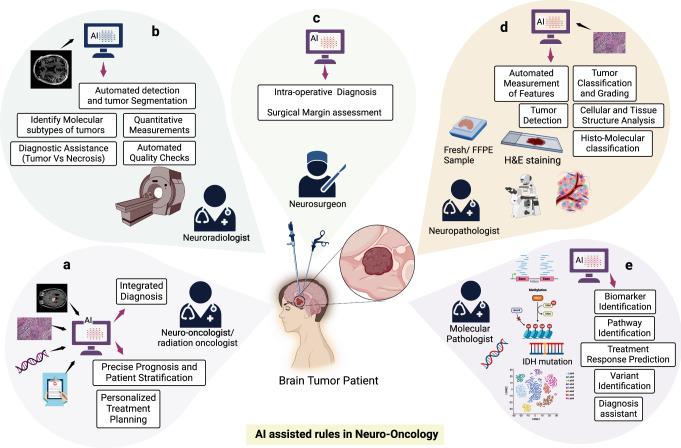
This review delves into the most recent advancements in applying artificial intelligence (AI) within neuro-oncology, specifically emphasizing work on gliomas, a class of brain tumors that represent a significant global health issue. AI has brought transformative innovations to brain tumor management, utilizing imaging, histopathological, and genomic tools for efficient detection, categorization, outcome prediction, and treatment planning. Assessing its influence across all facets of malignant brain tumor management- diagnosis, prognosis, and therapy- AI models outperform human evaluations in terms of accuracy and specificity. Their ability to discern molecular aspects from imaging may reduce reliance on invasive diagnostics and may accelerate the time to molecular diagnoses. The review covers AI techniques, from classical machine learning to deep learning, highlighting current applications and challenges. Promising directions for future research include multimodal data integration, generative AI, large medical language models, precise tumor delineation and characterization, and addressing racial and gender disparities. Adaptive personalized treatment strategies are also emphasized for optimizing clinical outcomes. Ethical, legal, and social implications are discussed, advocating for transparency and fairness in AI integration for neuro-oncology and providing a holistic understanding of its transformative impact on patient care.
本综述深入探讨了人工智能(AI)在神经肿瘤学领域的最新进展,特别着重于胶质瘤方面的研究,胶质瘤是一类脑肿瘤,是一个重大的全球健康问题。人工智能给脑肿瘤管理带来了变革性创新,利用成像、组织病理学和基因组工具进行高效检测、分类、结果预测和治疗规划。在评估人工智能对恶性脑肿瘤管理的各个方面(诊断、预后和治疗)的影响时,人工智能模型在准确性和特异性方面优于人类评估。它们从成像中辨别分子特征的能力可能会减少对侵入性诊断的依赖,并可能加快分子诊断的时间。该综述涵盖了从经典机器学习到深度学习的人工智能技术,突出了当前的应用和挑战。未来研究的有前景方向包括多模态数据整合、生成式人工智能、大型医学语言模型、精确的肿瘤勾勒和特征描述,以及解决种族和性别差异问题。还强调了适应性个性化治疗策略以优化临床结果。讨论了伦理、法律和社会影响,倡导在神经肿瘤学中人工智能整合方面保持透明和公平,并全面理解其对患者护理的变革性影响。

 Zotero 插件