
毛细血管再充盈时间对液体冲击或血管加压药试验的反应:一项观察性概念验证研究。
Capillary refill time response to a fluid challenge or a vasopressor test: an observational, proof-of-concept study.
作者信息
Hernández Glenn, Valenzuela Emilio Daniel, Kattan Eduardo, Castro Ricardo, Guzmán Camila, Kraemer Alicia Elzo, Sarzosa Nicolás, Alegría Leyla, Contreras Roberto, Oviedo Vanessa, Bravo Sebastián, Soto Dagoberto, Sáez Claudia, Ait-Oufella Hafid, Ospina-Tascón Gustavo, Bakker Jan
机构信息
Departamento de Medicina Intensiva, Facultad de Medicina, Pontificia Universidad Católica de Chile, Avenida Diagonal Paraguay 362, Santiago, Chile.
Departamento de Hematología Oncología, Facultad de Medicina, Pontificia Universidad Católica de Chile, Santiago, Chile.
出版信息
Ann Intensive Care. 2024 Apr 1;14(1):49. doi: 10.1186/s13613-024-01275-5.
BACKGROUND
Several studies have validated capillary refill time (CRT) as a marker of tissue hypoperfusion, and recent guidelines recommend CRT monitoring during septic shock resuscitation. Therefore, it is relevant to further explore its kinetics of response to short-term hemodynamic interventions with fluids or vasopressors. A couple of previous studies explored the impact of a fluid bolus on CRT, but little is known about the impact of norepinephrine on CRT when aiming at a higher mean arterial pressure (MAP) target in septic shock. We designed this observational study to further evaluate the effect of a fluid challenge (FC) and a vasopressor test (VPT) on CRT in septic shock patients with abnormal CRT after initial resuscitation. Our purpose was to determine the effects of a FC in fluid-responsive patients, and of a VPT aimed at a higher MAP target in chronically hypertensive fluid-unresponsive patients on the direction and magnitude of CRT response.
METHODS
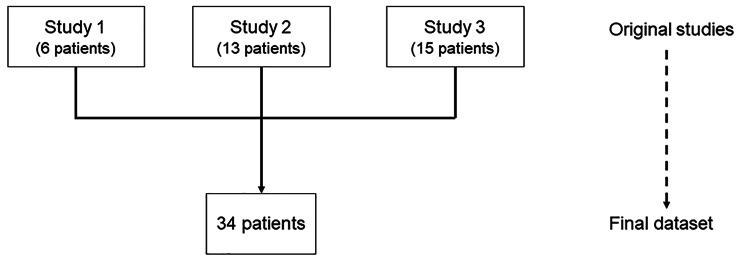
Thirty-four septic shock patients were included. Fluid responsiveness was assessed at baseline, and a FC (500 ml/30 mins) was administered in 9 fluid-responsive patients. A VPT was performed in 25 patients by increasing norepinephrine dose to reach a MAP to 80-85 mmHg for 30 min. Patients shared a multimodal perfusion and hemodynamic monitoring protocol with assessments at at least two time-points (baseline, and at the end of interventions).
RESULTS
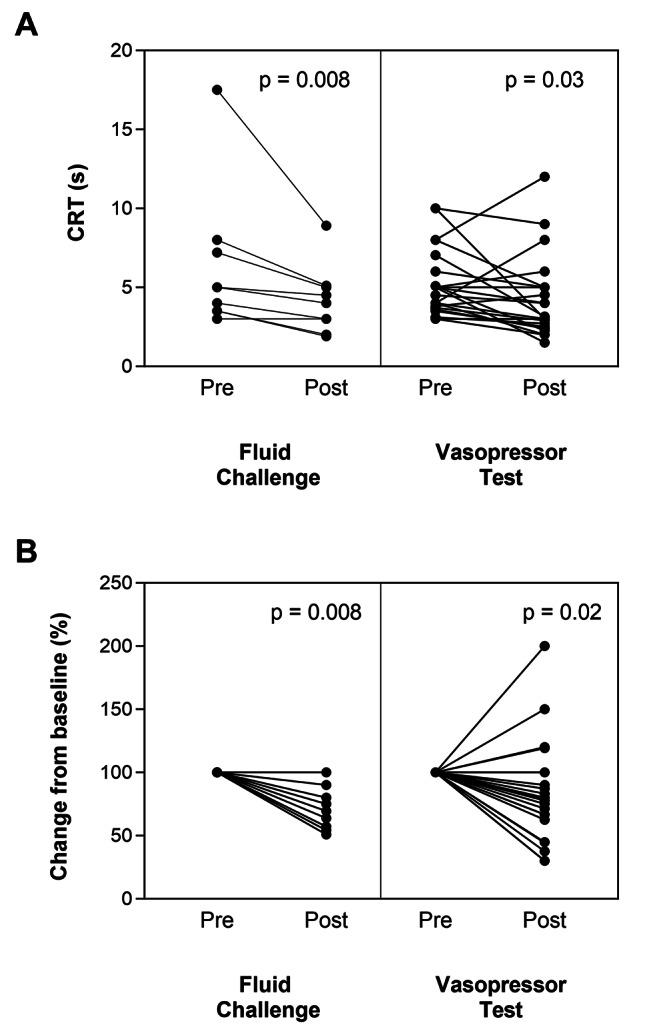
CRT decreased significantly with both tests (from 5 [3.5-7.6] to 4 [2.4-5.1] sec, p = 0.008 after the FC; and from 4.0 [3.3-5.6] to 3 [2.6 -5] sec, p = 0.03 after the VPT. A CRT-response was observed in 7/9 patients after the FC, and in 14/25 pts after the VPT, but CRT deteriorated in 4 patients on this latter group, all of them receiving a concomitant low-dose vasopressin.
CONCLUSIONS
Our findings support that fluid boluses may improve CRT or produce neutral effects in fluid-responsive septic shock patients with persistent hypoperfusion. Conversely, raising NE doses to target a higher MAP in previously hypertensive patients elicits a more heterogeneous response, improving CRT in the majority, but deteriorating skin perfusion in some patients, a fact that deserves further research.
背景
多项研究已证实毛细血管再充盈时间(CRT)可作为组织灌注不足的指标,近期指南建议在感染性休克复苏期间监测CRT。因此,进一步探究其对液体或血管升压药短期血流动力学干预的反应动力学具有重要意义。此前有几项研究探讨了液体冲击对CRT的影响,但对于感染性休克中以更高平均动脉压(MAP)为目标时去甲肾上腺素对CRT的影响知之甚少。我们设计了这项观察性研究,以进一步评估液体负荷试验(FC)和血管升压药试验(VPT)对初始复苏后CRT异常的感染性休克患者CRT的影响。我们的目的是确定FC对液体反应性患者的影响,以及VPT对慢性高血压液体无反应患者以更高MAP为目标时CRT反应的方向和幅度的影响。
方法
纳入34例感染性休克患者。在基线时评估液体反应性,对9例液体反应性患者给予FC(500 ml/30分钟)。对25例患者进行VPT,通过增加去甲肾上腺素剂量使MAP达到80 - 85 mmHg并维持30分钟。患者共享多模式灌注和血流动力学监测方案,至少在两个时间点(基线和干预结束时)进行评估。
结果
两项试验后CRT均显著降低(FC后从5[3.5 - 7.6]秒降至4[2.4 - 5.1]秒,p = 0.008;VPT后从4.0[3.3 - 5.6]秒降至3[2.6 - 5]秒,p = 0.03)。FC后7/9例患者观察到CRT反应,VPT后14/25例患者观察到CRT反应,但后一组中有4例患者CRT恶化,他们均接受了低剂量血管加压素。
结论
我们的研究结果支持,在持续灌注不足的液体反应性感染性休克患者中,液体冲击可能改善CRT或产生中性效应。相反,在既往高血压患者中提高去甲肾上腺素剂量以达到更高的MAP会引发更异质性的反应,大多数患者CRT改善,但部分患者皮肤灌注恶化,这一事实值得进一步研究。
 Zotero 插件