
人类非整倍体胚胎分泌的细胞外囊泡呈现出独特的转录组图谱,并上调蜕膜化子宫内膜基质细胞中MUC1的转录。
Extracellular vesicles secreted by human aneuploid embryos present a distinct transcriptomic profile and upregulate MUC1 transcription in decidualised endometrial stromal cells.
作者信息
Makieva Sofia, Giacomini Elisa, Scotti Giulia Maria, Lazarevic Dejan, Pavone Valentina, Ottolina Jessica, Bartiromo Ludovica, Schimberni Matteo, Morelli Marco, Alteri Alessandra, Minetto Sabrina, Tonon Giovanni, Candiani Massimo, Papaleo Enrico, Viganò Paola
机构信息
Reproductive Sciences Laboratory, IRCCS San Raffaele Scientific Institute, Milan, Italy.
Centre for Omics Sciences, IRCCS San Raffaele Scientific Institute, Milan, Italy.
出版信息
Hum Reprod Open. 2024 Mar 12;2024(2):hoae014. doi: 10.1093/hropen/hoae014. eCollection 2024.
STUDY QUESTION
Do extracellular vesicles (EVs) secreted by aneuploid human embryos possess a unique transcriptomic profile that elicits a relevant transcriptomic response in decidualized primary endometrial stromal cells (dESCs)?
SUMMARY ANSWER
Aneuploid embryo-derived EVs contain transcripts of , , , and with differential abundance from euploid embryo-derived EVs and induce upregulation of transcript in dESCs.
WHAT IS KNOWN ALREADY
We have previously reported that IVF embryos secrete EVs that can be internalized by ESCs, conceptualizing that successful implantation to the endometrium is facilitated by EVs. Whether these EVs may additionally serve as biomarkers of ploidy status is unknown.
STUDY DESIGN SIZE DURATION
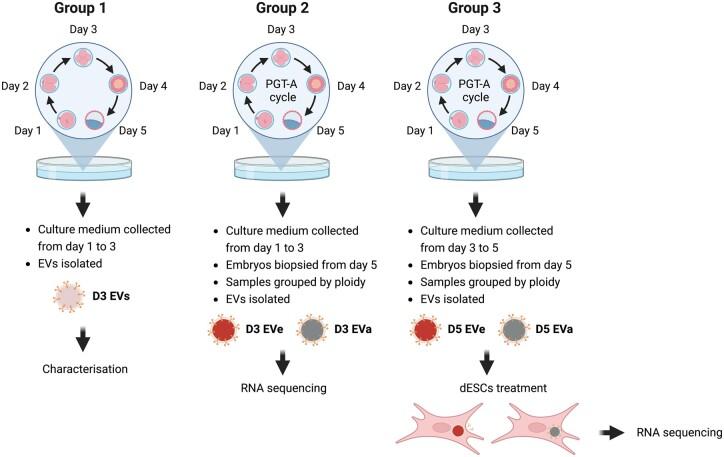
Embryos destined for biopsy for preimplantation genetic testing for aneuploidy (PGT-A) were grown under standard conditions. Spent media (30 μl) were collected from euploid (n = 175) and aneuploid (n = 140) embryos at cleavage (Days 1-3) stage and from euploid (n = 187) and aneuploid (n = 142) embryos at blastocyst (Days 3-5) stage. Media samples from n = 35 cleavage-stage embryos were pooled in order to obtain five euploid and four aneuploid pools. Similarly, media samples from blastocysts were pooled to create one euploid and one aneuploid pool. ESCs were obtained from five women undergoing diagnostic laparoscopy.
PARTICIPANTS/MATERIALS SETTING METHODS: EVs were isolated from pools of media by differential centrifugation and EV-RNA sequencing was performed following a single-cell approach that circumvents RNA extraction. ESCs were decidualized (estradiol: 10 nM, progesterone: 1 µM, cAMP: 0.5 mM twice every 48 h) and incubated for 24 h with EVs (50 ng/ml). RNA sequencing was performed on ESCs.
MAIN RESULTS AND THE ROLE OF CHANCE
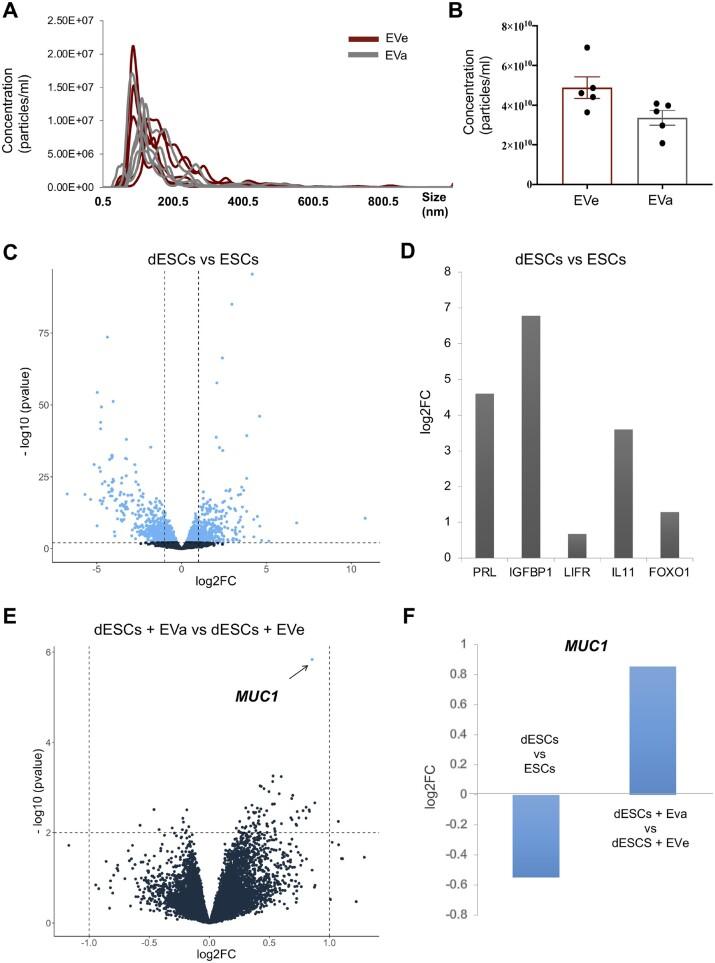
Aneuploid cleavage stage embryos secreted EVs that were less abundant in RNA fragments originating from the genes (log2fc = -5.13, = 0.011), (log2fc = -7.87, = 0.010), and (log2fc = -7.30, = 0.017) and more abundant in (log2fc = 1.63, = 0.025) compared to EVs of euploid embryos. Decidualization induced downregulation of (log2fc = -0.54, = 0.0028) in ESCs as a prerequisite for the establishment of receptive endometrium. The expression of transcript in decidualized ESCs was significantly increased following treatment with aneuploid compared to euploid embryo-secreted EVs (log2fc = 0.85, = 0.0201).
LARGE SCALE DATA
Raw data have been uploaded to GEO (accession number GSE234338).
LIMITATIONS REASONS FOR CAUTION
The findings of the study will require validation utilizing a second cohort of EV samples.
WIDER IMPLICATIONS OF THE FINDINGS
The discovery that the transcriptomic profile of EVs secreted from aneuploid cleavage stage embryos differs from that of euploid embryos supports the possibility to develop a non-invasive methodology for PGT-A. The upregulation of in dESCs following aneuploid embryo EV treatment proposes a new mechanism underlying implantation failure.
STUDY FUNDING/COMPETING INTERESTS: The study was supported by a Marie Skłodowska-Curie Actions fellowship awarded to SM by the European Commission (CERVINO grant agreement ID: 79620) and by a BIRTH research grant from Theramex HQ UK Ltd. The authors have no conflicts of interest to declare.
研究问题
非整倍体人类胚胎分泌的细胞外囊泡(EVs)是否具有独特的转录组特征,从而在蜕膜化的原代子宫内膜基质细胞(dESCs)中引发相关的转录组反应?
简要回答
非整倍体胚胎来源的EVs含有与整倍体胚胎来源的EVs丰度不同的 、 、 和 的转录本,并诱导dESCs中 转录本上调。
已知信息
我们之前报道过,体外受精胚胎分泌的EVs可被子宫内膜基质细胞内化,由此推测EVs有助于成功植入子宫内膜。这些EVs是否还可作为倍性状态的生物标志物尚不清楚。
研究设计、规模、持续时间:准备进行非整倍体植入前基因检测(PGT-A)活检的胚胎在标准条件下培养。在卵裂期(第1 - 3天)从整倍体(n = 175)和非整倍体(n = 140)胚胎中收集废弃培养基(30 μl),在囊胚期(第3 - 5天)从整倍体(n = 187)和非整倍体(n = 142)胚胎中收集。将n = 35个卵裂期胚胎的培养基样本合并,以获得5个整倍体样本池和4个非整倍体样本池。同样,将囊胚的培养基样本合并,创建1个整倍体样本池和1个非整倍体样本池。从5名接受诊断性腹腔镜检查的女性中获取子宫内膜基质细胞。
参与者/材料、设置、方法:通过差速离心从培养基样本池中分离出EVs,并采用一种避免RNA提取的单细胞方法进行EV-RNA测序。将子宫内膜基质细胞进行蜕膜化处理(雌二醇:10 nM,孕酮:1 μM,cAMP:0.5 mM,每48小时两次),并与EVs(50 ng/ml)孵育24小时。对子宫内膜基质细胞进行RNA测序。
主要结果及偶然性的作用
与整倍体胚胎的EVs相比,非整倍体卵裂期胚胎分泌的EVs中,来自基因 (log2倍变化 = -5.13, = 0.011)、 (log2倍变化 = -7.87, = 0.010)和 (log2倍变化 = -7.30, = 0.017)的RNA片段丰度较低,而 (log2倍变化 = 1.63, = 0.025)的丰度较高。蜕膜化诱导子宫内膜基质细胞中 (log2倍变化 = -0.54, = 0.0028)下调,这是建立容受性子宫内膜的前提条件。与整倍体胚胎分泌的EVs相比,用非整倍体胚胎分泌的EVs处理后,蜕膜化子宫内膜基质细胞中 转录本的表达显著增加(log2倍变化 = 0.85, = 0.0201)。
大规模数据
原始数据已上传至GEO(登录号GSE234338)。
局限性、谨慎原因:本研究结果需要利用第二批EV样本进行验证。
研究结果的更广泛意义
非整倍体卵裂期胚胎分泌的EVs转录组特征与整倍体胚胎不同,这一发现支持了开发一种用于PGT-A非侵入性方法的可能性。非整倍体胚胎EV处理后dESCs中 的上调提出了植入失败的一种新机制。
研究资金/利益冲突:本研究由欧盟授予SM的玛丽·居里行动计划奖学金(CERVINO资助协议编号:79620)以及Theramex英国总部有限公司的一项BIRTH研究资助提供支持。作者声明无利益冲突。



 Zotero 插件