
用于原发性进行性失语症分类的可解释机器学习放射组学模型。
Explainable machine learning radiomics model for Primary Progressive Aphasia classification.
作者信息
Tafuri Benedetta, De Blasi Roberto, Nigro Salvatore, Logroscino Giancarlo
机构信息
Department of Translational Biomedicine and Neuroscience (DiBraiN), University of Bari Aldo Moro, Bari, Italy.
Center for Neurodegenerative Diseases and the Aging Brain, University of Bari Aldo Moro at Pia Fondazione "Card. G. Panico", Tricase, Italy.
出版信息
Front Syst Neurosci. 2024 Mar 18;18:1324437. doi: 10.3389/fnsys.2024.1324437. eCollection 2024.
INTRODUCTION
Primary Progressive Aphasia (PPA) is a neurodegenerative disease characterized by linguistic impairment. The two main clinical subtypes are semantic (svPPA) and non-fluent/agrammatic (nfvPPA) variants. Diagnosing and classifying PPA patients represents a complex challenge that requires the integration of multimodal information, including clinical, biological, and radiological features. Structural neuroimaging can play a crucial role in aiding the differential diagnosis of PPA and constructing diagnostic support systems.
METHODS
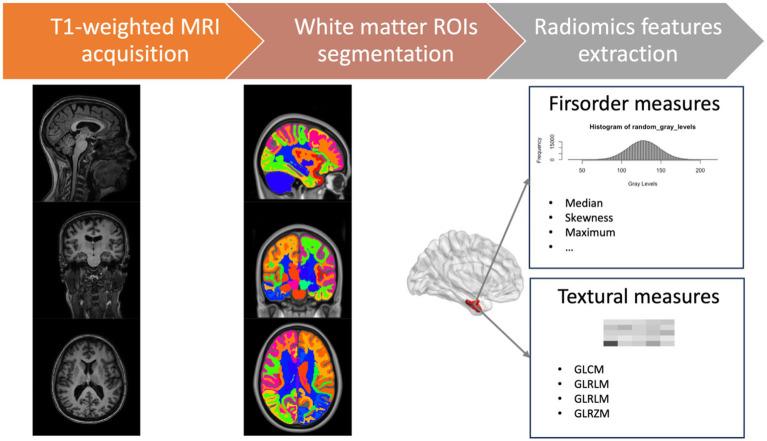
In this study, we conducted a white matter texture analysis on T1-weighted images, including 56 patients with PPA (31 svPPA and 25 nfvPPA), and 53 age- and sex-matched controls. We trained a tree-based algorithm over combined clinical/radiomics measures and used Shapley Additive Explanations (SHAP) model to extract the greater impactful measures in distinguishing svPPA and nfvPPA patients from controls and each other.
RESULTS
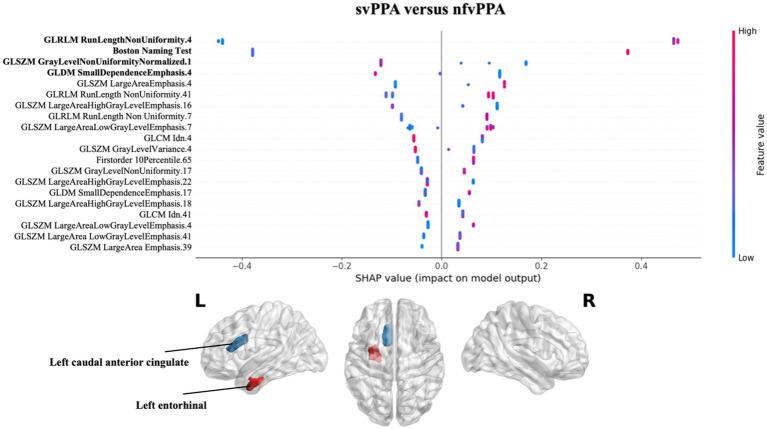
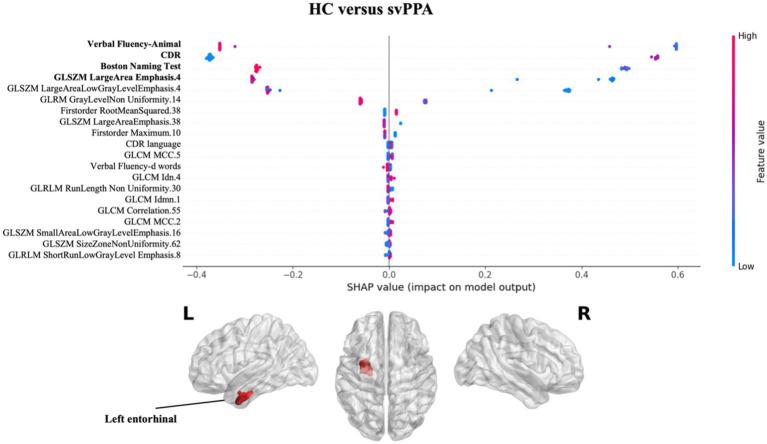
Radiomics-integrated classification models demonstrated an accuracy of 95% in distinguishing svPPA patients from controls and of 93.7% in distinguishing svPPA from nfvPPA. An accuracy of 93.7% was observed in differentiating nfvPPA patients from controls. Moreover, Shapley values showed the strong involvement of the white matter near left entorhinal cortex in patients classification models.
DISCUSSION
Our study provides new evidence for the usefulness of radiomics features in classifying patients with svPPA and nfvPPA, demonstrating the effectiveness of an explainable machine learning approach in extracting the most impactful features for assessing PPA.
引言
原发性进行性失语(PPA)是一种以语言障碍为特征的神经退行性疾病。两个主要的临床亚型是语义性(svPPA)和非流利/语法缺失性(nfvPPA)变体。对PPA患者进行诊断和分类是一项复杂的挑战,需要整合多模态信息,包括临床、生物学和放射学特征。结构神经影像学在辅助PPA的鉴别诊断和构建诊断支持系统方面可以发挥关键作用。
方法
在本研究中,我们对T1加权图像进行了白质纹理分析,包括56例PPA患者(31例svPPA和25例nfvPPA)以及53例年龄和性别匹配的对照。我们基于临床/放射组学综合测量训练了一种基于树的算法,并使用Shapley值加法解释(SHAP)模型来提取在区分svPPA和nfvPPA患者与对照以及彼此之间更具影响力的测量指标。
结果
放射组学整合分类模型在区分svPPA患者与对照方面的准确率为95%,在区分svPPA与nfvPPA方面的准确率为93.7%。在区分nfvPPA患者与对照方面观察到的准确率为93.7%。此外,Shapley值显示左内嗅皮质附近的白质在患者分类模型中起重要作用。
讨论
我们的研究为放射组学特征在svPPA和nfvPPA患者分类中的有用性提供了新证据,证明了一种可解释的机器学习方法在提取评估PPA最具影响力特征方面的有效性。

 Zotero 插件