
腹部 CT 检查中的肌肉脂肪浸润和主动脉钙评分作为非透析慢性肾脏病患者的预后标志物。
Myosteatosis and aortic calcium score on abdominal CT as prognostic markers in non-dialysis chronic kidney disease patients.
机构信息
Department of Radiology, Hanyang University Medical Center, 222-1 Wangsimni-ro, Seongdong-gu, Seoul, 04763, Republic of Korea.
Department of Internal Medicine, Hanyang University Medical Center, 222-1 Wangsimni-ro, Seongdong-gu, Seoul, Republic of Korea.
出版信息
Sci Rep. 2024 Apr 2;14(1):7718. doi: 10.1038/s41598-024-58293-3.
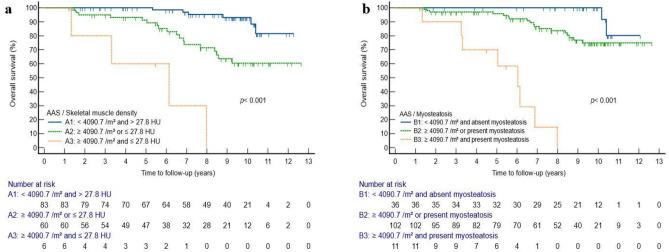
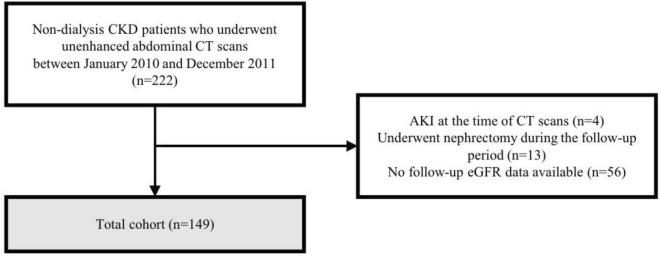
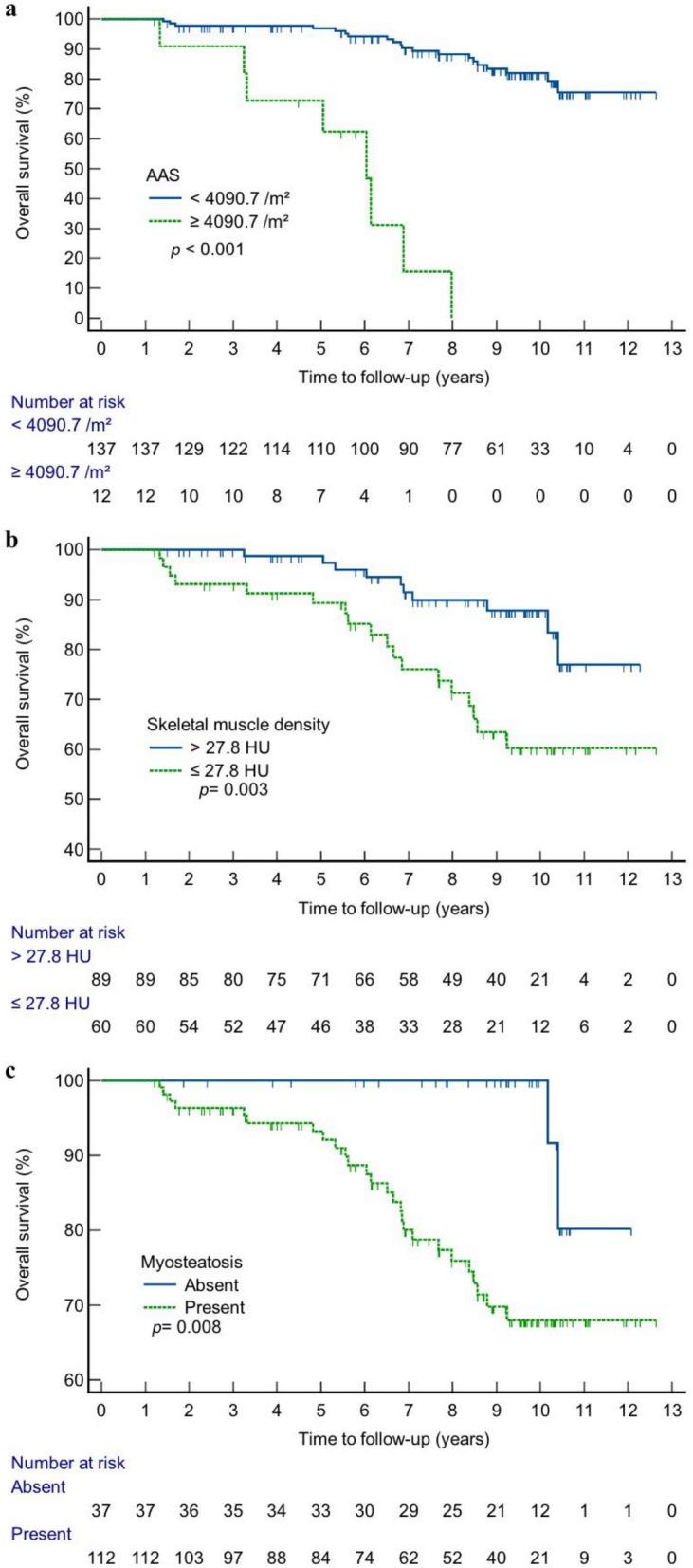
We aimed to examine the relationship between abdominal computed tomography (CT)-based body composition data and both renal function decline and all-cause mortality in patients with non-dialysis chronic kidney disease (CKD). This retrospective study comprised non-dialysis CKD patients who underwent consecutive unenhanced abdominal CT between January 2010 and December 2011. CT-based body composition was measured using semiautomated method that included visceral fat, subcutaneous fat, skeletal muscle area and density, and abdominal aortic calcium score (AAS). Sarcopenia and myosteatosis were defined by decreased skeletal muscle index (SMI) and decreased skeletal muscle density, respectively, each with specific cutoffs. Risk factors for CKD progression and survival were identified using logistic regression and Cox proportional hazard regression models. Survival between groups based on myosteatosis and AAS was compared using the Kaplan-Meier curve. 149 patients (median age: 70 years) were included; 79 (53.0%) patients had sarcopenia and 112 (75.2%) had myosteatosis. The median AAS was 560.9 (interquartile range: 55.7-1478.3)/m. The prognostic factors for CKD progression were myosteatosis [odds ratio (OR) = 4.31, p = 0.013] and high AAS (OR = 1.03, p = 0.001). Skeletal muscle density [hazard ratio (HR) = 0.93, p = 0.004] or myosteatosis (HR = 4.87, p = 0.032) and high AAS (HR = 1.02, p = 0.001) were independent factors for poor survival outcomes. The presence of myosteatosis and the high burden of aortic calcium were significant factors for CKD progression and survival in patients with non-dialysis CKD.
我们旨在研究非透析慢性肾脏病(CKD)患者腹部计算机断层扫描(CT)为基础的身体成分数据与肾功能下降和全因死亡率之间的关系。这项回顾性研究纳入了 2010 年 1 月至 2011 年 12 月间连续进行非增强腹部 CT 的非透析 CKD 患者。采用半自动方法测量 CT 为基础的身体成分,包括内脏脂肪、皮下脂肪、骨骼肌面积和密度以及腹主动脉钙评分(AAS)。通过降低的骨骼肌指数(SMI)和降低的骨骼肌密度分别定义肌少症和肌脂病,每种疾病都有特定的截断值。使用逻辑回归和 Cox 比例风险回归模型确定 CKD 进展和生存的危险因素。使用 Kaplan-Meier 曲线比较基于肌脂病和 AAS 的组间生存情况。共纳入 149 例患者(中位年龄:70 岁);79 例(53.0%)患者存在肌少症,112 例(75.2%)存在肌脂病。中位 AAS 为 560.9(四分位间距:55.7-1478.3)/m。CKD 进展的预测因素是肌脂病[比值比(OR)=4.31,p=0.013]和高 AAS(OR=1.03,p=0.001)。骨骼肌密度[风险比(HR)=0.93,p=0.004]或肌脂病(HR=4.87,p=0.032)和高 AAS(HR=1.02,p=0.001)是生存不良的独立因素。肌脂病和主动脉钙负荷较高是影响非透析 CKD 患者 CKD 进展和生存的重要因素。

 Zotero 插件