
在慢性肾病患者中,肌肉脂肪浸润与肥胖、代谢紊乱及死亡率相关。
Myosteatosis is associated with adiposity, metabolic derangements and mortality in patients with chronic kidney disease.
作者信息
Sabatino Alice, Cordeiro Antonio C, Prado Carla M, Lindholm Bengt, Stenvinkel Peter, Avesani Carla Maria
机构信息
Division of Nephrology, Department of Medicine and Surgery, University of Parma, Parma, Italy.
Baxter Novum, Division of Renal Medicine, Department of Clinical Science Intervention and Technology, Karolinska Institute, Stockholm, Sweden.
出版信息
Eur J Clin Nutr. 2025 May;79(5):475-483. doi: 10.1038/s41430-024-01551-4. Epub 2025 Jan 2.
BACKGROUND/OBJECTIVES: Myosteatosis has been associated with sarcopenia, and increased mortality risk in patients on hemodialysis. We aimed to explore the associations between myosteatosis, as assessed by computed tomography (CT), with demographic parameters, body composition metrics, muscle strength, metabolic parameters and mortality in patients with chronic kidney disease (CKD).
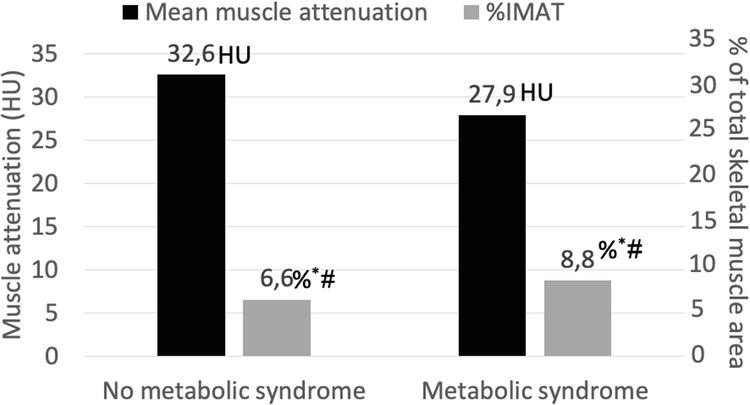
SUBJECTS/METHODS: We enrolled 216 patients (age 60.3 ± 10.6 years, 63% men) with CKD stages 3-5. Abdominal CT scans at the third lumbar vertebra (L3) were used to assess body composition. Abdominal obesity was determined by abdominal adipose tissue (AT), sarcopenia by low skeletal muscle area (SMA) and low handgrip strength. Myosteatosis was evaluated by two parameters using CT scans at L3: mean muscle attenuation and percentage of intermuscular adipose tissue (%IMAT) within SMA. We evaluated the correlation between parameters of myosteatosis with demographic, clinical and metabolic variables. To determine independent predictors of myosteatosis, a multiple linear regression model was fitted. Mortality risk was evaluated with Cox-regression analysis.
RESULTS
Both parameters of myosteatosis were independently associated with age, metabolic syndrome, abdominal AT and SMA in the multiple linear regression analysis (adjusted R for multiple linear regression: muscle attenuation model 0.535, P < 0.001; %IMAT model 0.462, P < 0.001). Moreover, higher %IMAT and lower attenuation were associated with a higher mortality risk.
CONCLUSION
In patients with CKD, increased myosteatosis, as assessed by abdominal CT, was associated with old age, adiposity, metabolic dysfunction, and higher mortality risk.
背景/目的:肌少脂症与肌肉减少症以及血液透析患者死亡率增加有关。我们旨在探讨通过计算机断层扫描(CT)评估的肌少脂症与慢性肾脏病(CKD)患者的人口统计学参数、身体成分指标、肌肉力量、代谢参数和死亡率之间的关联。
受试者/方法:我们纳入了216例CKD 3 - 5期患者(年龄60.3±10.6岁,63%为男性)。使用第三腰椎(L3)水平的腹部CT扫描评估身体成分。通过腹部脂肪组织(AT)确定腹部肥胖,通过低骨骼肌面积(SMA)和低握力确定肌肉减少症。使用L3水平的CT扫描通过两个参数评估肌少脂症:平均肌肉衰减和SMA内肌间脂肪组织百分比(%IMAT)。我们评估了肌少脂症参数与人口统计学、临床和代谢变量之间的相关性。为了确定肌少脂症的独立预测因素,拟合了多元线性回归模型。使用Cox回归分析评估死亡风险。
结果
在多元线性回归分析中,肌少脂症的两个参数均与年龄、代谢综合征、腹部AT和SMA独立相关(多元线性回归的调整R:肌肉衰减模型为0.535,P < 0.001;%IMAT模型为0.462,P < 0.001)。此外,较高的%IMAT和较低的衰减与较高的死亡风险相关。
结论
在CKD患者中,通过腹部CT评估的肌少脂症增加与老年、肥胖、代谢功能障碍和较高的死亡风险相关。


 Zotero 插件