
Themis 通过正向调控 Vav1 控制中枢神经系统炎症小鼠模型中 CD4 T 细胞的致病性。
Positive regulation of Vav1 by Themis controls CD4 T cell pathogenicity in a mouse model of central nervous system inflammation.
机构信息
Institut Toulousain des Maladies Infectieuses Et Inflammatoires (Infinity), Université de Toulouse, Centre National de la Recherche Scientifique (CNRS), Institut National de la Santé et de la Recherche Médicale (Inserm), INSERM U1291, Université Paul Sabatier (UPS), CHU Purpan, BP 3028, 31024, Toulouse Cedex 3, France.
Division of Immune Regulation, La Jolla Institute for Immunology, La Jolla, CA, USA.
出版信息
Cell Mol Life Sci. 2024 Apr 2;81(1):161. doi: 10.1007/s00018-024-05203-5.
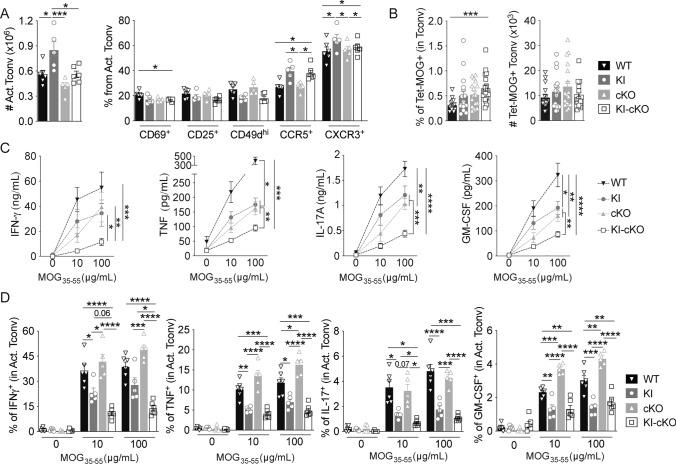
The susceptibility to autoimmune diseases is conditioned by the association of modest genetic alterations which altogether weaken self-tolerance. The mechanism whereby these genetic interactions modulate T-cell pathogenicity remains largely uncovered. Here, we investigated the epistatic interaction of two interacting proteins involved in T Cell Receptor signaling and which were previously associated with the development of Multiple Sclerosis. To this aim, we used mice expressing an hypomorphic variant of Vav1 (Vav1), combined with a T cell-conditional deletion of Themis. We show that the combined mutations in Vav1 and Themis induce a strong attenuation of the severity of Experimental Autoimmune Encephalomyelitis (EAE), contrasting with the moderate effect of the single mutation in each of those two proteins. This genotype-dependent gradual decrease of EAE severity correlates with decreased quantity of phosphorylated Vav1 in CD4 T cells, establishing that Themis promotes the development of encephalitogenic Tconv response by enhancing Vav1 activity. We also show that the cooperative effect of Themis and Vav1 on EAE severity is independent of regulatory T cells and unrelated to the impact of Themis on thymic selection. Rather, it results from decreased production of pro-inflammatory cytokines (IFN-γ, IL-17, TNF and GM-CSF) and reduced T cell infiltration in the CNS. Together, our results provide a rationale to study combination of related genes, in addition to single gene association, to better understand the genetic bases of human diseases.
自身免疫性疾病的易感性受轻度遗传改变的影响,这些改变共同削弱了自身耐受性。这些遗传相互作用调节 T 细胞致病性的机制在很大程度上尚未被揭示。在这里,我们研究了两个相互作用的蛋白之间的上位性相互作用,这些蛋白参与 T 细胞受体信号转导,先前与多发性硬化症的发展有关。为此,我们使用表达 Vav1 (Vav1)低功能变体的小鼠,结合 T 细胞条件性缺失 Themis。我们表明,Vav1 和 Themis 的联合突变导致实验性自身免疫性脑脊髓炎(EAE)的严重程度明显减弱,而这两种蛋白的单一突变的影响则适中。这种基因型依赖性的 EAE 严重程度逐渐降低与 CD4 T 细胞中磷酸化 Vav1 的数量减少相关,这表明 Themis 通过增强 Vav1 活性促进了致脑炎性 Tconv 反应的发展。我们还表明,Themis 和 Vav1 对 EAE 严重程度的协同作用独立于调节性 T 细胞,与 Themis 对胸腺选择的影响无关。相反,它是由于促炎细胞因子(IFN-γ、IL-17、TNF 和 GM-CSF)的产生减少和中枢神经系统中 T 细胞浸润减少所致。总之,我们的研究结果为研究相关基因的组合提供了依据,除了单基因关联,以更好地理解人类疾病的遗传基础。


 Zotero 插件