
免疫逃避、衰减和增强对疫苗接种多数人群与未接种少数人群混合动态的影响。
Impact of immune evasion, waning and boosting on dynamics of population mixing between a vaccinated majority and unvaccinated minority.
机构信息
Dalla Lana School of Public Health, University of Toronto, Toronto, Ontario, Canada.
Centre for Immunization Programs, Public Health Agency of Canada, Ottawa, Ontario, Canada.
出版信息
PLoS One. 2024 Apr 4;19(4):e0297093. doi: 10.1371/journal.pone.0297093. eCollection 2024.
BACKGROUND
We previously demonstrated that when vaccines prevent infection, the dynamics of mixing between vaccinated and unvaccinated sub-populations is such that use of imperfect vaccines markedly decreases risk for vaccinated people, and for the population overall. Risks to vaccinated people accrue disproportionately from contact with unvaccinated people. In the context of the emergence of Omicron SARS-CoV-2 and evolving understanding of SARS-CoV-2 epidemiology, we updated our analysis to evaluate whether our earlier conclusions remained valid.
METHODS
We modified a previously published Susceptible-Infectious-Recovered (SIR) compartmental model of SARS-CoV-2 with two connected sub-populations: vaccinated and unvaccinated, with non-random mixing between groups. Our expanded model incorporates diminished vaccine efficacy for preventing infection with the emergence of Omicron SARS-CoV-2 variants, waning immunity, the impact of prior immune experience on infectivity, "hybrid" effects of infection in previously vaccinated individuals, and booster vaccination. We evaluated the dynamics of an epidemic within each subgroup and in the overall population over a 10-year time horizon.
RESULTS
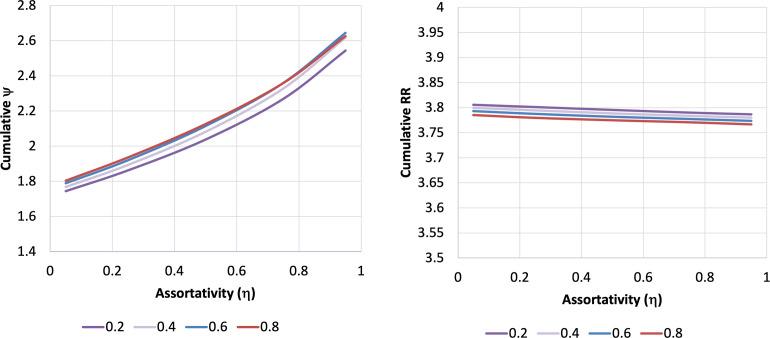
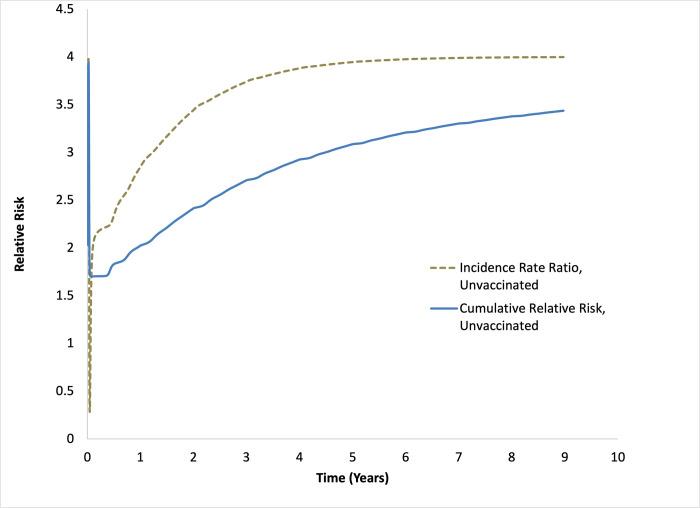
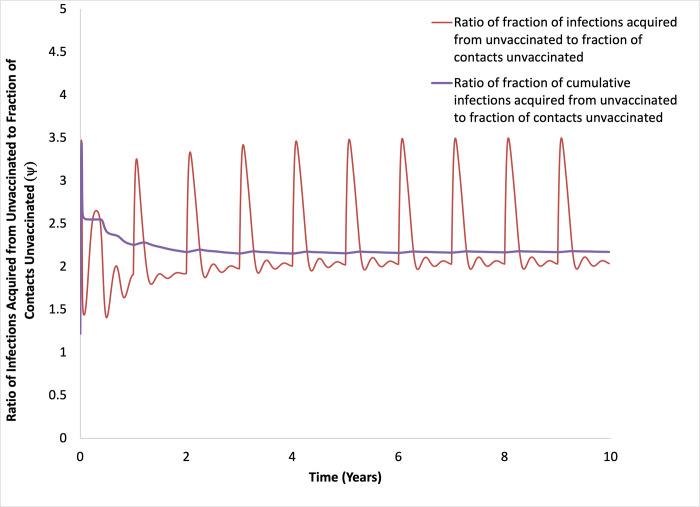
Even with vaccine efficacy as low as 20%, and in the presence of waning immunity, the incidence of COVID-19 in the vaccinated subpopulation was lower than that among the unvaccinated population across the full 10-year time horizon. The cumulative risk of infection was 3-4 fold higher among unvaccinated people than among vaccinated people, and unvaccinated people contributed to infection risk among vaccinated individuals at twice the rate that would have been expected based on the frequency of contacts. These findings were robust across a range of assumptions around the rate of waning immunity, the impact of "hybrid immunity", frequency of boosting, and the impact of prior infection on infectivity in unvaccinated people.
INTERPRETATION
Although the emergence of the Omicron variants of SARS-CoV-2 has diminished the protective effects of vaccination against infection with SARS-CoV-2, updating our earlier model to incorporate loss of immunity, diminished vaccine efficacy and a longer time horizon, does not qualitatively change our earlier conclusions. Vaccination against SARS-CoV-2 continues to diminish the risk of infection among vaccinated people and in the population as a whole. By contrast, the risk of infection among vaccinated people accrues disproportionately from contact with unvaccinated people.
背景
我们之前的研究表明,当疫苗能够预防感染时,接种疫苗和未接种疫苗的人群之间的混合动态使得使用不完美的疫苗会显著降低接种者和整个人群的风险。接种者的风险主要来自于与未接种者的接触。在奥密克戎 SARS-CoV-2 出现和 SARS-CoV-2 流行病学认识不断发展的背景下,我们更新了分析,以评估我们之前的结论是否仍然成立。
方法
我们用两个相互连接的亚人群(接种疫苗和未接种疫苗)修改了之前发表的 SARS-CoV-2 易感-感染-恢复(SIR) compartmental 模型,并在群体之间进行了非随机混合。我们的扩展模型纳入了奥密克戎 SARS-CoV-2 变体出现后疫苗预防感染的功效降低、免疫力下降、既往免疫经验对传染性的影响、既往接种个体感染的“混合”效应以及加强针接种。我们评估了在 10 年时间范围内每个亚组和整个人群内的疫情动态。
结果
即使疫苗的有效性低至 20%,并且存在免疫衰减,在整个 10 年时间范围内,接种疫苗亚组的 COVID-19 发病率仍低于未接种疫苗的人群。未接种疫苗人群的累计感染风险比接种疫苗人群高 3-4 倍,未接种疫苗人群对接种疫苗人群的感染风险贡献是基于接触频率预计的两倍。这些发现在围绕免疫衰减率、“混合免疫”的影响、加强针接种频率以及未接种人群既往感染对传染性的影响的一系列假设下是稳健的。
解释
尽管 SARS-CoV-2 的奥密克戎变体的出现降低了 SARS-CoV-2 感染的疫苗保护效果,但更新我们早期的模型以纳入免疫丧失、疫苗效力降低和更长的时间范围,并没有从质上改变我们早期的结论。接种 SARS-CoV-2 疫苗继续降低接种者和整个人群的感染风险。相比之下,接种者的感染风险主要来自于与未接种者的接触。

 Zotero 插件