
用于预测精神疾病患者2型糖尿病的机器学习模型的开发与验证
Development and validation of a machine learning model for prediction of type 2 diabetes in patients with mental illness.
作者信息
Bernstorff Martin, Hansen Lasse, Enevoldsen Kenneth, Damgaard Jakob, Hæstrup Frida, Perfalk Erik, Danielsen Andreas Aalkjær, Østergaard Søren Dinesen
机构信息
Department of Affective Disorders, Aarhus University Hospital - Psychiatry, Aarhus, Denmark.
Department of Clinical Medicine, Aarhus University, Aarhus, Denmark.
出版信息
Acta Psychiatr Scand. 2025 Mar;151(3):245-258. doi: 10.1111/acps.13687. Epub 2024 Apr 4.
BACKGROUND
Type 2 diabetes (T2D) is approximately twice as common among individuals with mental illness compared with the background population, but may be prevented by early intervention on lifestyle, diet, or pharmacologically. Such prevention relies on identification of those at elevated risk (prediction). The aim of this study was to develop and validate a machine learning model for prediction of T2D among patients with mental illness.
METHODS
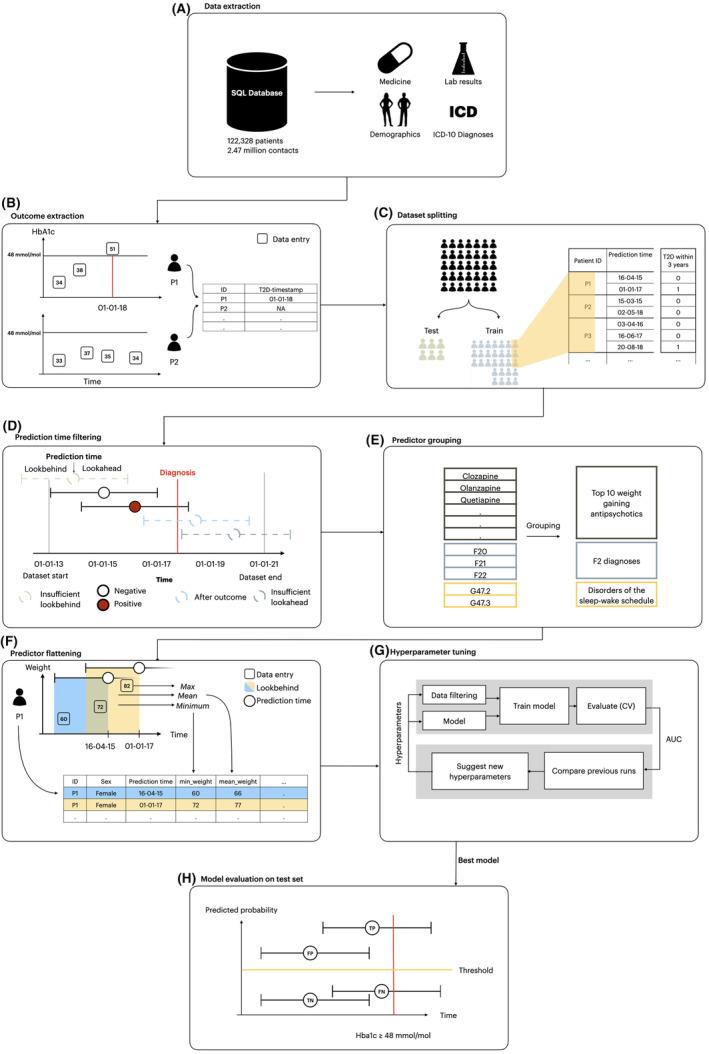
The study was based on routine clinical data from electronic health records from the psychiatric services of the Central Denmark Region. A total of 74,880 patients with 1.59 million psychiatric service contacts were included in the analyses. We created 1343 potential predictors from 51 source variables, covering patient-level information on demographics, diagnoses, pharmacological treatment, and laboratory results. T2D was operationalised as HbA1c ≥48 mmol/mol, fasting plasma glucose ≥7.0 mmol/mol, oral glucose tolerance test ≥11.1 mmol/mol or random plasma glucose ≥11.1 mmol/mol. Two machine learning models (XGBoost and regularised logistic regression) were trained to predict T2D based on 85% of the included contacts. The predictive performance of the best performing model was tested on the remaining 15% of the contacts.
RESULTS
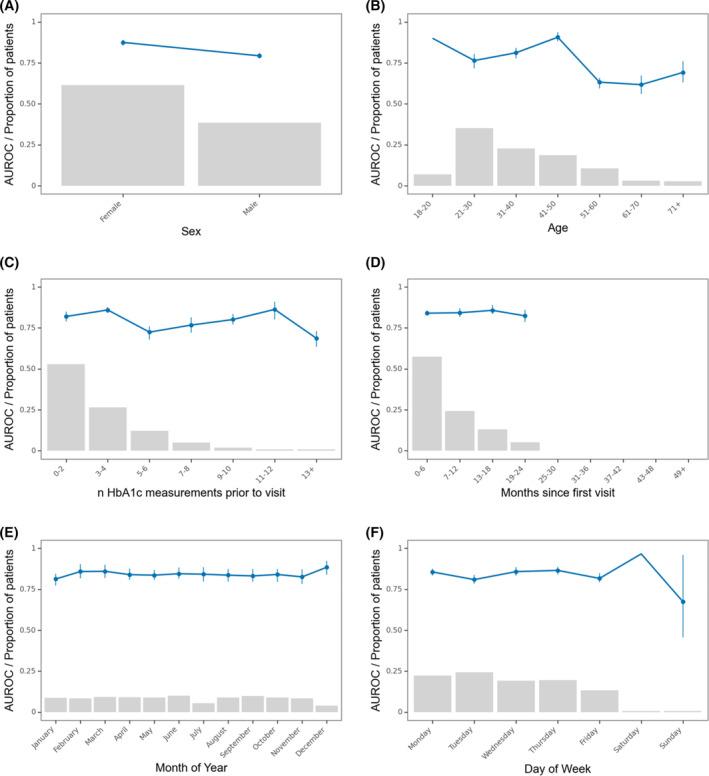
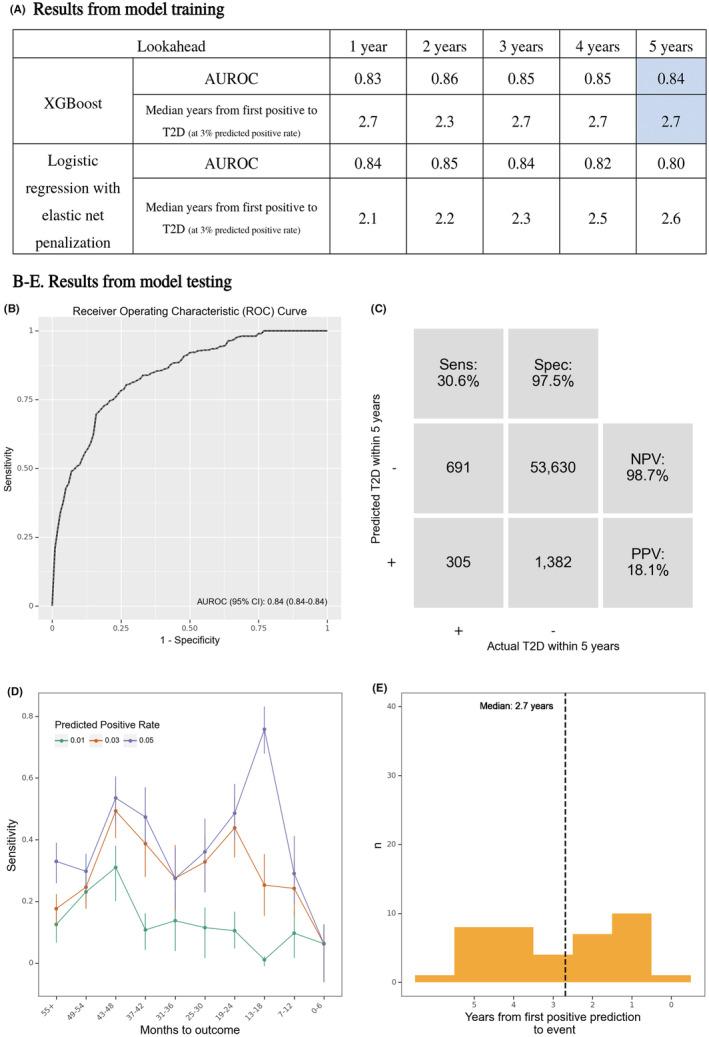
The XGBoost model detected patients at high risk 2.7 years before T2D, achieving an area under the receiver operating characteristic curve of 0.84. Of the 996 patients developing T2D in the test set, the model issued at least one positive prediction for 305 (31%).
CONCLUSION
A machine learning model can accurately predict development of T2D among patients with mental illness based on routine clinical data from electronic health records. A decision support system based on such a model may inform measures to prevent development of T2D in this high-risk population.
背景
与普通人群相比,2型糖尿病(T2D)在精神疾病患者中的发病率约为其两倍,但可通过早期生活方式干预、饮食干预或药物干预来预防。这种预防依赖于识别高危人群(预测)。本研究的目的是开发并验证一种用于预测精神疾病患者T2D的机器学习模型。
方法
本研究基于丹麦中部地区精神科服务电子健康记录中的常规临床数据。分析纳入了总共74880名患者的159万次精神科服务接触记录。我们从51个源变量中创建了1343个潜在预测因子,涵盖患者层面的人口统计学信息、诊断、药物治疗和实验室检查结果。T2D的定义为糖化血红蛋白(HbA1c)≥48 mmol/mol、空腹血糖≥7.0 mmol/mol、口服葡萄糖耐量试验≥11.1 mmol/mol或随机血糖≥11.1 mmol/mol。基于85%的纳入接触记录,训练了两种机器学习模型(XGBoost和正则化逻辑回归)来预测T2D。在其余15%的接触记录上测试表现最佳模型的预测性能。
结果
XGBoost模型在T2D发生前2.7年检测到高危患者,受试者工作特征曲线下面积为0.84。在测试集中发生T2D的996名患者中,该模型至少做出一次阳性预测的有305名(31%)。
结论
基于电子健康记录中的常规临床数据,机器学习模型能够准确预测精神疾病患者T2D的发生。基于此类模型的决策支持系统可为该高危人群预防T2D的发生提供措施参考。
 Zotero 插件