
在一种锥蝽昆虫中编码一种热敏锚蛋白离子通道受体。
encodes a thermosensitive ankyrin ion channel receptor in a triatomine insect.
作者信息
Liénard Marjorie A, Baez-Nieto David, Tsai Cheng-Chia, Valencia-Montoya Wendy A, Werin Balder, Johanson Urban, Lassance Jean-Marc, Pan Jen Q, Yu Nanfang, Pierce Naomi E
机构信息
Department of Biology, Lund University, 22362 Lund, Sweden.
Department of Organismic and Evolutionary Biology and Museum of Comparative Zoology, Harvard University, Cambridge, MA 02138, USA.
出版信息
iScience. 2024 Mar 20;27(4):109541. doi: 10.1016/j.isci.2024.109541. eCollection 2024 Apr 19.
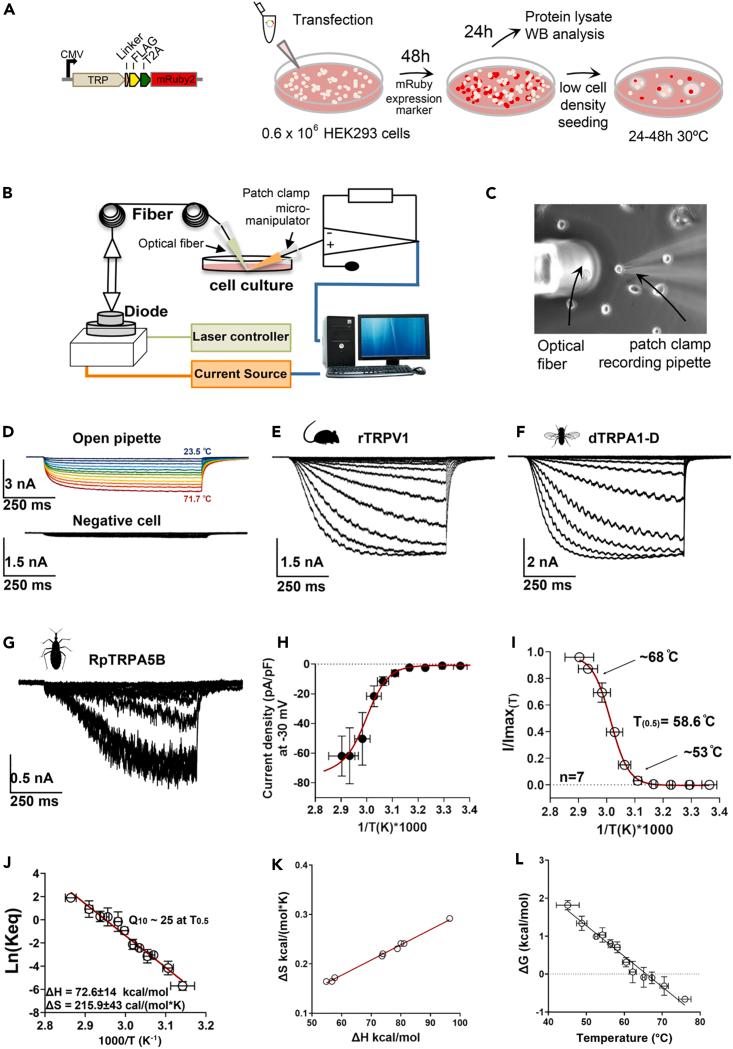
As ectotherms, insects need heat-sensitive receptors to monitor environmental temperatures and facilitate thermoregulation. We show that a class of ankyrin transient receptor potential (TRP) channels absent in dipteran genomes, may function as insect heat receptors. In the triatomine bug (order: Hemiptera), a vector of Chagas disease, the channel RpTRPA5B displays a uniquely high thermosensitivity, with biophysical determinants including a large channel activation enthalpy change (72 kcal/mol), a high temperature coefficient (Q = 25), and temperature-induced currents from 53°C to 68°C (T = 58.6°C), similar to noxious TRPV receptors in mammals. Monomeric and tetrameric ion channel structure predictions show reliable parallels with fruit fly dTRPA1, with structural uniqueness in ankyrin repeat domains, the channel selectivity filter, and potential TRP functional modulator regions. Overall, the finding of a member of as a temperature-activated receptor illustrates the diversity of insect molecular heat detectors.
作为变温动物,昆虫需要热敏受体来监测环境温度并促进体温调节。我们发现,双翅目基因组中不存在的一类锚蛋白瞬时受体电位(TRP)通道可能作为昆虫热受体发挥作用。在恰加斯病的传播媒介——锥蝽(半翅目)中,通道RpTRPA5B表现出独特的高热敏性,其生物物理决定因素包括较大的通道激活焓变(72千卡/摩尔)、较高的温度系数(Q = 25)以及53°C至68°C(T = 58.6°C)的温度诱导电流,类似于哺乳动物中的有害TRPV受体。单体和四聚体离子通道结构预测显示与果蝇dTRPA1有可靠的相似性,在锚蛋白重复结构域、通道选择性过滤器和潜在的TRP功能调节区域具有结构独特性。总体而言,发现一种作为温度激活受体的成员说明了昆虫分子热探测器的多样性。


 Zotero 插件