
微塑料和纳米塑料对肝脏健康的影响:当前认识和未来研究方向。
Impact of microplastics and nanoplastics on liver health: Current understanding and future research directions.
机构信息
School of Medicine, University of Pittsburgh, Pittsburgh, PA 15213, United States.
Pittsburgh Liver Research Center, University of Pittsburgh, Pittsburgh, PA 15213, United States.
出版信息
World J Gastroenterol. 2024 Mar 7;30(9):1011-1017. doi: 10.3748/wjg.v30.i9.1011.
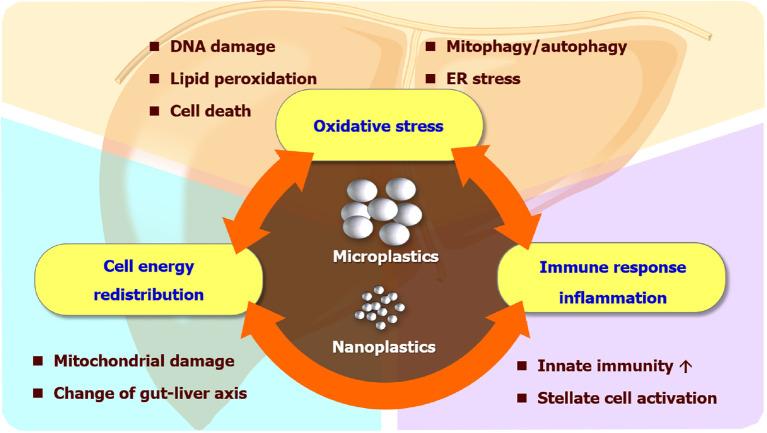
With continuous population and economic growth in the 21 century, plastic pollution is a major global issue. However, the health concern of microplastics/ nanoplastics (MPs/NPs) decomposed from plastic wastes has drawn public attention only in the recent decade. This article summarizes recent works dedicated to understanding the impact of MPs/NPs on the liver-the largest digestive organ, which is one of the primary routes that MPs/NPs enter human bodies. The interrelated mechanisms including oxidative stress, hepatocyte energy re-distribution, cell death and autophagy, as well as immune responses and inflammation, were also featured. In addition, the disturbance of microbiome and gut-liver axis, and the association with clinical diseases such as metabolic dysfunction-associated fatty liver disease, steatohepatitis, liver fibrosis, and cirrhosis were briefly discussed. Finally, we discussed potential directions in regard to this trending topic, highlighted current challenges in research, and proposed possible solutions.
随着 21 世纪人口和经济的持续增长,塑料污染是一个全球性的主要问题。然而,只有在最近十年,人们才开始关注塑料废物分解产生的微塑料/纳米塑料(MPs/NPs)对健康的影响。本文总结了最近的研究工作,旨在了解 MPs/NPs 对肝脏(最大的消化器官)的影响,肝脏是 MPs/NPs 进入人体的主要途径之一。还介绍了相关的机制,包括氧化应激、肝细胞能量再分布、细胞死亡和自噬,以及免疫反应和炎症。此外,还简要讨论了微生物组和肠-肝轴的紊乱,以及与代谢功能障碍相关的脂肪肝疾病、肝炎、肝纤维化和肝硬化等临床疾病的关联。最后,我们讨论了这一热门话题的潜在方向,强调了研究中的当前挑战,并提出了可能的解决方案。
 Zotero 插件