
前列腺癌中癌症相关成纤维细胞亚型的综合分析及其用于预测预后和免疫抑制微环境的评分系统。
Comprehensive analyses of the cancer-associated fibroblast subtypes and their score system for prediction of outcomes and immunosuppressive microenvironment in prostate cancer.
作者信息
Gao Ze, Zhang Ning, An Bingzheng, Li Dawei, Fang Zhiqing, Xu Dawei
机构信息
Department of Urology, Qilu Hospital of Shandong University, Jinan, 250012, China.
Institute of Andrology, Shandong University, Jinan, 250012, China.
出版信息
Cancer Cell Int. 2024 Apr 5;24(1):127. doi: 10.1186/s12935-024-03305-5.
BACKGROUND
Cancer-associated fibroblasts (CAFs) drive cancer progression and treatment failure on one hand, while their tumor-restraining functions are also observed on the other. Recent single cell RNA sequencing (scRNA-seq) analyses demonstrates heterogeneity of CAFs and defines molecular subtypes of CAFs, which help explain their different functions. However, it remains unclear whether these CAF subtypes have the same or different biological/clinical implications in prostate cancer (PCa) or other malignancies.
METHODS
PCa cells were incubated with supernatant from normal fibroblasts and CAFs to assess their effects on cell behaviors. Sequencing, genomic, and clinical data were collected from TCGA, MSKCC, CPGEA and GEO databases. CAF molecular subtypes and total CAF scores were constructed and grouped into low and high groups based on CAF-specific gene expression. Progression free interval (PFI), clinicopathological features, telomere length, immune cell infiltration, drug treatment and somatic mutations were compared among CAF molecular subtypes and low/high score groups.
RESULTS
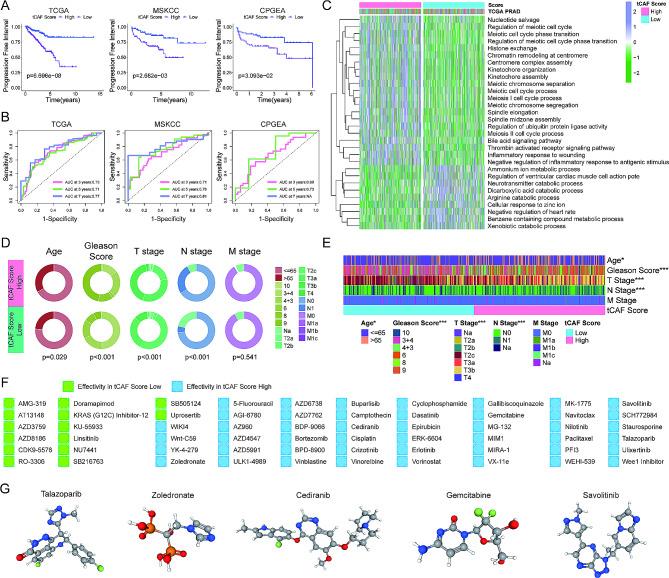
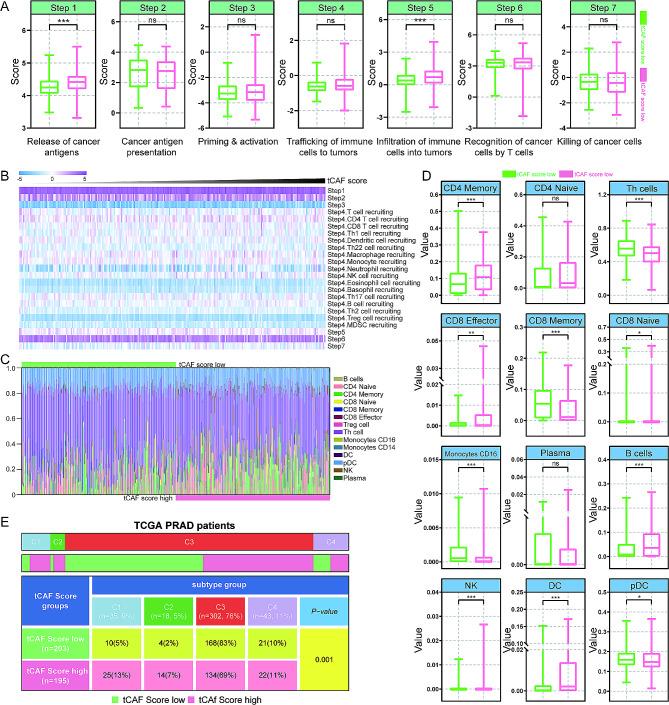
The PCa CAF-derived supernatant promoted PCa cell proliferation and invasion. Based on differentially expressed genes identified by scRNA-seq analyses, we classified CAFs into 6 molecular subtypes in PCa tumors, and each subtype was then categorized into score-high and low groups according to the subtype-specific gene expression level. Such score models in 6 CAF subtypes all predicted PFI. Telomeres were significantly shorter in high-score tumors. The total CAF score from 6 CAF subtypes was also associated with PFI in PCa patients inversely, which was consistent with results from cellular experiments. Immunosuppressive microenvironment occurred more frequently in tumors with a high CAF score, which was characterized by increased CTLA4 expression and indicated better responses to CTLA4 inhibitors. Moreover, this model can also serve as a useful PFI predictor in pan-cancers.
CONCLUSION
By combining scRNA-seq and bulk RNA-seq data analyses, we develop a CAF subtype score system as a prognostic factor for PCa and other cancer types. This model system also helps distinguish different immune-suppressive mechanisms in PCa, suggesting its implications in predicting response to immunotherapy. Thus, the present findings should contribute to personalized PCa intervention.
背景
癌症相关成纤维细胞(CAFs)一方面会促进癌症进展并导致治疗失败,另一方面也观察到它们具有抑制肿瘤的功能。最近的单细胞RNA测序(scRNA-seq)分析揭示了CAFs的异质性,并定义了CAFs的分子亚型,这有助于解释它们不同的功能。然而,这些CAF亚型在前列腺癌(PCa)或其他恶性肿瘤中是否具有相同或不同的生物学/临床意义仍不清楚。
方法
将PCa细胞与正常成纤维细胞和CAFs的上清液共同培养,以评估它们对细胞行为的影响。从TCGA、MSKCC、CPGEA和GEO数据库收集测序、基因组和临床数据。构建CAF分子亚型和总CAF评分,并根据CAF特异性基因表达将其分为低分组和高分组。比较CAF分子亚型和低/高评分组之间的无进展生存期(PFI)、临床病理特征、端粒长度、免疫细胞浸润、药物治疗和体细胞突变情况。
结果
PCa来源的CAF上清液促进了PCa细胞的增殖和侵袭。基于scRNA-seq分析鉴定出的差异表达基因,我们将PCa肿瘤中的CAFs分为6种分子亚型,然后根据亚型特异性基因表达水平将每种亚型分为高分和低分组。6种CAF亚型中的这种评分模型均能预测PFI。高分肿瘤中的端粒明显更短。6种CAF亚型的总CAF评分也与PCa患者的PFI呈负相关,这与细胞实验结果一致。在CAF评分高的肿瘤中,免疫抑制微环境更常见,其特征是CTLA4表达增加,表明对CTLA4抑制剂的反应更好。此外,该模型也可作为泛癌中有用的PFI预测指标。
结论
通过结合scRNA-seq和批量RNA-seq数据分析,我们开发了一种CAF亚型评分系统,作为PCa和其他癌症类型的预后因素。该模型系统还有助于区分PCa中不同的免疫抑制机制,提示其在预测免疫治疗反应方面的意义。因此,本研究结果应有助于PCa的个性化干预。





 Zotero 插件