
南非临床研究中移动技术的应用:审视对健康促进的挑战与影响——混合方法研究
Mobile Technology Use in Clinical Research Examining Challenges and Implications for Health Promotion in South Africa: Mixed Methods Study.
作者信息
Mabetha Khuthala, Soepnel Larske M, Mabena Gugulethu, Motlhatlhedi Molebogeng, Nyati Lukhanyo, Norris Shane A, Draper Catherine E
机构信息
South African Medical Research Council/Wits Developmental Pathways for Health Research Unit, Department of Paediatrics, Faculty of Health Sciences, School of Clinical Medicine, University of the Witwatersrand, Johannesburg, South Africa.
Julius Center for Health Sciences and Primary Care, University Medical Center, Utrecht University, Utrecht, Netherlands.
出版信息
JMIR Form Res. 2024 Apr 8;8:e48144. doi: 10.2196/48144.
BACKGROUND
The use of mobile technologies in fostering health promotion and healthy behaviors is becoming an increasingly common phenomenon in global health programs. Although mobile technologies have been effective in health promotion initiatives and follow-up research in higher-income countries and concerns have been raised within clinical practice and research in low- and middle-income settings, there is a lack of literature that has qualitatively explored the challenges that participants experience in terms of being contactable through mobile technologies.
OBJECTIVE
This study aims to explore the challenges that participants experience in terms of being contactable through mobile technologies in a trial conducted in Soweto, South Africa.
METHODS
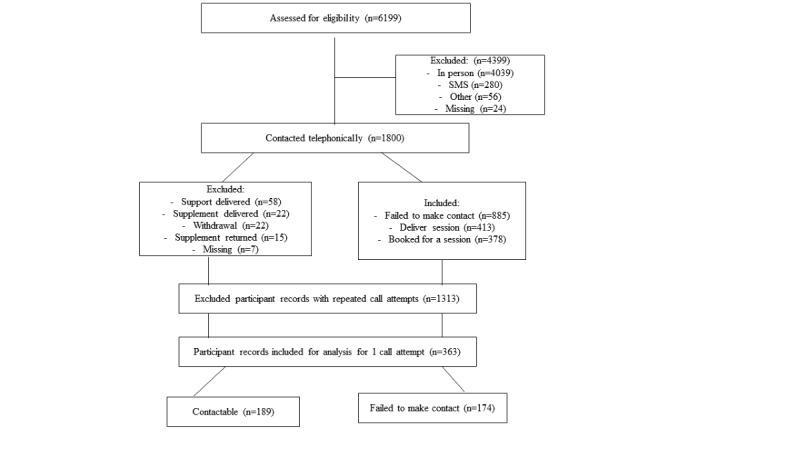
A convergent parallel mixed methods research design was used. In the quantitative phase, 363 young women in the age cohorts 18 to 28 years were contacted telephonically between August 2019 and January 2022 to have a session delivered to them or to be booked for a session. Call attempts initiated by the study team were restricted to only 1 call attempt, and participants who were reached at the first call attempt were classified as contactable (189/363, 52.1%), whereas those whom the study team failed to contact were classified as hard to reach (174/363, 47.9%). Two outcomes of interest in the quantitative phase were "contactability of the participants" and "participants' mobile number changes," and these outcomes were analyzed at a univariate and bivariate level using descriptive statistics and a 2-way contingency table. In the qualitative phase, a subsample of young women (20 who were part of the trial for ≥12 months) participated in in-depth interviews and were recruited using a convenience sampling method. A reflexive thematic analysis approach was used to analyze the data using MAXQDA software (version 20; VERBI GmbH).
RESULTS
Of the 363 trial participants, 174 (47.9%) were hard to reach telephonically, whereas approximately 189 (52.1%) were easy to reach telephonically. Most participants (133/243, 54.7%) who were contactable did not change their mobile number. The highest percentage of mobile number changes was observed among participants who were hard to reach, with three-quarters of the participants (12/16, 75%) being reported to have changed their mobile number ≥2 times. Eight themes were generated following the analysis of the transcripts, which provided an in-depth account of the reasons why some participants were hard to reach. These included mobile technical issues, coverage issues, lack of ownership of personal cell phones, and unregistered number.
CONCLUSIONS
Remote data collection remains an important tool in public health research. It could, thus, serve as a hugely beneficial mechanism in connecting with participants while actively leveraging the established relationships with participants or community-based organizations to deliver health promotion and practice.
背景
在全球卫生项目中,利用移动技术促进健康和培养健康行为正变得越来越普遍。尽管移动技术在高收入国家的健康促进倡议和后续研究中已证明有效,且在低收入和中等收入环境的临床实践和研究中也引发了关注,但缺乏定性探讨参与者在通过移动技术保持联系方面所面临挑战的文献。
目的
本研究旨在探讨在南非索韦托进行的一项试验中,参与者在通过移动技术保持联系方面所面临的挑战。
方法
采用了收敛平行混合方法研究设计。在定量阶段,2019年8月至2022年1月期间,通过电话联系了363名年龄在18至28岁之间的年轻女性,为她们提供一次课程或为她们预约一次课程。研究团队发起的呼叫尝试仅限于1次,首次呼叫成功联系到的参与者被归类为可联系(189/363,52.1%),而研究团队未能联系到的参与者被归类为难以联系(174/363,47.9%)。定量阶段关注的两个结果是“参与者的可联系性”和“参与者手机号码的变化”,并使用描述性统计和双向列联表在单变量和双变量层面分析这些结果。在定性阶段,一个年轻女性子样本(20名参与试验≥12个月的女性)参加了深入访谈,并采用便利抽样方法进行招募。使用MAXQDA软件(版本20;VERBI GmbH)采用反思性主题分析方法对数据进行分析。
结果
在363名试验参与者中,174名(47.9%)通过电话难以联系到,而约189名(52.1%)通过电话容易联系到。大多数可联系的参与者(133/243,54.7%)没有更换手机号码。在难以联系到的参与者中,手机号码更换的比例最高,据报告四分之三的参与者(12/16,75%)手机号码更换≥2次。对访谈记录进行分析后产生了八个主题,深入说明了一些参与者难以联系到的原因。这些原因包括移动技术问题、覆盖问题、缺乏个人手机所有权以及号码未注册。
结论
远程数据收集仍然是公共卫生研究中的一项重要工具。因此,它可以成为与参与者建立联系的极为有益的机制,同时积极利用与参与者或社区组织已建立的关系来开展健康促进和实践。
 Zotero 插件