
口服无刺蜂蜂蜜对链脲佐菌素诱导的糖尿病大鼠模型肝脏和肾脏的影响。
Hepatic and renal effects of oral stingless bee honey in a streptozotocin-induced diabetic rat model.
作者信息
Mohd Nasir Suriati, Ismail Anis Farihan, Tuan Ismail Tuan Salwani, Wan Abdul Rahman Wan Faiziah, Wan Ahmad Wan Amir Nizam, Tengku Din Tengku Ahmad Damitri Al-Astani, Sirajudeen Kuttulebbai Nainamohammed Salam
机构信息
Department of Chemical Pathology, School of Medical Sciences, Universiti Sains Malaysia, Kota Bharu 16150, Kelantan, Malaysia.
Endocrinology Laboratory, Department of Chemical Pathology, School of Medical Sciences, Universiti Sains Malaysia, Kota Bharu 16150, Kelantan, Malaysia.
出版信息
World J Exp Med. 2024 Mar 20;14(1):91271. doi: 10.5493/wjem.v14.i1.91271.
BACKGROUND
Diabetes is known damage the liver and kidney, leading to hepatic dysfunction and kidney failure. Honey is believed to help in lowering the blood glucose levels of diabetic patients and reducing diabetic complications. However, the effect of stingless bee honey (SBH) administration in relieving liver and kidney damage in diabetes has not been well-studied.
AIM
To investigate the effect of SBH administration on the kidney and liver of streptozotocin-induced (STZ; 55 mg/kg) diabetic Sprague Dawley rats.
METHODS
The rats were grouped as follows ( = 6 per group): non-diabetic (ND), untreated diabetic (UNT), metformin-treated (MET), and SBH+metformin-treated (SBME) groups. After successful diabetic induction, ND and UNT rats were given normal saline, whereas the treatment groups received SBH (2.0 g/kg and/or metformin (250 mg/kg) for 12 d. Serum biochemical parameters and histological changes using hematoxylin and eosin (H&E) and periodic acid-Schiff (PAS) staining were evaluated.
RESULTS
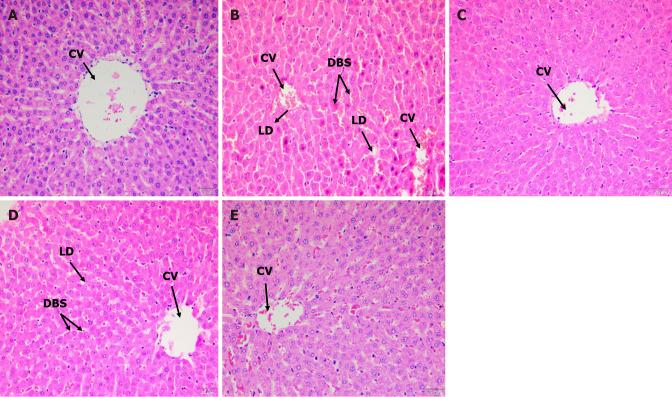
On H&E and PAS staining, the ND group showed normal architecture and cellularity of Bowman's capsule and tubules, whereas the UNT and MET groups had an increased glomerular cellularity and thickened basement membrane. The SBH-treated group showed a decrease in hydropic changes and mild cellularity of the glomerulus the ND group based on H&E staining, but the two were similar on PAS staining. Likewise, the SBME-treated group had an increase in cellularity of the glomerulus on H&E staining, but it was comparable to the SBH and ND groups on PAS staining. UNT diabetic rats had tubular hydropic tubules, which were smaller than other groups. Reduced fatty vacuole formation and dilated blood sinusoids in liver tissue were seen in the SBH group. Conversely, the UNT group had high glucose levels, which subsequently increased MDA levels, ultimately leading to liver damage. SBH treatment reduced this damage, as evidenced by having the lowest fasting glucose, serum alanine transaminase, aspartate transaminase, and alkaline phosphatase levels compared to other groups, although the levels of liver enzymes were not statistically significant.
CONCLUSION
The cellularity of the Bowman's capsule, as well as histological alteration of kidney tubules, glomerular membranes, and liver tissues in diabetic rats after oral SBH resembled those of ND rats. Therefore, SBH exhibited a protective hepatorenal effect in a diabetic rat model.
背景
糖尿病会损害肝脏和肾脏,导致肝功能障碍和肾衰竭。蜂蜜被认为有助于降低糖尿病患者的血糖水平并减少糖尿病并发症。然而,无刺蜂蜂蜜(SBH)对糖尿病患者肝肾损伤的缓解作用尚未得到充分研究。
目的
研究给予SBH对链脲佐菌素诱导(STZ;55mg/kg)的糖尿病斯普拉格-道利大鼠的肾脏和肝脏的影响。
方法
将大鼠分为以下几组(每组n = 6):非糖尿病组(ND)、未治疗糖尿病组(UNT)、二甲双胍治疗组(MET)和SBH + 二甲双胍治疗组(SBME)。成功诱导糖尿病后,ND组和UNT组大鼠给予生理盐水,而治疗组给予SBH(2.0g/kg)和/或二甲双胍(250mg/kg),持续12天。评估血清生化参数以及使用苏木精和伊红(H&E)染色和过碘酸希夫(PAS)染色的组织学变化。
结果
在H&E和PAS染色中,ND组肾小囊和肾小管的结构及细胞形态正常,而UNT组和MET组肾小球细胞增多且基底膜增厚。基于H&E染色,SBH治疗组与ND组相比,肾小球的水样变性和轻度细胞增多有所减少,但在PAS染色中两者相似。同样,基于H&E染色,SBME治疗组肾小球细胞增多,但在PAS染色中与SBH组和ND组相当。UNT糖尿病大鼠肾小管有肾小管水样变性,且比其他组小。SBH组肝脏组织中脂肪空泡形成减少,血窦扩张。相反,UNT组血糖水平高,随后丙二醛水平升高,最终导致肝损伤。与其他组相比,SBH治疗降低了这种损伤,这通过其空腹血糖、血清丙氨酸转氨酶、天冬氨酸转氨酶和碱性磷酸酶水平最低得到证明,尽管肝酶水平无统计学意义。
结论
口服SBH后,糖尿病大鼠的肾小囊细胞以及肾小管、肾小球膜和肝脏组织的组织学改变与ND大鼠相似。因此,SBH在糖尿病大鼠模型中表现出肝肾保护作用。


 Zotero 插件