
北非和中东地区神经疾病负担,1990-2019 年:2019 年全球疾病负担研究的系统分析。
The burden of neurological conditions in north Africa and the Middle East, 1990-2019: a systematic analysis of the Global Burden of Disease Study 2019.
出版信息
Lancet Glob Health. 2024 Jun;12(6):e960-e982. doi: 10.1016/S2214-109X(24)00093-7. Epub 2024 Apr 8.
BACKGROUND
The burden of neurological conditions in north Africa and the Middle East is increasing. We aimed to assess the changes in the burden of neurological conditions in this super-region to aid with future decision making.
METHODS
In this analysis of the Global Burden of Diseases, Injuries, and Risk Factors Study 2019 data, we examined temporal trends of disability-adjusted life-years (DALYs; deaths and disabilities combined), deaths, incident cases, and prevalent cases of 14 major neurological conditions and eight subtypes in 21 countries in the north Africa and the Middle East super-region. Additionally, we assessed neurological DALYs due to 22 potentially modifiable risk factors, within four levels of classification, during the period 1990-2019. We used a Bayesian modelling estimation approach, and generated 95% uncertainty intervals (UIs) for final estimates on the basis of the 2·5th and 97·5th percentiles of 1000 draws from the posterior distribution.
FINDINGS
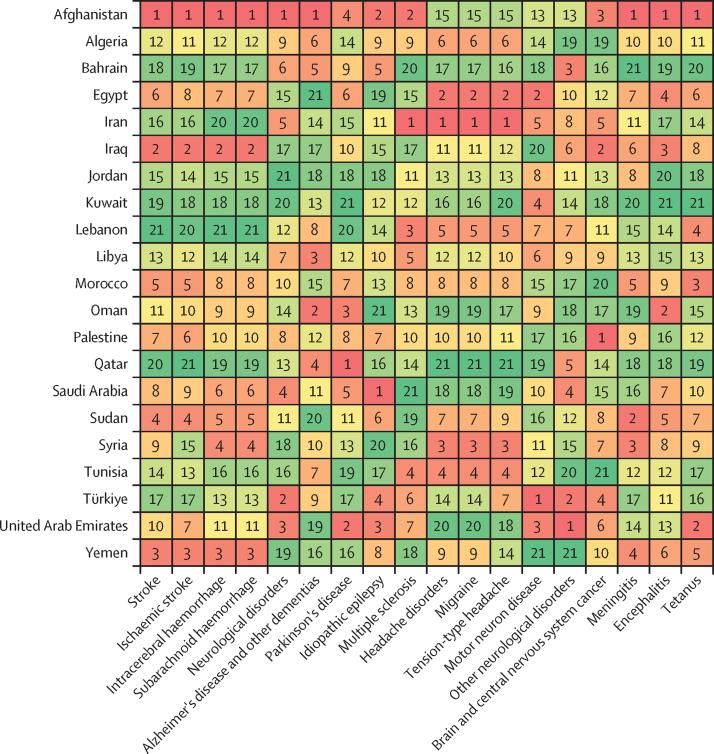
In 2019, there were 441·1 thousand (95% UI 347·2-598·4) deaths and 17·6 million (12·5-24·7) neurological DALYs in north Africa and the Middle East. The leading causes of neurological DALYs were stroke, migraine, and Alzheimer's disease and other dementias (hereafter dementias). In north Africa and the Middle East in 2019, 85·8% (82·6-89·1) of stroke and 39·9% (26·4-54·7) of dementia age-standardised DALYs were attributable to modifiable risk factors. North Africa and the Middle East had the highest age-standardised DALY rates per 100 000 population due to dementia (387·0 [172·0-848·5]), Parkinson's disease (84·4 [74·7-103·2]), and migraine (601·4 [107·0-1371·8]) among the global super-regions. Between 1990 and 2019, there was a decrease in the age-standardised DALY rates related to meningitis (-75·8% [-81·1 to -69·5]), tetanus (-88·2% [-93·9 to -76·1]), stroke (-32·0% [-39·1 to -23·3]), intracerebral haemorrhage (-51·7% [-58·2 to -43·8]), idiopathic epilepsy (-26·2% [-43·6 to -1·1]), and subarachnoid haemorrhage (-62·8% [-71·6 to -41·0]), but for all other neurological conditions there was no change. During 1990-2019, the number of DALYs due to dementias, Parkinson's disease, multiple sclerosis, ischaemic stroke, and headache disorder (ie, migraine and tension-type headache) more than doubled in the super-region, and the burden of years lived with disability (YLDs), incidence, and prevalence of multiple sclerosis, motor neuron disease, Parkinson's disease, and ischaemic stroke increased both in age-standardised rate and count. During this period, the absolute burden of YLDs due to head and spinal injuries almost doubled.
INTERPRETATION
The increasing burden of neurological conditions in north Africa and the Middle East accompanies the increasing ageing population. Stroke and dementia are the primary causes of neurological disability and death, primarily attributable to common modifiable risk factors. Synergistic, systematic, lifetime, and multi-sectoral interventions aimed at preventing or mitigating the burden are needed.
FUNDING
Bill & Melinda Gates Foundation.
TRANSLATIONS
For the Persian, Arabic and Turkish translations of the abstract see Supplementary Materials section.
背景
北非和中东地区的神经疾病负担正在增加。我们旨在评估该超区域神经疾病负担的变化情况,以帮助未来的决策制定。
方法
在这项 2019 年全球疾病、伤害和风险因素研究的分析中,我们考察了 21 个北非和中东国家的 14 种主要神经疾病和 8 种亚型的残疾调整生命年(DALY;死亡和残疾综合)、死亡、发病和现患病例的时间趋势。此外,我们评估了 1990 年至 2019 年期间 22 种潜在可改变风险因素在四个分类水平上对神经疾病的影响。我们使用贝叶斯建模估计方法,根据 1000 次后分布的 2.5 分位值和 97.5 分位值生成最终估计值的 95%不确定性区间(UI)。
结果
2019 年,北非和中东地区有 44.1 万(95%UI 34.7-59.8)人死亡和 1760 万(1250-2470)个神经疾病 DALY。神经疾病 DALY 的主要原因是中风、偏头痛和阿尔茨海默病和其他痴呆症(以下简称痴呆症)。2019 年,在北非和中东地区,85.8%(82.6-89.1)的中风和 39.9%(26.4-54.7)的痴呆症年龄标准化 DALY 归因于可改变的风险因素。北非和中东地区的痴呆症(387.0[172.0-848.5])、帕金森病(84.4[74.7-103.2])和偏头痛(601.4[107.0-1371.8])的年龄标准化 DALY 率居全球超地区之首。1990 年至 2019 年,脑膜炎(-75.8%[-81.1 至-69.5])、破伤风(-88.2%[-93.9 至-76.1])、中风(-32.0%[-39.1 至-23.3])、颅内出血(-51.7%[-58.2 至-43.8])、特发性癫痫(-26.2%[-43.6 至-1.1])和蛛网膜下腔出血(-62.8%[-71.6 至-41.0])相关的年龄标准化 DALY 率下降,但其他所有神经疾病均无变化。1990-2019 年期间,痴呆症、帕金森病、多发性硬化症、缺血性中风和头痛障碍(即偏头痛和紧张性头痛)所致的 DALY 数在该超地区增加了一倍以上,多发性硬化症、运动神经元疾病、帕金森病和缺血性中风的残疾年限(YLDs)、发病和流行率均增加,无论是年龄标准化率还是计数。在此期间,头部和脊柱损伤所致 YLDs 的绝对负担几乎增加了一倍。
结论
北非和中东地区神经疾病负担的增加伴随着人口老龄化的增加。中风和痴呆症是神经残疾和死亡的主要原因,主要归因于常见的可改变的风险因素。需要采取协同、系统、终身和多部门的干预措施,以预防或减轻负担。
资助
比尔及梅琳达·盖茨基金会。



 Zotero 插件