
用于研究宿主-肠道微生物组相互作用的以宿主为中心的分子工具的最新进展。
Recent advances in host-focused molecular tools for investigating host-gut microbiome interactions.
作者信息
Wang Siyao, Gong Xu, Xiao Fei, Yang Yun
机构信息
Key Laboratory for Biomechanics and Mechanobiology of Ministry of Education, Beijing Advanced Innovation Centre for Biomedical Engineering, School of Engineering Medicine, Beihang University, Beijing, China.
Key Laboratory of Big Data-Based Precision Medicine, Ministry of Industry and Information Technology, Beihang University, Beijing, China.
出版信息
Front Microbiol. 2024 Mar 28;15:1335036. doi: 10.3389/fmicb.2024.1335036. eCollection 2024.
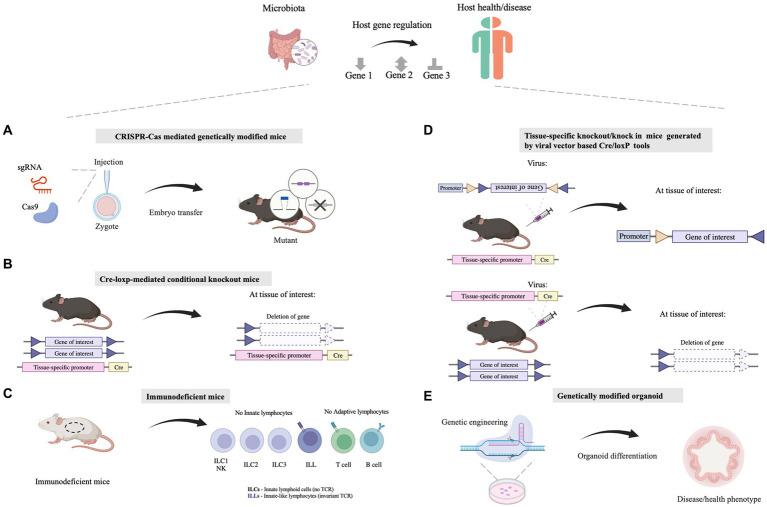
Microbial communities in the human gut play a significant role in regulating host gene expression, influencing a variety of biological processes. To understand the molecular mechanisms underlying host-microbe interactions, tools that can dissect signaling networks are required. In this review, we discuss recent advances in molecular tools used to study this interplay, with a focus on those that explore how the microbiome regulates host gene expression. These tools include CRISPR-based whole-body genetic tools for deciphering host-specific genes involved in the interaction process, Cre- based tissue/cell-specific gene editing approaches, and models of host-derived organoids. Overall, the application of these molecular tools is revolutionizing our understanding of how host-microbiome interactions contribute to health and disease, paving the way for improved therapies and interventions that target microbial influences on the host.
人类肠道中的微生物群落对调节宿主基因表达起着重要作用,影响着多种生物学过程。为了理解宿主与微生物相互作用的分子机制,需要能够剖析信号网络的工具。在这篇综述中,我们讨论了用于研究这种相互作用的分子工具的最新进展,重点关注那些探索微生物群如何调节宿主基因表达的工具。这些工具包括用于破译参与相互作用过程的宿主特异性基因的基于CRISPR的全身遗传工具、基于Cre的组织/细胞特异性基因编辑方法以及宿主来源类器官模型。总体而言,这些分子工具的应用正在彻底改变我们对宿主-微生物群相互作用如何影响健康和疾病的理解,为针对微生物对宿主影响的改进疗法和干预措施铺平了道路。

 Zotero 插件