
国家基因组流行病学调查揭示了耐碳青霉烯类大肠杆菌在健康人群中的传播及其对公共卫生的影响。
National genomic epidemiology investigation revealed the spread of carbapenem-resistant Escherichia coli in healthy populations and the impact on public health.
机构信息
Jiangsu Co-Innovation Center for Prevention and Control of Important Animal Infectious Diseases and Zoonoses, College of Veterinary Medicine, Yangzhou University, 48 East Wenhui Road, Yangzhou, Jiangsu, 225009, P. R. China.
Department of Clinical Laboratory, Second Affiliated Hospital of Zhejiang University, School of Medicine, Hangzhou, Zhejiang, P. R. China.
出版信息
Genome Med. 2024 Apr 16;16(1):57. doi: 10.1186/s13073-024-01310-x.
BACKGROUND
Carbapenem-resistant Escherichia coli (CREC) has been considered as WHO priority pathogens, causing a great public health concern globally. While CREC from patients has been thoroughly investigated, the prevalence and underlying risks of CREC in healthy populations have been overlooked. Systematic research on the prevalence of CREC in healthy individuals was conducted here. We aimed to characterize CREC collected from healthy populations in China between 2020 and 2022 and to compare the genomes of CREC isolates isolated from healthy individuals and clinical patients.
METHODS
We present a nationwide investigation of CREC isolates among healthy populations in China, employing robust molecular and genomic analyses. Antimicrobial susceptibility testing, whole-genome sequencing, and bioinformatics were utilized to analyze a cohort of CREC isolates (n = 113) obtained from fecal samples of 5 064 healthy individuals. Representative plasmids were extracted for third-generation nanopore sequencing. We previously collected 113 non-duplicate CREC isolates (59 in 2018, 54 in 2020) collected from ICU patients in 15 provinces and municipalities in China, and these clinical isolates were used to compare with the isolates in this study. Furthermore, we employ comparative genomics approaches to elucidate molecular variations and potential correlations between clinical and non-clinical CREC isolates.
RESULTS
A total of 147 CREC isolates were identified from 5 064 samples collected across 11 provinces in China. These isolates were classified into 64 known sequence types (STs), but no dominant STs were observed. In total, seven carbapenemase genes were detected with bla (n = 116) being the most prevalent one. Genetic environments and plasmid backbones of bla were conserved in CREC isolated from healthy individuals. Furthermore, we compared clinical and healthy human-originated CRECs, revealing noteworthy distinctions in 23 resistance genes, including bla, bla, and bla (χ test, p < 0.05). Clinical isolates contained more virulence factors associated with iron uptake, adhesion, and invasion than those obtained from healthy individuals. Notably, CREC isolates generally found healthy people are detected in hospitalized patients.
CONCLUSIONS
Our findings underscore the significance of healthy populations-derived CRECs as a crucial reservoir of antibiotic resistance genes (ARGs). This highlights the need for ongoing monitoring of CREC isolates in healthy populations to accurately assess the potential risks posed by clinical CREC isolates.
背景
耐碳青霉烯类大肠杆菌(CREC)已被世界卫生组织列为优先病原体,在全球范围内引起了极大的公共卫生关注。虽然已经对患者来源的 CREC 进行了彻底的研究,但健康人群中 CREC 的流行率和潜在风险却被忽视了。本研究旨在对 2020 年至 2022 年期间中国健康人群中 CREC 的流行率进行系统研究,并比较从健康个体和临床患者中分离出的 CREC 分离株的基因组。
方法
我们对中国健康人群中 CREC 分离株进行了全国性调查,采用了强大的分子和基因组分析方法。对来自 5064 名健康个体粪便样本的 CREC 分离株(n=113)进行了药敏试验、全基因组测序和生物信息学分析。提取代表性质粒进行第三代纳米孔测序。我们之前从中国 15 个省和直辖市的 ICU 患者中收集了 113 株非重复的 CREC 分离株(2018 年 59 株,2020 年 54 株),并将这些临床分离株与本研究中的分离株进行了比较。此外,我们还采用比较基因组学方法阐明了临床和非临床 CREC 分离株之间的分子变异和潜在相关性。
结果
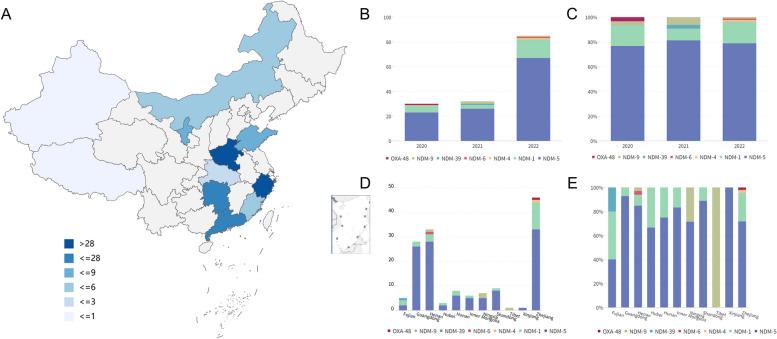
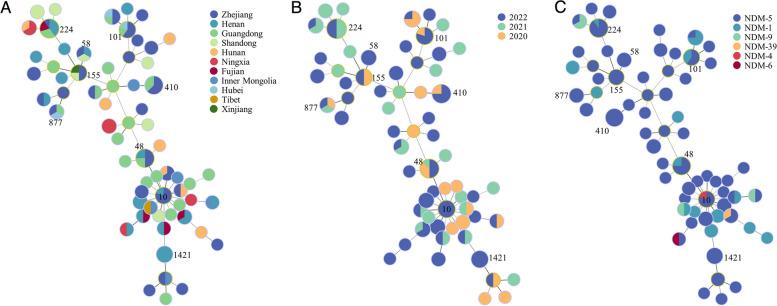
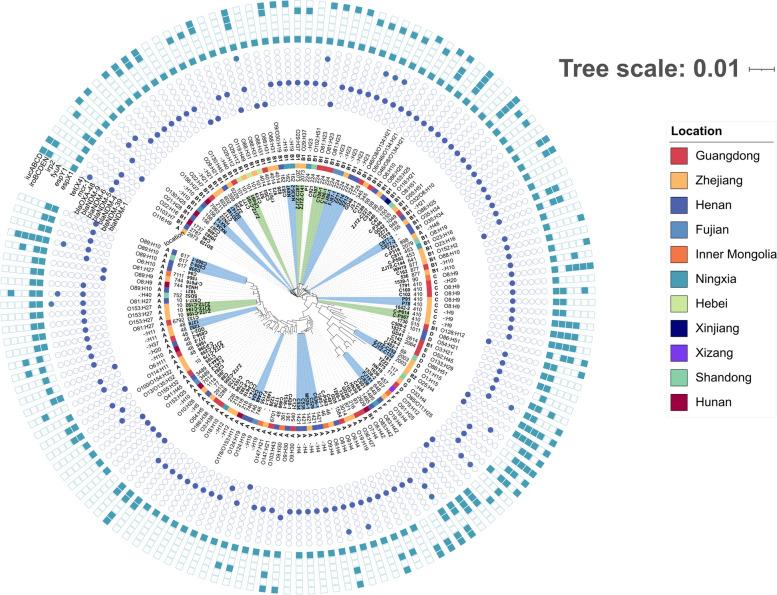
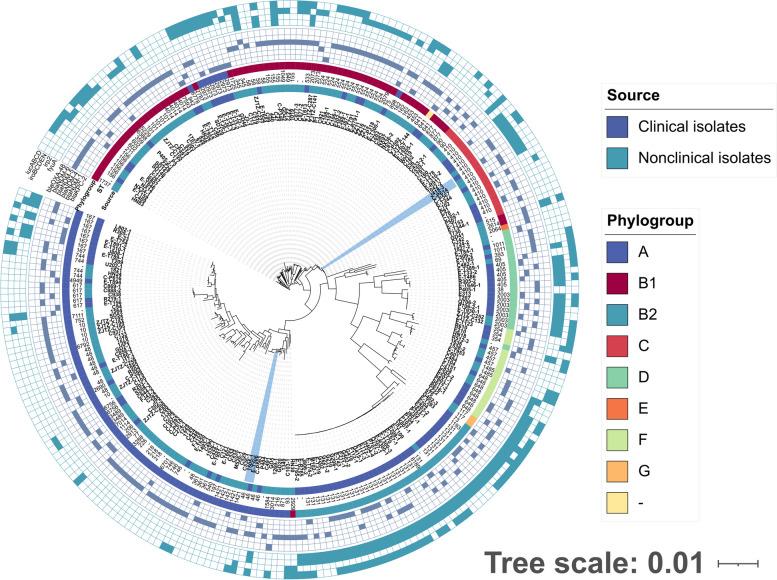
从中国 11 个省份的 5064 个样本中共鉴定出 147 株 CREC 分离株。这些分离株被分为 64 个已知的序列型(STs),但没有观察到优势 STs。共检测到 7 种碳青霉烯酶基因,其中 bla(n=116)最为常见。在健康个体中分离出的 CREC 中,bla 的遗传环境和质粒骨架是保守的。此外,我们比较了临床和健康人群来源的 CREC,发现 23 种耐药基因(包括 bla、bla 和 bla)存在显著差异(χ检验,p<0.05)。临床分离株比从健康个体中分离出的 CREC 含有更多与铁摄取、粘附和侵袭相关的毒力因子。值得注意的是,一般在住院患者中检测到的 CREC 分离株也存在于健康人群中。
结论
我们的研究结果强调了健康人群来源的 CREC 作为抗生素耐药基因(ARGs)重要储存库的重要性。这表明需要对健康人群中的 CREC 分离株进行持续监测,以准确评估临床 CREC 分离株带来的潜在风险。

 Zotero 插件