
美国中年成年人氧化平衡评分与低肌肉量之间的关联。
Association between the oxidative balance score and low muscle mass in middle-aged US adults.
作者信息
Chen Kun, Yin Qiang, Guan Jiangan, Yang Jingwen, Ma Yuan, Hu Yu, Chen Chan, Chen Wenwen
机构信息
Department of Thoracic Surgery, The First Affiliated Hospital of Wenzhou Medical University, Wenzhou Medical University, Wenzhou, China.
Department of Geriatric Medicine, The First Affiliated Hospital of Wenzhou Medical University, Wenzhou Medical University, Wenzhou, China.
出版信息
Front Nutr. 2024 Apr 5;11:1358231. doi: 10.3389/fnut.2024.1358231. eCollection 2024.
BACKGROUND
Oxidative Balance Score (OBS) is a tool for assessing the oxidative stress-related exposures of diet and lifestyle. The study aimed to investigate the association between OBS and low muscle mass.
METHODS
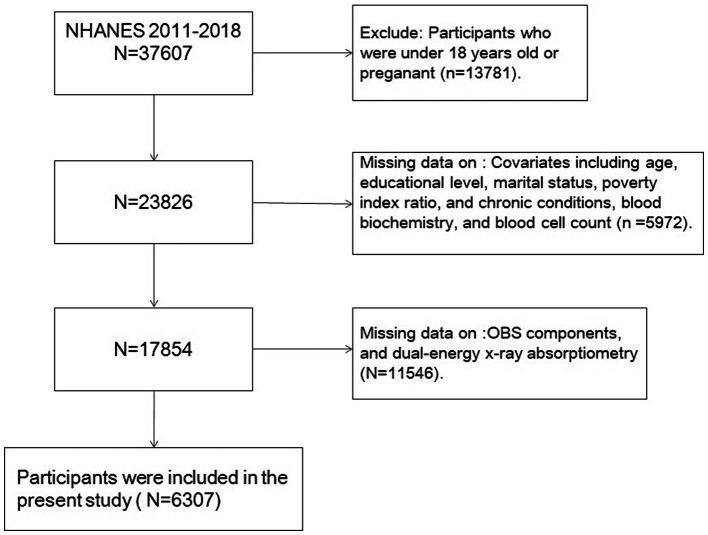
Overall, 6,307 individuals over the age of 18 were assessed using data from the 2011 to 2018 National Health and Nutrition Examination Survey (NHANES). Weighted logistic regression and models were used, together with adjusted models.
RESULTS
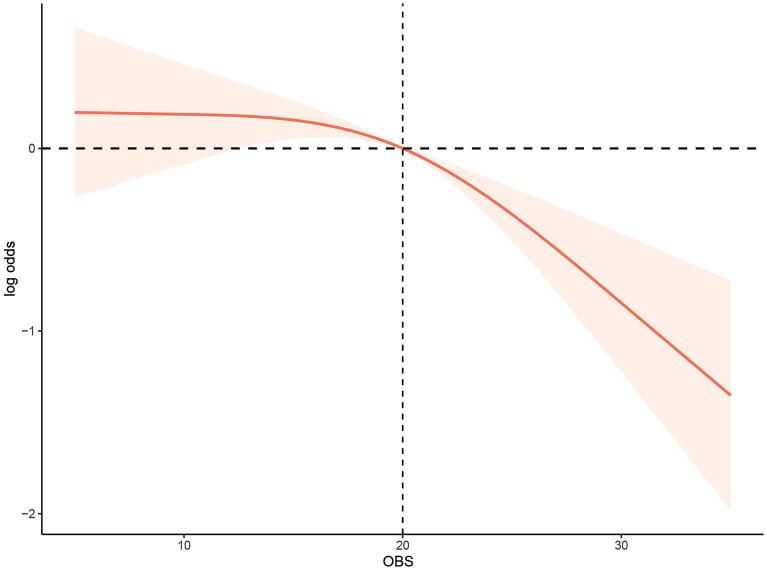
There was a negative relationship between OBS and low muscle mass [odds ratio (OR): 0.96, 95% confidence interval (CI): 0.94-0.97, 0.0001] using the first OBS level as reference. The values (all 95% CI) were 0.745 (0.527-1.054) for the second level, 0.650 (0.456-0.927) for the third level, and 0.326 (0.206-0.514) for the fourth level (P for trend <0.0001). Independent links with low muscle mass were found for diet and lifestyle factors. A restricted cubic spline model indicated a non-linear association between OBS and low muscle mass risk (P for non-linearity<0.05). In addition, the inflection points of the nonlinear curves for the relationship between OBS and risk of low muscle mass were 20.
CONCLUSION
OBS and low muscle mass were found to be significantly negatively correlated. By modulating oxidative balance, a healthy lifestyle and antioxidant rich diet could be a preventive strategy for low muscle mass.
背景
氧化平衡评分(OBS)是一种用于评估饮食和生活方式中与氧化应激相关暴露的工具。本研究旨在调查氧化平衡评分与低肌肉量之间的关联。
方法
总体而言,使用2011年至2018年国家健康与营养检查调查(NHANES)的数据对6307名18岁以上的个体进行了评估。使用了加权逻辑回归和模型以及调整后的模型。
结果
以第一个OBS水平为参照,OBS与低肌肉量之间存在负相关关系[比值比(OR):0.96,95%置信区间(CI):0.94 - 0.97,P < 0.0001]。第二个水平的值(所有95%CI)为0.745(0.527 - 1.054),第三个水平为0.650(0.456 - 0.927),第四个水平为0.326(0.206 - 0.514)(趋势P < 0.0001)。发现饮食和生活方式因素与低肌肉量存在独立关联。受限立方样条模型表明OBS与低肌肉量风险之间存在非线性关联(非线性P < 0.05)。此外,OBS与低肌肉量风险关系的非线性曲线的拐点为20。
结论
发现OBS与低肌肉量显著负相关。通过调节氧化平衡,健康的生活方式和富含抗氧化剂的饮食可能是预防低肌肉量的一种策略。
 Zotero 插件