
通过单细胞测序分析探讨 PDGFD 在骨肉瘤转移中的作用。
Exploring the impact of PDGFD in osteosarcoma metastasis through single-cell sequencing analysis.
机构信息
Department of Oncology, Shanghai Sixth People's Hospital, Shanghai Jiaotong University School of Medicine, Shanghai, China.
State Key Laboratory of Systems Medicine for Cancer, Shanghai Cancer Institute, Shanghai Jiaotong University School of Medicine, Shanghai, China.
出版信息
Cell Oncol (Dordr). 2024 Oct;47(5):1715-1733. doi: 10.1007/s13402-024-00949-3. Epub 2024 Apr 23.
PURPOSE
The overall survival rate for metastatic osteosarcoma hovers around 20%. Responses to second-line chemotherapy, targeted therapies, and immunotherapies have demonstrated limited efficacy in metastatic osteosarcoma. Our objective is to validate differentially expressed genes and signaling pathways between non-metastatic and metastatic osteosarcoma, employing single-cell RNA sequencing (scRNA-seq) and additional functional investigations. We aim to enhance comprehension of metastatic mechanisms and potentially unveil a therapeutic target.
METHODS
scRNA-seq was performed on two primary osteosarcoma lesions (1 non-metastatic and 1 metastatic). Seurat package facilitated dimensionality reduction and cluster identification. Copy number variation (CNV) was predicted using InferCNV. CellChat characterized ligand-receptor-based intercellular communication networks. Differentially expressed genes underwent GO function enrichment analysis and GSEA. Validation was achieved through the GSE152048 dataset, which identified PDGFD-PDGFRB as a common ligand-receptor pair with significant contribution. Immunohistochemistry assessed PDGFD and PDGFRB expression, while multicolor immunofluorescence and flow cytometry provided insight into spatial relationships and the tumor immune microenvironment. Kaplan-Meier survival analysis compared metastasis-free survival and overall survival between high and low levels of PDGFD and PDGFRB. Manipulation of PDGFD expression in primary osteosarcoma cells examined invasion abilities and related markers.
RESULTS
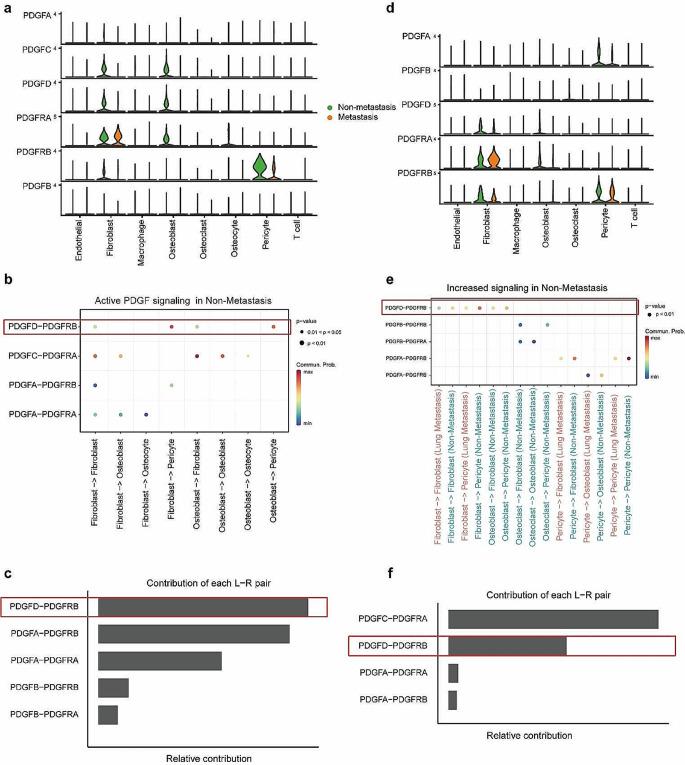
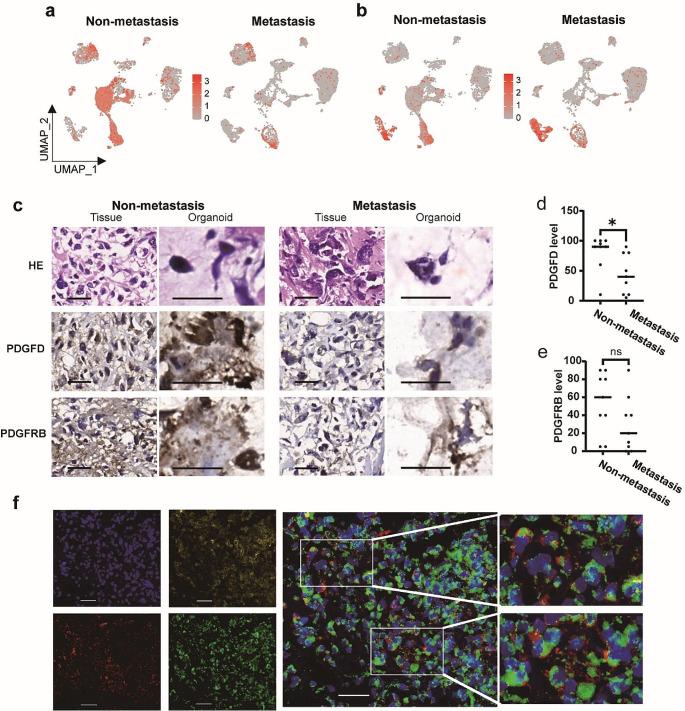
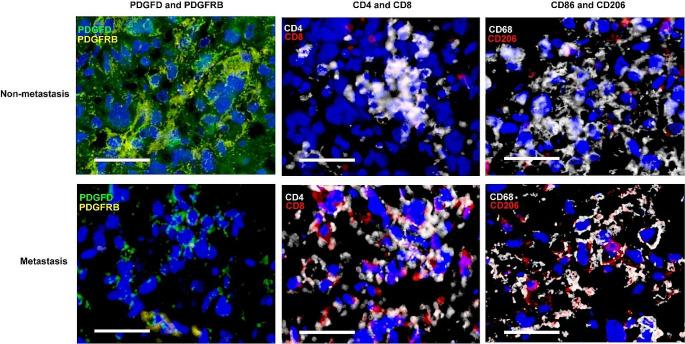
Ten clusters encompassing osteoblasts, osteoclasts, osteocytes, fibroblasts, pericytes, endothelial cells, myeloid cells, T cells, B cells, and proliferating cells were identified. Osteoblasts, osteoclasts, and osteocytes exhibited heightened CNV levels. Ligand-receptor-based communication networks exposed significant fibroblast crosstalk with other cell types, and the PDGF signaling pathway was activated in non-metastatic osteosarcoma primary lesion. These results were corroborated by the GSE152048 dataset, confirming the prominence of PDGFD-PDGFRB as a common ligand-receptor pair. Immunohistochemistry demonstrated considerably greater PDGFD expression in non-metastatic osteosarcoma tissues and organoids, correlating with extended metastasis-free and overall survival. PDGFRB expression showed no significant variation between non-metastatic and metastatic osteosarcoma, nor strong correlations with survival times. Multicolor immunofluorescence suggested co-localization of PDGFD with PDGFRB. Flow cytometry unveiled a highly immunosuppressive microenvironment in metastatic osteosarcoma. Manipulating PDGFD expression demonstrated altered invasive abilities and marker expressions in primary osteosarcoma cells from both non-metastatic and metastatic lesions.
CONCLUSIONS
scRNA-seq illuminated the activation of the PDGF signaling pathway in primary lesion of non-metastatic osteosarcoma. PDGFD displayed an inhibitory effect on osteosarcoma metastasis, likely through the suppression of the EMT signaling pathway.
目的
转移性骨肉瘤的总生存率约为 20%。二线化疗、靶向治疗和免疫治疗对转移性骨肉瘤的疗效有限。我们的目的是通过单细胞 RNA 测序 (scRNA-seq) 和其他功能研究,验证非转移性和转移性骨肉瘤之间差异表达的基因和信号通路。我们旨在增强对转移机制的理解,并可能揭示治疗靶点。
方法
对两个原发性骨肉瘤病变(1 个非转移性和 1 个转移性)进行 scRNA-seq。Seurat 包促进了维度降低和聚类识别。使用 InferCNV 预测拷贝数变异 (CNV)。CellChat 描述了基于配体-受体的细胞间通讯网络。差异表达基因进行了 GO 功能富集分析和 GSEA。通过 GSE152048 数据集进行验证,该数据集确定了 PDGFD-PDGFRB 作为具有重要贡献的常见配体-受体对。免疫组织化学评估了 PDGFD 和 PDGFRB 的表达,而多色免疫荧光和流式细胞术提供了对空间关系和肿瘤免疫微环境的深入了解。Kaplan-Meier 生存分析比较了 PDGFD 和 PDGFRB 高表达和低表达患者的无转移生存和总生存情况。在原发性骨肉瘤细胞中操纵 PDGFD 表达,研究了侵袭能力和相关标志物。
结果
确定了包含成骨细胞、破骨细胞、骨细胞、成纤维细胞、周细胞、内皮细胞、髓细胞、T 细胞、B 细胞和增殖细胞的 10 个簇。成骨细胞、破骨细胞和骨细胞表现出较高的 CNV 水平。基于配体-受体的通讯网络揭示了成纤维细胞与其他细胞类型的显著串扰,非转移性骨肉瘤原发病灶中 PDGF 信号通路被激活。GSE152048 数据集的结果证实了 PDGFD-PDGFRB 作为常见配体-受体对的重要性。免疫组织化学显示,非转移性骨肉瘤组织和类器官中 PDGFD 的表达明显增加,与无转移生存和总生存时间延长相关。PDGFRB 表达在非转移性和转移性骨肉瘤之间没有显著差异,与生存时间也没有很强的相关性。多色免疫荧光提示 PDGFD 与 PDGFRB 共定位。流式细胞术揭示了转移性骨肉瘤中高度免疫抑制的微环境。操纵 PDGFD 表达可改变原发性骨肉瘤细胞的侵袭能力和标志物表达,无论其源自非转移性还是转移性病变。
结论
scRNA-seq 揭示了非转移性骨肉瘤原发病灶中 PDGF 信号通路的激活。PDGFD 对骨肉瘤转移具有抑制作用,可能通过抑制 EMT 信号通路。




 Zotero 插件