
智能载小檗碱红细胞减轻巨噬细胞中炎性细胞因子的产生。
Intelligent berberine-loaded erythrocytes attenuated inflammatory cytokine productions in macrophages.
作者信息
Aghili Zahra Sadat, Magnani Mauro, Ghatrehsamani Mehdi, Nourian Dehkordi Azar, Mirzaei Seyed Abbas, Banitalebi Dehkordi Mehdi
机构信息
Department of Molecular Medicine, School of Advanced Technologies, Shahrekord University of Medical Sciences, Shahrekord, Iran.
Department of Biomolecular Sciences, University of Urbino Carlo Bo, Via Saffi 2, 61029, Urbino, PU, Italy.
出版信息
Sci Rep. 2024 Apr 23;14(1):9381. doi: 10.1038/s41598-024-60103-9.
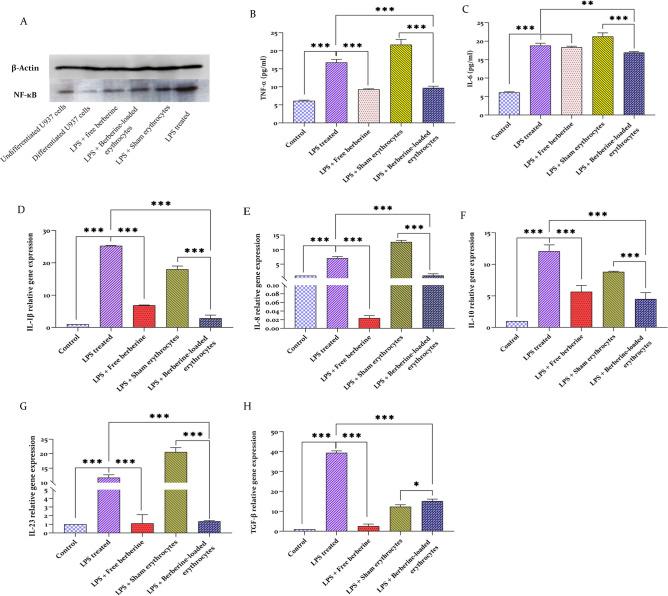
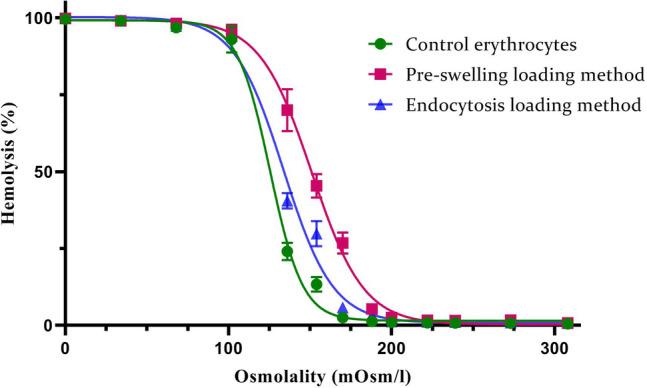
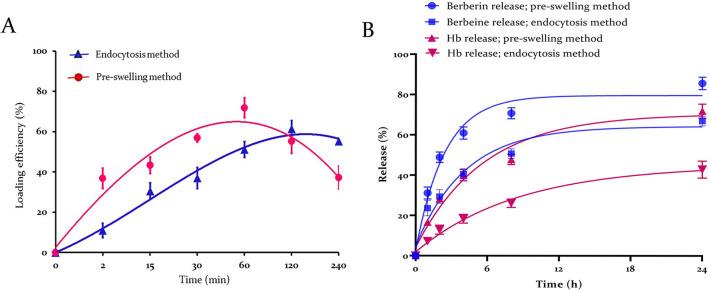
Erythrocytes are impressive tools for drug delivery, especially to macrophages. Therefore, berberine was loaded into erythrocytes using both hypotonic pre-swelling and endocytosis methods to target macrophages. Physicochemical and kinetic parameters of the resulting carrier cells, such as drug loading/release kinetics, osmotic fragility, and hematological indices, were determined. Drug loading was optimized for the study using Taguchi experimental design and lab experiments. Loaded erythrocytes were targeted to macrophages using ZnCl and bis-sulfosuccinimidyl-suberate, and targeting was evaluated using flow cytometry and Wright-Giemsa staining. Differentiated macrophages were stimulated with lipopolysaccharide, and the inflammatory profiles of macrophages were evaluated using ELISA, western blotting, and real-time PCR. Findings indicated that the endocytosis method is preferred due to its low impact on the erythrocyte's structural integrity. Maximum loading achieved (1386.68 ± 22.43 μg/ml) at 1500 μg/ml berberine treatment at 37 °C for 2 h. Berberine successfully inhibited NF-κB translation in macrophages, and inflammatory response markers such as IL-1β, IL-8, IL-23, and TNF-α were decreased by approximately ninefold, sixfold, twofold, eightfold, and twofold, respectively, compared to the LPS-treated macrophages. It was concluded that berberine-loaded erythrocytes can effectively target macrophages and modulate the inflammatory response.
红细胞是用于药物递送的有效工具,尤其是对于巨噬细胞。因此,使用低渗预肿胀和内吞作用方法将黄连素载入红细胞以靶向巨噬细胞。测定了所得载体细胞的物理化学和动力学参数,如药物载入/释放动力学、渗透脆性和血液学指标。利用田口实验设计和实验室实验对该研究的药物载入进行了优化。使用ZnCl和双磺基琥珀酰亚胺辛二酸酯将载入药物的红细胞靶向巨噬细胞,并通过流式细胞术和瑞氏-吉姆萨染色评估靶向效果。用脂多糖刺激分化的巨噬细胞,并使用酶联免疫吸附测定(ELISA)、蛋白质免疫印迹法和实时聚合酶链反应(PCR)评估巨噬细胞的炎症特征。研究结果表明,内吞作用方法更可取,因为它对红细胞结构完整性的影响较小。在37℃下用1500μg/ml黄连素处理2小时,最大载入量达到(1386.68±22.43μg/ml)。黄连素成功抑制了巨噬细胞中核因子κB(NF-κB)的翻译,与经脂多糖处理的巨噬细胞相比,白细胞介素-1β(IL-1β)、白细胞介素-8(IL-8)、白细胞介素-23(IL-23)和肿瘤坏死因子-α(TNF-α)等炎症反应标志物分别下降了约9倍、6倍、2倍、8倍和2倍。得出的结论是,载入黄连素的红细胞可以有效地靶向巨噬细胞并调节炎症反应。


 Zotero 插件