
生物杂交磁性机器人:从生物工程到靶向治疗。
Bio-Hybrid Magnetic Robots: From Bioengineering to Targeted Therapy.
作者信息
Zhang Qian, Zeng Yun, Zhao Yang, Peng Xuqi, Ren En, Liu Gang
机构信息
Institute of Artificial Intelligence, Xiamen University, Xiamen 361005, China.
State Key Laboratory of Vaccines for Infectious Diseases, Center for Molecular Imaging and Translational Medicine, Xiang An Biomedicine Laboratory, School of Public Health, Xiamen University, Xiamen 361005, China.
出版信息
Bioengineering (Basel). 2024 Mar 26;11(4):311. doi: 10.3390/bioengineering11040311.
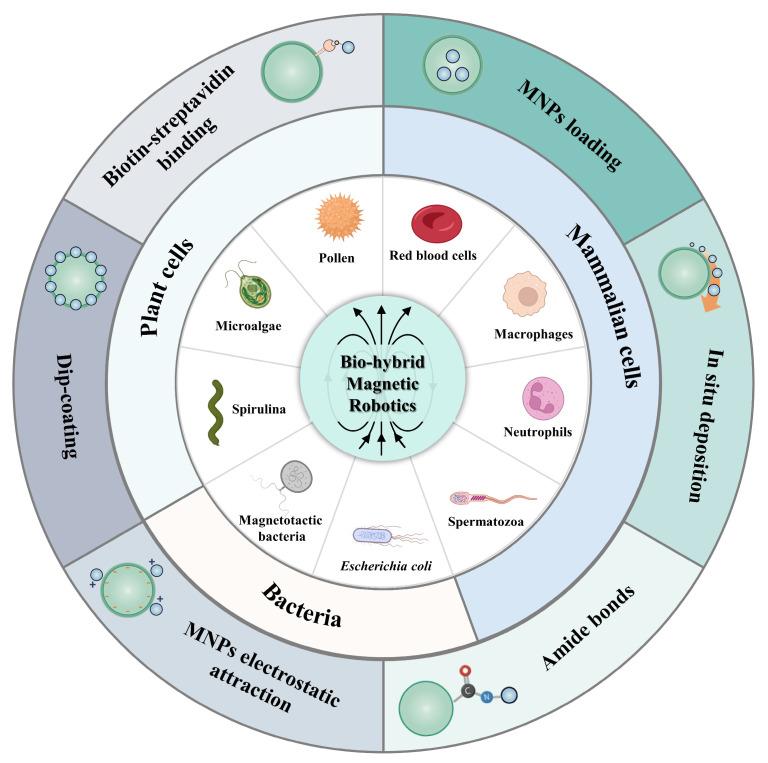
Magnetic robots possess an innate ability to navigate through hard-to-reach cavities in the human body, making them promising tools for diagnosing and treating diseases minimally invasively. Despite significant advances, the development of robots with desirable locomotion and full biocompatibility under harsh physiological conditions remains challenging, which put forward new requirements for magnetic robots' design and material synthesis. Compared to robots that are synthesized with inorganic materials, natural organisms like cells, bacteria or other microalgae exhibit ideal properties for in vivo applications, such as biocompatibility, deformability, auto-fluorescence, and self-propulsion, as well as easy for functional therapeutics engineering. In the process, these organisms can provide autonomous propulsion in biological fluids or external magnetic fields, while retaining their functionalities with integrating artificial robots, thus aiding targeted therapeutic delivery. This kind of robotics is named bio-hybrid magnetic robotics, and in this mini-review, recent progress including their design, engineering and potential for therapeutics delivery will be discussed. Additionally, the historical context and prominent examples will be introduced, and the complexities, potential pitfalls, and opportunities associated with bio-hybrid magnetic robotics will be discussed.
磁性机器人具有在人体难以触及的腔体内导航的固有能力,使其成为微创诊断和治疗疾病的有前途的工具。尽管取得了重大进展,但在苛刻的生理条件下开发具有理想运动能力和完全生物相容性的机器人仍然具有挑战性,这对磁性机器人的设计和材料合成提出了新的要求。与由无机材料合成的机器人相比,细胞、细菌或其他微藻等天然生物体在体内应用中表现出理想的特性,如生物相容性、可变形性、自发荧光和自我推进能力,并且易于进行功能治疗工程。在此过程中,这些生物体可以在生物流体或外部磁场中提供自主推进力,同时通过与人工机器人集成来保留其功能,从而有助于靶向治疗递送。这种机器人被称为生物杂交磁性机器人,在本综述中,将讨论其包括设计、工程和治疗递送潜力在内的最新进展。此外,还将介绍其历史背景和突出实例,并讨论与生物杂交磁性机器人相关的复杂性、潜在陷阱和机遇。



 Zotero 插件