
代谢相关脂肪性肝病-肝硬化谱系的发病机制与可能的治疗方法之间的关系
The Relationship between Pathogenesis and Possible Treatments for the MASLD-Cirrhosis Spectrum.
作者信息
Vidal-Cevallos Paulina, Sorroza-Martínez Adriana P, Chávez-Tapia Norberto C, Uribe Misael, Montalvo-Javé Eduardo E, Nuño-Lámbarri Natalia
机构信息
Obesity and Digestive Diseases Unit, Medica Sur Clinic & Foundation, Mexico City 14050, Mexico.
Translational Research Unit, Medica Sur Clinic & Foundation, Mexico City 14050, Mexico.
出版信息
Int J Mol Sci. 2024 Apr 16;25(8):4397. doi: 10.3390/ijms25084397.
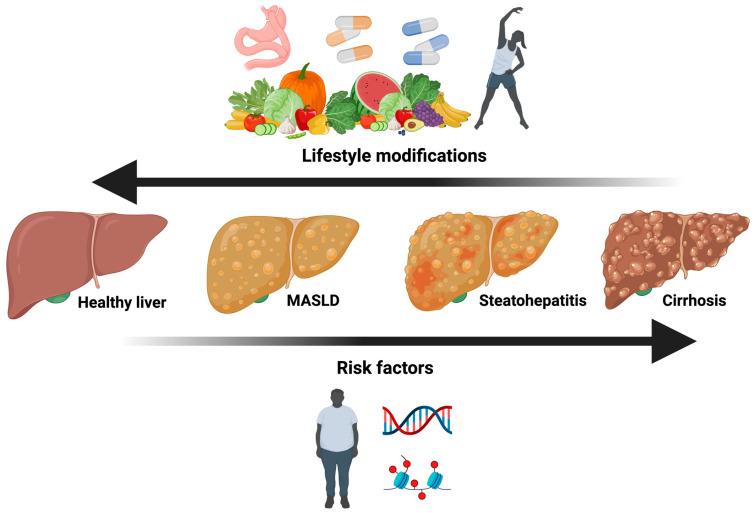
Metabolic dysfunction-associated steatotic liver disease (MASLD) is a term that entails a broad spectrum of conditions that vary in severity. Its development is influenced by multiple factors such as environment, microbiome, comorbidities, and genetic factors. MASLD is closely related to metabolic syndrome as it is caused by an alteration in the metabolism of fatty acids due to the accumulation of lipids because of an imbalance between its absorption and elimination in the liver. Its progression to fibrosis is due to a constant flow of fatty acids through the mitochondria and the inability of the liver to slow down this metabolic load, which generates oxidative stress and lipid peroxidation, triggering cell death. The development and progression of MASLD are closely related to unhealthy lifestyle habits, and nutritional epigenetic and genetic mechanisms have also been implicated. Currently, lifestyle modification is the first-line treatment for MASLD and nonalcoholic steatohepatitis; weight loss of ≥10% produces resolution of steatohepatitis and fibrosis regression. In many patients, body weight reduction cannot be achieved; therefore, pharmacological treatment should be offered in particular populations.
代谢功能障碍相关脂肪性肝病(MASLD)是一个涵盖了一系列严重程度各异病症的术语。其发展受到多种因素影响,如环境、微生物群、合并症和遗传因素等。MASLD与代谢综合征密切相关,因为肝脏中脂肪酸吸收与清除失衡导致脂质蓄积,进而引起脂肪酸代谢改变,最终引发MASLD。其向纤维化进展是由于脂肪酸持续流经线粒体,而肝脏无法减轻这种代谢负荷,从而产生氧化应激和脂质过氧化,触发细胞死亡。MASLD的发生和发展与不健康的生活方式习惯密切相关,营养表观遗传和遗传机制也与之有关。目前,生活方式改变是MASLD和非酒精性脂肪性肝炎的一线治疗方法;体重减轻≥10%可使脂肪性肝炎消退并使纤维化逆转。在许多患者中,体重减轻无法实现;因此,应针对特定人群提供药物治疗。

 Zotero 插件