
探讨血液恶性肿瘤中 p16 与其他衰老分子标志物与临床虚弱的关系。
Determining the relationship of p16 and additional molecular markers of aging with clinical frailty in hematologic malignancy.
机构信息
Division of Hematology, The Ohio State University, Columbus, OH, USA.
James Comprehensive Cancer Center, 300 West 10th Ave, Columbus, Ohio, 43210, United States.
出版信息
J Cancer Surviv. 2024 Aug;18(4):1168-1178. doi: 10.1007/s11764-024-01591-6. Epub 2024 Apr 28.
PURPOSE
Older adults with hematologic malignancies (HM) have unique challenges due to age and fitness. The primary aim of this pilot study was to benchmark the ability of multiple biomarkers of aging (p16, epigenetic clocks, T cell gene expression profiles, and T cell receptor excision circles (TREC) to identify frailty as measured by a clinical impairment index (I) in patients with HM.
METHODS
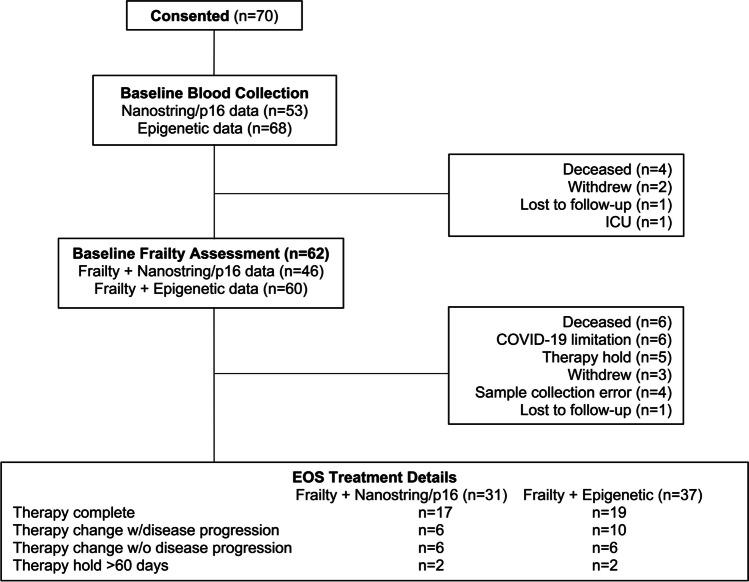
70 patients newly diagnosed with HM had peripheral blood T lymphocytes (PBTL) analyzed for p16 expression using the OSU_Senescence Nanostring CodeSet. PBTL epigenetic age was measured using 7 epigenetic clocks, and TREC were quantified by qRT-PCR. A composite clinical impairment index (I) was generated by combining values from 11 geriatric metrics (Independent Activities of Daily Living (iADL), physical health score, Short Physical Performance Battery (SPPB), Body Mass Index (BMI), Eastern Cooperative Oncology Group (ECOG) performance status, self-reported KPS, Blessed Orientation Memory Concentration (BOMC), polypharmacy, Mental Health Inventory (MHI)-17, Medical Outcomes Study (MOS) subscales). Clinical frailty was defined as a score of 7 or greater on the I.
RESULTS
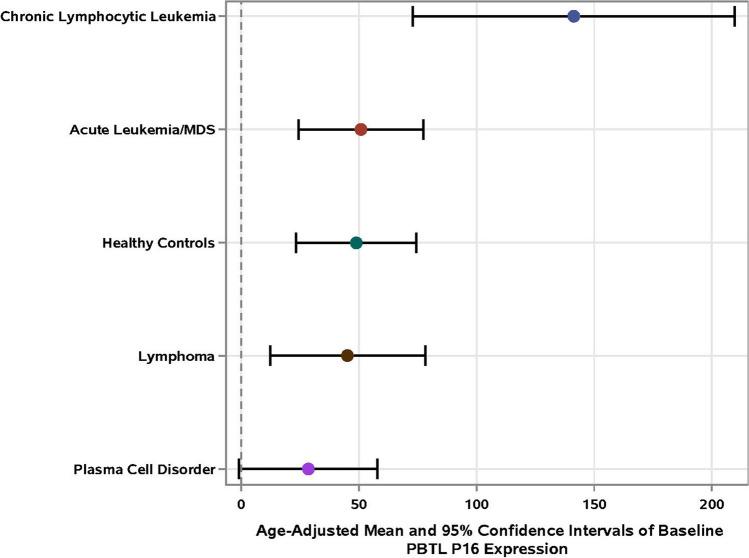
Age-adjusted p16 was similar in newly diagnosed patients and healthy controls (p > 0.1). PBTL p16 levels correlated positively with the Hannum [r = 0.35, 95% CI (0.09-0.75); p adj. = 0.04] and PhenoAge [r = 0.37, 95% CI (0.11-0.59); p adj. = 0.04] epigenetic clocks. The discrimination ability of the I model was calculated using the area under the receiver operating characteristic curve (AUC). After adjusting for chronologic age and disease group, baseline p16 [AUC = 0.76, 95% CI (0.56-0.98); p = 0.01], Hannum [AUC = 0.70, 95% CI (0.54-0.85); p = 0.01], PhenoAge [AUC = 0.71, 95% CI (0.55-0.86); p = 0.01], and DunedinPACE [AUC = 0.73, 95% CI (0.57-0.88); p = < 0.01] measures showed the greatest potential to identify clinical frailty using the I.
CONCLUSIONS
Our pilot data suggest that multiple blood-based aging biomarkers have potential to identify frailty in older adults with HM.
IMPLICATIONS FOR CANCER SURVIVORS
We developed the I index to quantify impairments across geriatric domains and discovered that PBTL p16, Hannum, PhenoAge, and DunedinPACE are promising indicators of frailty in HM.
目的
老年血液恶性肿瘤(HM)患者由于年龄和健康状况而面临独特的挑战。本初步研究的主要目的是通过临床损伤指数(I)来确定多种衰老生物标志物(p16、表观遗传时钟、T 细胞基因表达谱和 T 细胞受体切除环(TREC))在 HM 患者中识别脆弱性的能力,该指数是通过对新诊断的 HM 患者的外周血 T 淋巴细胞(PBTL)进行分析得出的。使用 OSU_Senescence Nanostring CodeSet 测量了 p16 的表达。通过 qRT-PCR 定量测量了 PBTL 的表观遗传年龄。通过将 11 项老年学指标(独立日常生活活动(iADL)、身体健康评分、简短身体表现电池(SPPB)、体重指数(BMI)、东部合作肿瘤组(ECOG)表现状态、自我报告的 KPS、祝福定向记忆浓度(BOMC)、多药治疗、心理健康量表(MHI)-17、医疗结果研究(MOS)子量表)的值组合生成综合临床损伤指数(I)。临床脆弱性定义为 I 评分≥7。
方法
对新诊断的 HM 患者和健康对照者的外周血 T 淋巴细胞(PBTL)进行 p16 表达的 OSU_Senescence Nanostring CodeSet 分析。年龄调整后的 p16 在新诊断的患者和健康对照者中相似(p>0.1)。PBTL p16 水平与 Hannum [r=0.35,95%CI(0.09-0.75);p adj. =0.04]和 PhenoAge [r=0.37,95%CI(0.11-0.59);p adj. =0.04]表观遗传时钟呈正相关。使用受试者工作特征曲线(ROC)下面积(AUC)计算 I 模型的判别能力。在调整了chronologic 年龄和疾病组后,基线 p16 [AUC=0.76,95%CI(0.56-0.98);p=0.01]、Hannum [AUC=0.70,95%CI(0.54-0.85);p=0.01]、PhenoAge [AUC=0.71,95%CI(0.55-0.86);p=0.01]和 DunedinPACE [AUC=0.73,95%CI(0.57-0.88);p= <0.01] 指标显示出通过 I 识别临床脆弱性的最大潜力。
结论
我们的初步数据表明,多种基于血液的衰老生物标志物有可能识别 HM 中老年人的脆弱性。
对癌症幸存者的意义
我们开发了 I 指数来量化老年学领域的损伤,并发现 PBTL p16、Hannum、PhenoAge 和 DunedinPACE 是 HM 中脆弱性的有前途的指标。

 Zotero 插件