
癌症及癌症治疗中的加速衰老:生物标志物的现状
Accelerated Aging in Cancer and Cancer Treatment: Current Status of Biomarkers.
作者信息
Abraham Soniya, Parekh Jay, Lee Seohyuk, Afrin Humayra, Rozenblit Mariya, Blenman Kim R M, Perry Rachel J, Ferrucci Leah M, Liu Jessica, Irwin Melinda L, Lustberg Maryam
机构信息
Department of Internal Medicine, Yale-New Haven Health Bridgeport Hospital, Bridgeport, Connecticut, USA.
Yale School of Medicine, Yale University, New Haven, Connecticut, USA.
出版信息
Cancer Med. 2025 May;14(9):e70929. doi: 10.1002/cam4.70929.
BACKGROUND
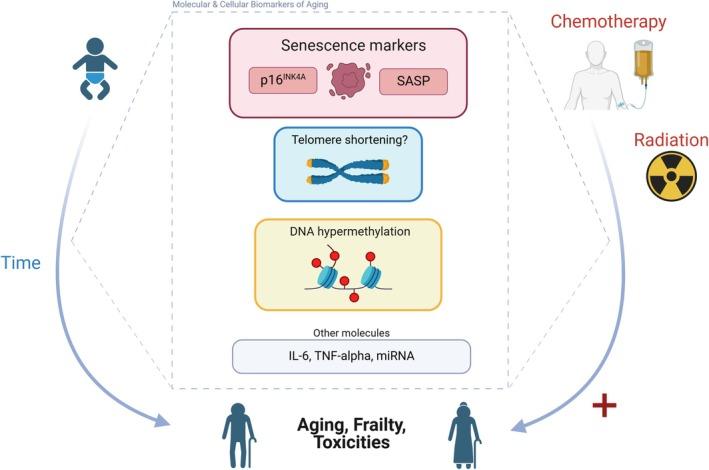
Aging in humans is a heterogeneous process influenced by both biological and chronological factors. Biological age reflects an individual's physiological reserve and functional status. Increasing evidence suggests that cancer and its therapies accelerate biological aging. Many biomarkers have been evaluated to assess the biological age of patients with cancer. These biomarkers are emerging as potential tools to predict cancer-related toxicity and an individual's functional capacity as well as to individualize treatment.
METHODS
This review summarizes the current literature on aging biomarkers in cancer patients, with a focus on markers of cellular senescence and epigenetic modification. We evaluate the existing evidence supporting their use as predictors of toxicity in patients undergoing chemotherapy and radiation therapy.
RESULTS
Biomarkers such as interleukin-6 (IL-6), leukocyte telomere length (LTL), and DNA methylation age show potential for assessing biological age, frailty, and functional reserve. The expression of p16INK4A has demonstrated promise in predicting therapy-induced toxicity and making treating decisions. However, additional confirmatory studies are necessary to further validate these biomarkers before they can be utilized as decision aids.
CONCLUSION
Aging biomarkers hold promise for individualizing cancer therapy and predicting treatment-related toxicity. However, further studies are essential to validate their reliability and support their integration into clinical practice.
背景
人类衰老过程具有异质性,受到生物学因素和时间因素的共同影响。生物学年龄反映个体的生理储备和功能状态。越来越多的证据表明,癌症及其治疗会加速生物学衰老。许多生物标志物已被评估用于评估癌症患者的生物学年龄。这些生物标志物正逐渐成为预测癌症相关毒性、个体功能能力以及实现治疗个体化的潜在工具。
方法
本综述总结了目前关于癌症患者衰老生物标志物的文献,重点关注细胞衰老和表观遗传修饰的标志物。我们评估了支持将其用作化疗和放疗患者毒性预测指标的现有证据。
结果
白细胞介素 - 6(IL - 6)、白细胞端粒长度(LTL)和DNA甲基化年龄等生物标志物在评估生物学年龄、虚弱程度和功能储备方面具有潜力。p16INK4A的表达在预测治疗诱导的毒性和做出治疗决策方面已显示出前景。然而,在这些生物标志物可作为决策辅助工具使用之前,还需要更多的验证性研究来进一步验证它们。
结论
衰老生物标志物在癌症治疗个体化和预测治疗相关毒性方面具有前景。然而,进一步的研究对于验证其可靠性并支持将其纳入临床实践至关重要。

 Zotero 插件