
1 型糖尿病和非酒精性脂肪性肝病:两样本孟德尔随机研究。
Type 1 diabetes mellitus and non-alcoholic fatty liver disease: a two-sample Mendelian randomization study.
机构信息
Department of Infectious Disease, Sichuan Provincial People's Hospital, University of Electronic Science and Technology of China, Chengdu, China.
出版信息
Front Endocrinol (Lausanne). 2024 Apr 12;15:1315046. doi: 10.3389/fendo.2024.1315046. eCollection 2024.
BACKGROUND
NAFLD (Nonalcoholic fatty liver disease) is becoming an increasingly common cause of chronic liver disease. Metabolic dysfunction, overweight/obesity, and diabetes are thought to be closely associated with increased NAFLD risk. However, few studies have focused on the mechanisms of NAFLD occurrence in T1DM.
METHODS
We conducted a two-sample Mendelian randomization (MR) analysis to assess the causal association between T1DM and NAFLD with/without complications, such as coma, renal complications, ketoacidosis, neurological complications, and ophthalmic complications. Multiple Mendelian randomization methods, such as the inverse variance weighted (IVW) method, weighted median method, and MR-Egger test were performed to evaluate the causal association of T1DM and NAFLD using genome-wide association study summary data from different consortia, such as Finngen and UK biobank.
RESULTS
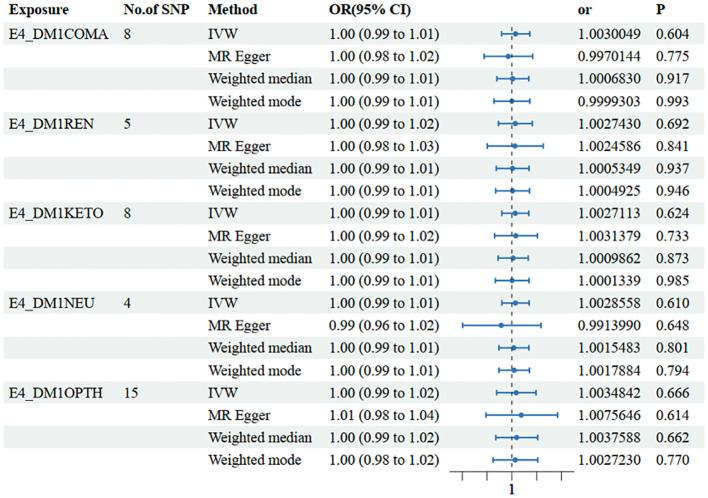
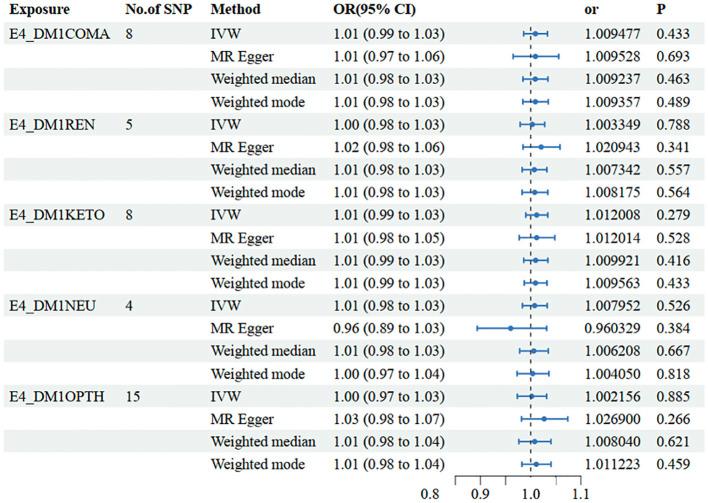
We selected 37 SNPs strongly associated with NAFLD/LFC (at a significance level of < 5 × 10⁻⁸) as instrumental variables from the Finnish database based on the T1DM phenotype (8,967 cases and 308,373 controls). We also selected 14/16 SNPs based on with or without complications. The results suggest that the genetic susceptibility of T1DM does not increase the risk of NAFLD (OR=1.005 [0.99, 1.02], IVW p=0.516, MR Egger =0.344, Weighted median =0.959, Weighted mode =0.791), regardless of whether complications are present. A slight causal effect of T1DM without complications on LFC was observed (OR=1.025 [1.00, 1.03], MR Egger =0.045). However, none of the causal relationships were significant in the IVW (=0.317), Weighted median (=0.076), and Weighted mode (=0.163) methods.
CONCLUSION
Our study did not find conclusive evidence for a causal association between T1DM and NAFLD, although clinical observations indicate increasing abnormal transaminase prevalence and NAFLD progression in T1DM patients.
背景
非酒精性脂肪性肝病(NAFLD)正成为慢性肝病越来越常见的病因。代谢功能障碍、超重/肥胖和糖尿病被认为与 NAFLD 风险增加密切相关。然而,很少有研究关注 1 型糖尿病(T1DM)中 NAFLD 发生的机制。
方法
我们进行了两样本孟德尔随机化(MR)分析,以评估 T1DM 与伴有/不伴有并发症(如昏迷、肾脏并发症、酮症酸中毒、神经并发症和眼科并发症)的 NAFLD 之间的因果关系。使用来自不同联盟(如芬兰基因研究和英国生物银行)的全基因组关联研究汇总数据,采用逆方差加权(IVW)法、加权中位数法和 MR-Egger 检验等多种 MR 方法,评估 T1DM 和 NAFLD 的因果关系。
结果
我们从芬兰数据库中基于 T1DM 表型(8967 例病例和 308373 例对照)选择了 37 个与 NAFLD/LFC 显著相关(显著水平为<5×10⁻⁸)的强关联 SNP 作为工具变量。我们还根据是否伴有并发症选择了 14/16 个 SNP。结果表明,T1DM 的遗传易感性不会增加 NAFLD 的风险(OR=1.005[0.99,1.02],IVW p=0.516,MR Egger=0.344,加权中位数=0.959,加权众数=0.791),无论是否存在并发症。在不伴有并发症的情况下,T1DM 对 LFC 有轻微的因果影响(OR=1.025[1.00,1.03],MR Egger=0.045)。然而,在 IVW(=0.317)、加权中位数(=0.076)和加权众数(=0.163)方法中,没有一种因果关系是显著的。
结论
虽然临床观察表明 1 型糖尿病患者中转氨酶异常升高和 NAFLD 进展的发生率增加,但我们的研究没有发现 T1DM 与 NAFLD 之间存在因果关系的确凿证据。


 Zotero 插件