
识别新冠疫情期间无风险、有风险和交叉群体在精神疾病和幸福感方面的差异,以及社会人口统计学因素在心理健康结果中的作用。
Identifying disparities in mental illness and well-being across no-risk, risk, and intersectional groups during the Covid-19 pandemic and the role of sociodemographics in mental health outcomes.
作者信息
Fernandes Cristofthe J, Neto Félix, Costa Patrício
机构信息
Faculdade de Psicologia e Ciências da Educação, Universidade do Porto, Porto, Portugal.
Faculdade de Psicologia e Ciências da Educação, Universidade do Porto, Porto, Portugal. Instituto de Investigação em Ciências da Vida e Saúde (ICVS), Escola de Medicina, Universidade do Minho, Braga, Portugal. Laboratório Associado ICVS/3B's, Braga/Guimarães, Portugal.
出版信息
Braz J Psychiatry. 2024;46:e20233532. doi: 10.47626/1516-4446-2023-3532. Epub 2024 May 2.
OBJECTIVE
Few pandemic studies have explored positive aspects of mental health employing an intersectional perspective. Our intersectional investigation aimed to identify mental illness and well-being differences between groups identified as psychologically vulnerable during the pandemic by the World Health Organization (immigrants, minorities, and people with psychiatric diagnoses) and people without pre-existing risk factors while controlling for sociodemographic variables.
METHODS
This cross-sectional survey included 1,134 participants (76.1% women) aged 18 to 76 years. We used the Depression, Anxiety, and Stress Scales to assess mental disorders and the Satisfaction with Life Scale and the Positive and Negative Affect Schedules to assess well-being.
RESULTS
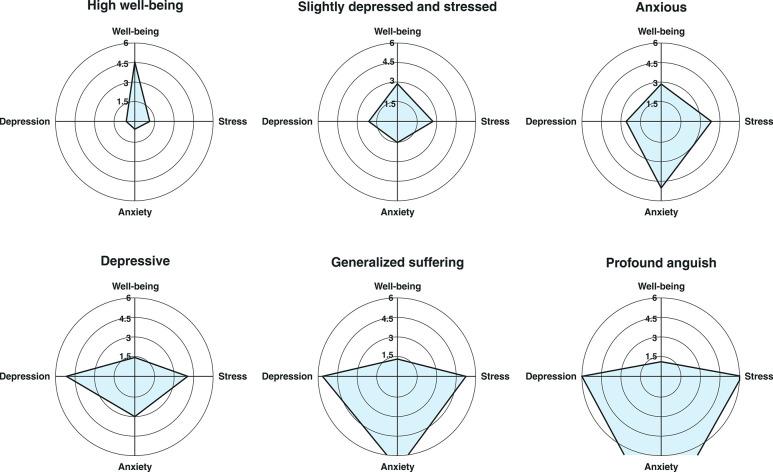
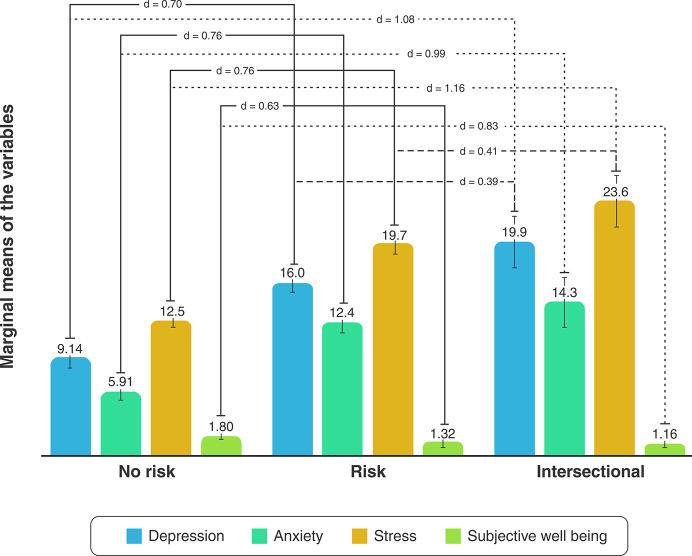
Through a variable-centered approach, multivariate analysis revealed significant mental health differences between the groups: depression (F2.1131 = 72.7, p < 0.001), anxiety (F2.1131 = 78.0, p < 0.001), stress (F2.1131 = 85.9, p < 0.001), and subjective well-being (F2.1131 = 53.6, p < 0.001). The groups also differed when a person-centered approach was used to analyze the variables jointly through latent profile analysis. We identified six mental profiles consisting of different levels of depression, anxiety, stress, and well-being. The risk and intersectional groups were more likely to be characterized by the generalized suffering (ORrisk = 0.85, ORintersec = 0.93) and profound anguish (ORrisk&intersec = 0.97) profiles. After controlling for demographic variables, mental health disparities were partially attributed to participant risk conditions.
CONCLUSIONS
Based on our results, we emphasize the urgent need for public health policies that consider the specificities and vulnerabilities of minority and risk groups.
目的
很少有关于大流行的研究从交叉视角探讨心理健康的积极方面。我们的交叉研究旨在确定世界卫生组织认定的在大流行期间心理脆弱群体(移民、少数族裔和有精神疾病诊断的人)与无既往风险因素的人群之间的精神疾病及幸福感差异,同时控制社会人口统计学变量。
方法
这项横断面调查纳入了1134名年龄在18至76岁之间的参与者(76.1%为女性)。我们使用抑郁、焦虑和压力量表评估精神障碍,使用生活满意度量表以及积极和消极情绪量表评估幸福感。
结果
通过以变量为中心的方法,多变量分析显示不同群体之间存在显著的心理健康差异:抑郁(F2.1131 = 72.7,p < 0.001)、焦虑(F2.1131 = 78.0,p < 0.001)、压力(F2.1131 = 85.9,p < 0.001)和主观幸福感(F2.1131 = 53.6,p < 0.001)。当采用以人为中心的方法通过潜在剖面分析联合分析变量时,不同群体之间也存在差异。我们确定了六种精神状态剖面,其抑郁、焦虑、压力和幸福感水平各不相同。风险组和交叉群体更有可能表现为普遍痛苦(风险组OR = 0.85,交叉群体OR = 0.93)和极度痛苦(风险组与交叉群体OR = 0.97)剖面。在控制人口统计学变量后,心理健康差异部分归因于参与者的风险状况。
结论
基于我们的研究结果,我们强调迫切需要制定考虑少数族裔和风险群体特殊性及脆弱性的公共卫生政策。
 Zotero 插件