
骨密度作为接受免疫检查点抑制剂治疗的非小细胞肺癌患者的个体预后生物标志物。
Bone mineral density as an individual prognostic biomarker in NSCLC patients treated with immune checkpoint inhibitors.
作者信息
Lou Jie, Gong Bingxin, Li Yi, Guo Yusheng, Li Lin, Wang Jing, Liu Weiwei, You Ziang, Zhang Hongyong, Pan Feng, Liang Bo, Yang Lian, Zhou Guofeng
机构信息
Department of Ultrasound Medicine, Union Hospital, Tongji Medical College, Huazhong University of Science and Technology, Wuhan, China.
Hubei Key Laboratory of Molecular Imaging, Wuhan, China.
出版信息
Front Immunol. 2024 Apr 18;15:1332303. doi: 10.3389/fimmu.2024.1332303. eCollection 2024.
BACKGROUND
Immune checkpoint inhibitors (ICIs) have left a deep impression in the treatment of non-small cell lung cancer (NSCLC), however, not all patients benefit from it. The purpose of this study was to investigate the prognostic value of baseline bone mineral density (BMD) derived from chest computed tomography (CT) scans in NSCLC patients treated with ICIs.
METHODS
This study included patients with advanced NSCLC who underwent ICI treatment at the Wuhan Union Hospital from March 2020 to October 2022. Baseline BMD was evaluated at non-contrast chest CT at the level of first lumbar vertebra. Patients were divided into BMD-lower group and BMD-higher group according to the optimal cutoff value calculated by X-tile software. Baseline characteristics of the two groups were compared and variables between the two groups were balanced by propensity score matching (PSM) analysis. We calculated the objective response rate (ORR) and disease control rate (DCR) of the two groups and analyzed overall survival (OS) and progression-free survival (PFS) using BMD and other clinical indexes through Cox regression models and Kaplan-Meier survival curves.
RESULTS
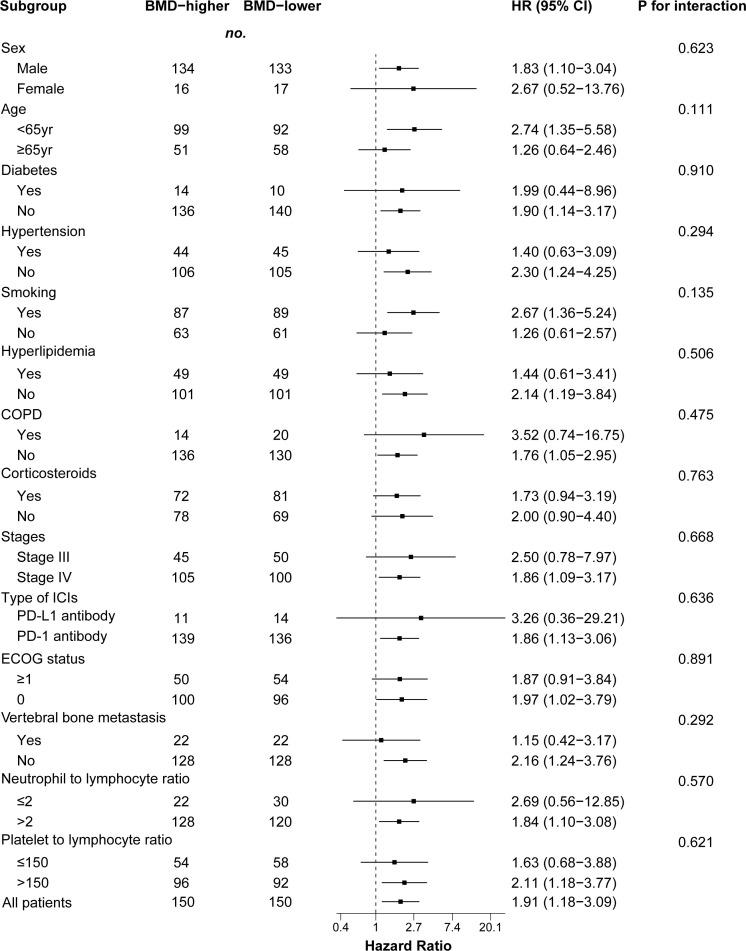
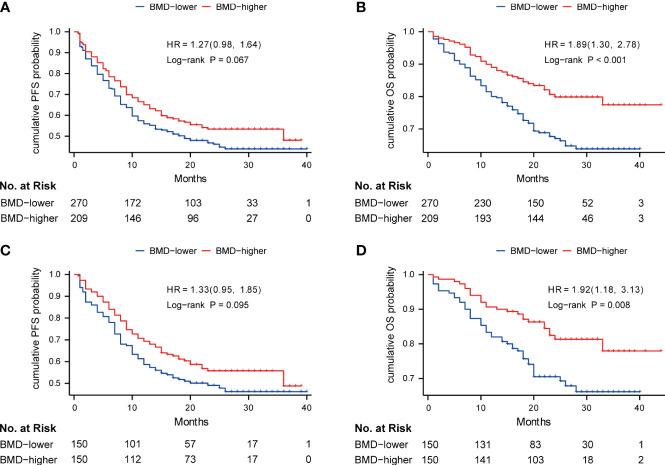
A total of 479 patients were included in this study, and all patients were divided into BMD-lower group (n=270) and BMD-higher group (n=209). After PSM analysis, each group consisted of 150 patients. ORR (43.3% vs. 43.5% before PSM, = 0.964; 44.7% vs. 44.7% after PSM, = 1.000) and DCR (91.1% vs. 94.3% before PSM, = 0.195; 93.3% vs. 96.7% after PSM, =0.190) were similar in two groups. There was no statistically significant relationship between BMD degree and PFS before (16.0 months vs. 18.0 months, = 0.067) and after PSM analysis (17.0 months vs. 19.0 months, = 0.095). However, lower BMD was associated with shorter OS both before (20.5 months vs. 23.0 months, < 0.001) and after PSM analysis (20.0 months vs. 23.0 months, = 0.008).
CONCLUSION
Lower baseline BMD is associated with worse clinical outcomes in NSCLC patients treated with ICIs. As a reliable and easily obtained individual prognostic biomarker, BMD can become a routine detection indicator before immunotherapy.
背景
免疫检查点抑制剂(ICIs)在非小细胞肺癌(NSCLC)治疗中留下了深刻印象,然而,并非所有患者都能从中获益。本研究的目的是探讨胸部计算机断层扫描(CT)扫描得出的基线骨密度(BMD)在接受ICIs治疗的NSCLC患者中的预后价值。
方法
本研究纳入了2020年3月至2022年10月在武汉协和医院接受ICI治疗的晚期NSCLC患者。在第一腰椎水平的非增强胸部CT上评估基线骨密度。根据X-tile软件计算的最佳截断值,将患者分为低骨密度组和高骨密度组。比较两组的基线特征,并通过倾向评分匹配(PSM)分析平衡两组之间的变量。我们计算了两组的客观缓解率(ORR)和疾病控制率(DCR),并通过Cox回归模型和Kaplan-Meier生存曲线,使用骨密度和其他临床指标分析总生存期(OS)和无进展生存期(PFS)。
结果
本研究共纳入479例患者,所有患者分为低骨密度组(n = 270)和高骨密度组(n = 209)。PSM分析后,每组各有150例患者。ORR(PSM前43.3%对43.5%,P = 0.964;PSM后44.7%对44.7%,P = 1.000)和DCR(PSM前91.1%对94.3%,P = 0.195;PSM后93.3%对96.7%,P = 0.190)在两组中相似。在PSM分析前后,骨密度程度与PFS之间均无统计学显著关系(PSM前16.0个月对18.0个月,P = 0.067;PSM后17.0个月对19.0个月,P = 0.095)。然而,低骨密度与较短的OS相关,这在PSM分析前后均成立(PSM前20.5个月对23.0个月,P < 0.001;PSM后20.0个月对23.0个月,P = 0.008)。
结论
在接受ICIs治疗的NSCLC患者中低基线骨密度与较差的临床结局相关。作为一种可靠且易于获得的个体预后生物标志物,骨密度可成为免疫治疗前的常规检测指标。



 Zotero 插件