
温和噬菌体如何成为有效的细菌武器?
What makes a temperate phage an effective bacterial weapon?
机构信息
Division of Evolution and Genomic Sciences, Faculty of Biology, Medicine and Health, University of Manchester, Manchester, United Kingdom.
出版信息
mSystems. 2024 Jun 18;9(6):e0103623. doi: 10.1128/msystems.01036-23. Epub 2024 May 10.
UNLABELLED
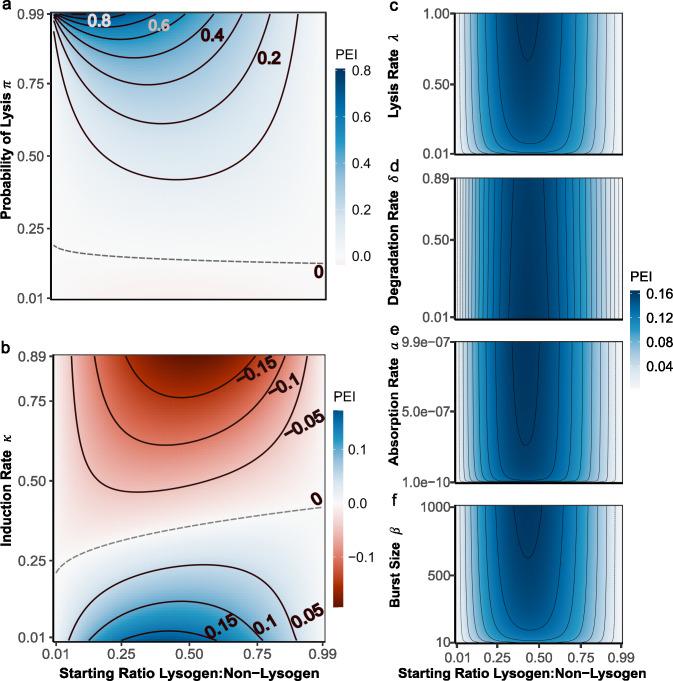
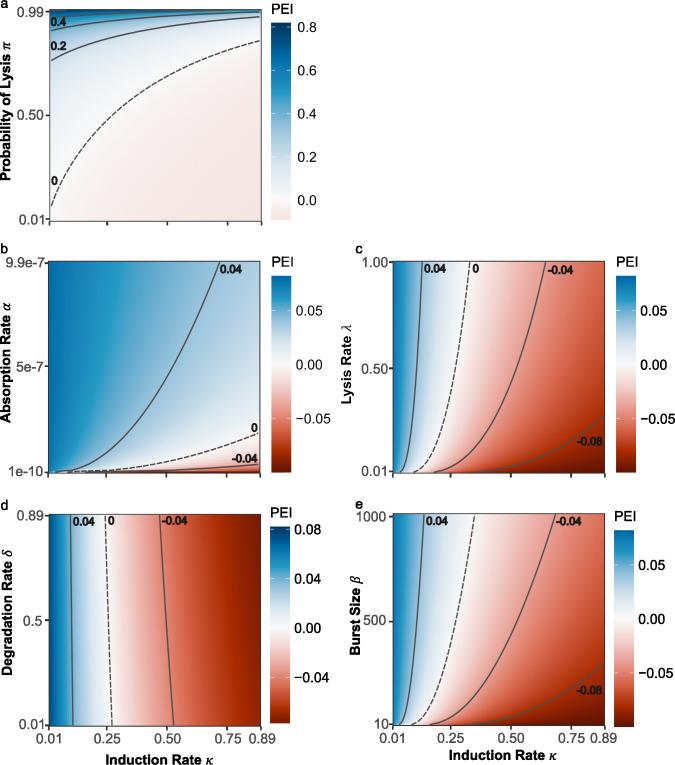
Temperate bacteriophages (phages) are common features of bacterial genomes and can act as self-amplifying biological weapons, killing susceptible competitors and thus increasing the fitness of their bacterial hosts (lysogens). Despite their prevalence, however, the key characteristics of an effective temperate phage weapon remain unclear. Here, we use systematic mathematical analyses coupled with experimental tests to understand what makes an effective temperate phage weapon. We find that effectiveness is controlled by phage life history traits-in particular, the probability of lysis and induction rate-but that the optimal combination of traits varies with the initial frequency of a lysogen within a population. As a consequence, certain phage weapons can be detrimental when their hosts are rare yet beneficial when their hosts are common, while subtle changes in individual life history traits can completely reverse the impact of an individual phage weapon on lysogen fitness. We confirm key predictions of our model experimentally, using temperate phages isolated from the clinically relevant Liverpool epidemic strain of . Through these experiments, we further demonstrate that nutrient availability can also play a critical role in driving frequency-dependent patterns in phage-mediated competition. Together, these findings highlight the complex and context-dependent nature of temperate phage weapons and the importance of both ecological and evolutionary processes in shaping microbial community dynamics more broadly.
IMPORTANCE
Temperate bacteriophages-viruses that integrate within bacterial DNA-are incredibly common within bacterial genomes and can act as powerful self-amplifying weapons. Bacterial hosts that carry temperate bacteriophages can thus gain a fitness advantage within a given niche by killing competitors. But what makes an effective phage weapon? Here, we first use a simple mathematical model to explore the factors determining bacteriophage weapon utility. Our models suggest that bacteriophage weapons are nuanced and context-dependent; an individual bacteriophage may be beneficial or costly depending upon tiny changes to how it behaves or the bacterial community it inhabits. We then confirm these mathematical predictions experimentally, using phages isolated from cystic fibrosis patients. But, in doing so, we also find that another factor-nutrient availability-plays a key role in shaping bacteriophage-mediated competition. Together, our results provide new insights into how temperate bacteriophages modulate bacterial communities.
未加标签
温和噬菌体(噬菌体)是细菌基因组中的常见特征,可作为自我放大的生物武器,杀死易感的竞争者,从而提高其细菌宿主(溶原菌)的适应性。然而,尽管它们很普遍,但有效的温和噬菌体武器的关键特征仍不清楚。在这里,我们使用系统的数学分析结合实验测试来了解是什么使温和噬菌体成为有效的武器。我们发现,有效性由噬菌体的生活史特征控制-特别是裂解概率和诱导率-但最佳特征组合随种群中溶原菌的初始频率而变化。因此,某些噬菌体武器在其宿主稀少时可能有害,但在宿主常见时却有益,而个体生活史特征的细微变化可能会完全改变单个噬菌体武器对溶原菌适应性的影响。我们通过使用从临床相关的利物浦流行株中分离出来的温和噬菌体进行实验,验证了我们模型的关键预测。通过这些实验,我们进一步证明了营养物质的可用性也可以在驱动噬菌体介导的竞争中依赖频率的模式方面发挥关键作用。总之,这些发现强调了温和噬菌体武器的复杂和依赖背景的性质,以及生态和进化过程在更广泛地塑造微生物群落动态方面的重要性。
重要性
温和噬菌体-整合在细菌 DNA 中的病毒-在细菌基因组中非常普遍,可作为强大的自我放大武器。携带温和噬菌体的细菌宿主因此可以通过杀死竞争者而在特定生态位中获得适应性优势。但是,是什么使噬菌体成为有效的武器呢?在这里,我们首先使用简单的数学模型来探索决定噬菌体武器效用的因素。我们的模型表明,噬菌体武器是微妙且依赖背景的;单个噬菌体可能是有益的,也可能是有代价的,这取决于它的行为或它所栖息的细菌群落的微小变化。然后,我们使用从囊性纤维化患者中分离出的噬菌体来实验验证这些数学预测。但是,在这样做的过程中,我们还发现另一个因素-营养物质的可用性-在塑造噬菌体介导的竞争中起着关键作用。总的来说,我们的结果提供了有关温和噬菌体如何调节细菌群落的新见解。




 Zotero 插件