
膝关节骨关节炎患者滑液中单核细胞与淋巴细胞比值预测患者对保守治疗的反应:一项回顾性队列研究。
Synovial fluid monocyte-to-lymphocyte ratio in knee osteoarthritis patients predicts patient response to conservative treatment: a retrospective cohort study.
机构信息
Department of Orthopaedic Surgery, School of Medicine, Ajou University, Suwon, South Korea.
Cell Therapy Center, Ajou Medical Center, Suwon, Republic of Korea.
出版信息
BMC Musculoskelet Disord. 2024 May 14;25(1):379. doi: 10.1186/s12891-024-07475-1.
BACKGROUND
Biomarkers that predict the treatment response in patients with knee osteoarthritis are scarce. This study aimed to investigate the potential role of synovial fluid cell counts and their ratios as biomarkers of primary knee osteoarthritis.
METHODS
This retrospective study investigated 96 consecutive knee osteoarthritis patients with knee effusion who underwent joint fluid aspiration analysis and received concomitant intra-articular corticosteroid injections and blood tests. The monocyte-to-lymphocyte ratio (MLR) and neutrophil-to-lymphocyte ratio (NLR) were calculated. After 6 months of treatment, patients were divided into two groups: the responder group showing symptom resolution, defined by a visual analog scale (VAS) score of ≤ 3, without additional treatment, and the non-responder group showing residual symptoms, defined by a VAS score of > 3 and requiring further intervention, such as additional medication, repeated injections, or surgical treatment. Unpaired t-tests and univariate and multivariate logistic regression analyses were conducted between the two groups to predict treatment response after conservative treatment. The predictive value was calculated using the area under the receiver operating characteristic curve, and the optimal cutoff value was determined.
RESULTS
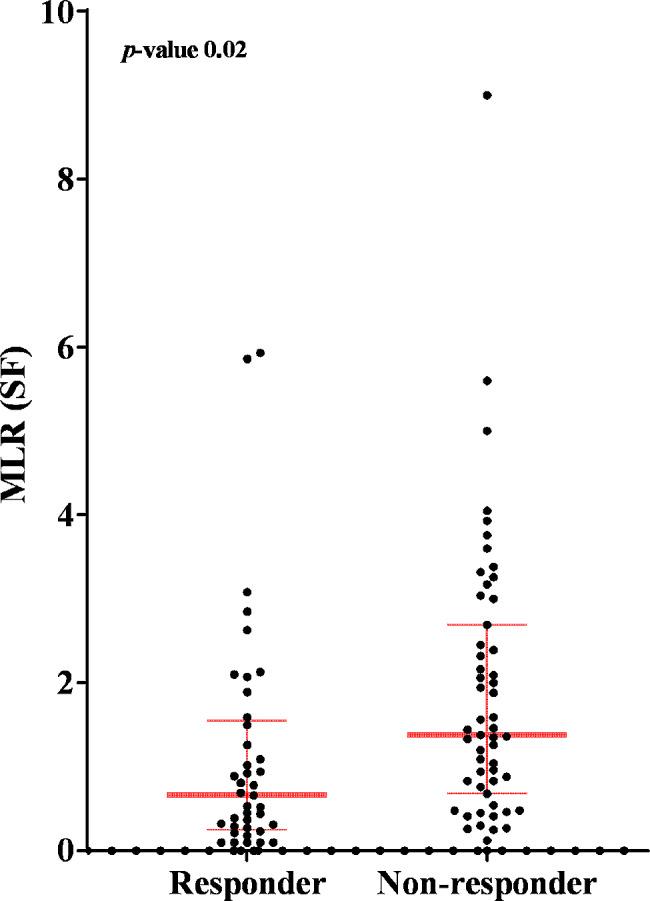
Synovial fluid MLR was significantly higher in the non-responder group compared to the responder group (1.86 ± 1.64 vs. 1.11 ± 1.37, respectively; p = 0.02). After accounting for confounding variables, odds ratio of non-responder due to increased MLR were 1.63 (95% confidence interval: 1.11-2.39). The optimal MLR cutoff value for predicting patient response to conservative treatment was 0.941.
CONCLUSIONS
MLR may be a potential biomarker for predicting the response to conservative treatment in patients with primary knee osteoarthritis.
背景
预测膝骨关节炎患者治疗反应的生物标志物稀缺。本研究旨在探讨滑液细胞计数及其比值作为原发性膝骨关节炎生物标志物的潜在作用。
方法
这是一项回顾性研究,共纳入 96 例膝关节积液的原发性膝骨关节炎患者,所有患者均接受关节液抽吸分析,并同时接受关节内皮质类固醇注射和血液检查。计算单核细胞与淋巴细胞比值(MLR)和中性粒细胞与淋巴细胞比值(NLR)。治疗 6 个月后,根据视觉模拟评分(VAS)≤3 分且无需进一步治疗的患者为缓解组,VAS 评分>3 分且需要进一步药物、重复注射或手术治疗的患者为未缓解组。对两组间预测保守治疗后治疗反应的差异进行了独立样本 t 检验、单因素和多因素逻辑回归分析。采用受试者工作特征曲线下面积计算预测价值,并确定最佳截断值。
结果
与缓解组相比,未缓解组的滑液 MLR 明显更高(1.86±1.64 对 1.11±1.37;p=0.02)。在调整混杂因素后,MLR 升高导致未缓解的比值比为 1.63(95%置信区间:1.11-2.39)。预测患者对保守治疗反应的最佳 MLR 截断值为 0.941。
结论
MLR 可能是预测原发性膝骨关节炎患者保守治疗反应的潜在生物标志物。


 Zotero 插件