
巴西老年精神-躯体多病患者的常规初级保健和卫生服务利用来源。
Regular source of primary care and health services utilisation among Brazilian elderly with mental-physical multimorbidity.
机构信息
Faculty of Medicine, Federal University of Goiás, Goiânia, Brazil.
Postgraduate Program in Medical Sciences, Faculty of Medicine, University of Brasília, Brasília, Brazil.
出版信息
BMC Geriatr. 2024 May 15;24(1):430. doi: 10.1186/s12877-024-05048-4.
BACKGROUND
In ageing populations, multimorbidity is a complex challenge to health systems, especially when the individuals have both mental and physical morbidities. Although a regular source of primary care (RSPC) is associated with better health outcomes, its relation with health service utilisation in elderly patients with mental-physical multimorbidity (MP-MM) is scarce.
OBJECTIVE
This study explored the relations among health service utilisation, presence of RSPC and MP-MM among elderly Brazilians.
METHODS
A national cross-sectional study performed with data from national representative samples from the Brazilian National Health Research (PNS, in Portuguese; Pesquisa Nacional de Saúde) carried out in 2013 with 11,177 elderly Brazilian people. MP-MM was defined as the presence of two or more morbidities, including at least one mental morbidity, and was evaluated using a list of 16 physical and mental morbidities. The RSPC was analysed by the presence of regular font of care in primary care and health service utilisation according to the demand for health services ≤ 15 days, medical consultation ≤ 12 months, and hospitalisation ≤ 1 year. Frequency description of variables and bivariate association were performed using Stata v.15.2 software.
RESULTS
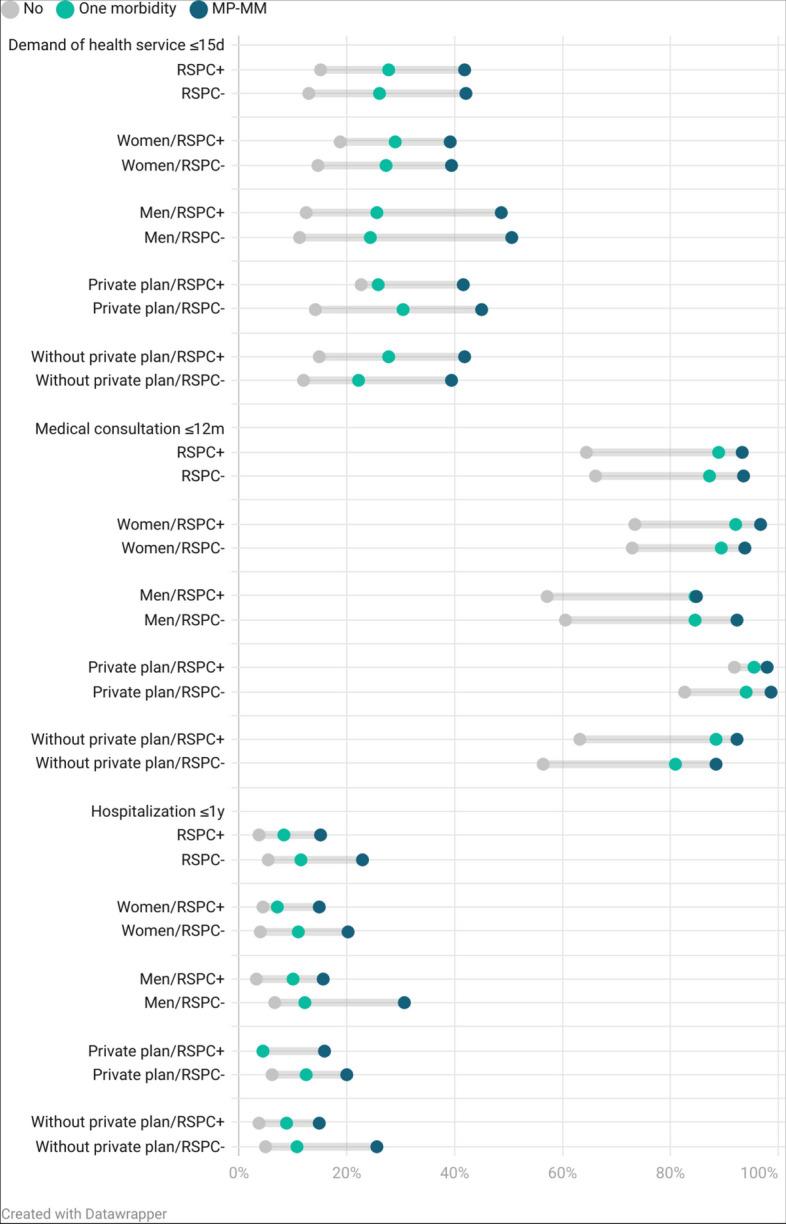
The majority of individuals was female (56.4%), and their mean age was 69.8 years. The observed prevalence of MP-MM was 12.2%. Individuals with MP-MM had higher utilisation of health services when compared to those without MP-MM. RSPC was present at 36.5% and was higher in women (37.8% vs. 34.9%). There was a lower occurrence of hospitalisation ≤ 1 year among MP-MM individuals with RSPC and without a private plan of health.
CONCLUSION
Our findings demonstrate that RSPC can be an important component of care in elderly individuals with MP-MM because it was associated with lower occurrence of hospitalisation, mainly in those that have not a private plan of health. Longitudinal studies are necessary to confirm these findings.
背景
在人口老龄化的背景下,多种疾病并存对卫生系统构成了复杂的挑战,尤其是当个人同时存在精神和身体疾病时。尽管有一个常规的初级保健来源(RSPC)与更好的健康结果相关,但它与患有精神-身体多种疾病(MP-MM)的老年患者的卫生服务利用之间的关系却很少被研究。
目的
本研究旨在探讨巴西老年人的卫生服务利用、RSPC 的存在与 MP-MM 之间的关系。
方法
这是一项全国性的横断面研究,使用了 2013 年巴西国家卫生研究(PNS)的全国代表性样本数据,共有 11177 名巴西老年人参与。MP-MM 的定义是存在两种或两种以上的疾病,至少有一种精神疾病,并使用包括 16 种身体和精神疾病的清单进行评估。RSPC 通过初级保健中定期的医疗服务来源来分析,根据卫生服务需求,卫生服务利用包括≤15 天的就诊、≤12 个月的就诊和≤1 年的住院治疗。使用 Stata v.15.2 软件对变量的频率描述和双变量关联进行分析。
结果
大多数参与者为女性(56.4%),平均年龄为 69.8 岁。观察到的 MP-MM 患病率为 12.2%。与没有 MP-MM 的个体相比,患有 MP-MM 的个体更倾向于利用卫生服务。RSPC 的存在率为 36.5%,女性的 RSPC 更高(37.8%比 34.9%)。在有 RSPC 且没有私人医疗保险计划的 MP-MM 个体中,住院治疗≤1 年的发生率较低。
结论
我们的研究结果表明,RSPC 可以成为 MP-MM 老年患者护理的一个重要组成部分,因为它与较低的住院治疗发生率相关,特别是在那些没有私人医疗保险计划的患者中。需要进行纵向研究来证实这些发现。
 Zotero 插件