
新型四基因 pyroptosis 模型对头颈部鳞状细胞癌的预后和化疗意义。
Prognostic and chemotherapeutic implications of a novel four-gene pyroptosis model in head and neck squamous cell carcinoma.
机构信息
State Key Laboratory of Oral Diseases & National Center for Stomatology & National Clinical Research Center for Oral Diseases & Department of Oral Medicine, West China Hospital of Stomatology, Sichuan University, Chengdu, China.
出版信息
PeerJ. 2024 May 13;12:e17296. doi: 10.7717/peerj.17296. eCollection 2024.
BACKGROUND
Head and neck squamous cell carcinoma (HNSCC) is one of the most common cancers. Chemotherapy remains one dominant therapeutic strategy, while a substantial proportion of patients may develop chemotherapeutic resistance; therefore, it is particularly significant to identify the patients who could achieve maximum benefits from chemotherapy. Presently, four pyroptosis genes are reported to correlate with the chemotherapeutic response or prognosis of HNSCC, while no study has assessed the combinatorial predicting efficacy of these four genes. Hence, this study aims to evaluate the predictive value of a multi-gene pyroptosis model regarding the prognosis and chemotherapeutic responsiveness in HNSCC.
METHODS
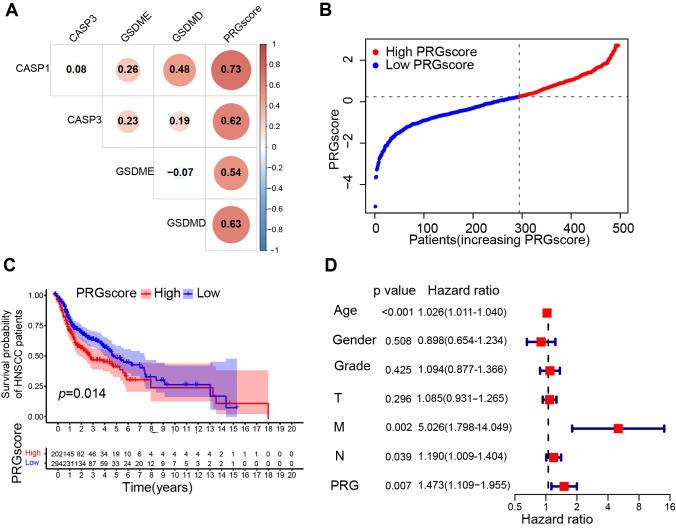
By utilizing RNA-sequencing data from The Cancer Genome Atlas database and the Gene Expression Omnibus database, the pyroptosis-related gene score (PRGscore) was computed for each HNSCC sample by performing a Gene Set Variation Analysis (GSVA) based on four genes (Caspase-1, Caspase-3, Gasdermin D, Gasdermin E). The prognostic significance of the PRGscore was assessed through Cox regression and Kaplan-Meier survival analyses. Additionally, chemotherapy sensitivity stratified by high and low PRGscore was examined to determine the potential association between pyroptosis activity and chemosensitivity. Furthermore, chemotherapy sensitivity assays were conducted in HNSCC cell lines .
RESULTS
As a result, our study successfully formulated a PRGscore reflective of pyroptotic activity in HNSCC. Higher PRGscore correlates with worse prognosis. However, patients with higher PRGscore were remarkably more responsive to chemotherapy. In agreement, chemotherapy sensitivity tests on HNSCC cell lines indicated a positive association between overall pyroptosis levels and chemosensitivity to cisplatin and 5-fluorouracil; in addition, patients with higher PRGscore may benefit from the immunotherapy. Overall, our study suggests that HNSCC patients with higher PRGscore, though may have a less favorable prognosis, chemotherapy and immunotherapy may exhibit better benefits in this population.
背景
头颈部鳞状细胞癌(HNSCC)是最常见的癌症之一。化疗仍然是一种主要的治疗策略,而相当一部分患者可能会产生化疗耐药性;因此,确定能够从化疗中获得最大益处的患者尤为重要。目前,有 4 个细胞焦亡基因与 HNSCC 的化疗反应或预后相关,但尚无研究评估这 4 个基因的联合预测效能。因此,本研究旨在评估多基因细胞焦亡模型对 HNSCC 预后和化疗反应性的预测价值。
方法
利用 TCGA 数据库和 GEO 数据库的 RNA-seq 数据,通过基于 Caspase-1、Caspase-3、Gasdermin D 和 Gasdermin E 这 4 个基因的基因集变异分析(GSVA)计算每个 HNSCC 样本的细胞焦亡相关基因评分(PRGscore)。通过 Cox 回归和 Kaplan-Meier 生存分析评估 PRGscore 的预后意义。此外,还通过高和低 PRGscore 分层的化疗敏感性评估来确定细胞焦亡活性与化疗敏感性之间的潜在关联。进一步,在 HNSCC 细胞系中进行了化疗敏感性实验。
结果
我们成功构建了一个反映 HNSCC 细胞焦亡活性的 PRGscore。较高的 PRGscore 与预后较差相关。然而,PRGscore 较高的患者对化疗的反应显著更好。同样,对 HNSCC 细胞系的化疗敏感性测试表明,总体细胞焦亡水平与顺铂和 5-氟尿嘧啶的化疗敏感性之间存在正相关;此外,PRGscore 较高的患者可能受益于免疫治疗。总体而言,我们的研究表明,PRGscore 较高的 HNSCC 患者,尽管预后较差,但化疗和免疫治疗可能对这部分患者更有益处。




 Zotero 插件