
基因预测的全身炎症与心房颤动风险:一项双向双样本孟德尔随机化研究。
Genetically predicted systemic inflammation and the risk of atrial fibrillation: A bidirectional two-sample Mendelian randomization study.
作者信息
Wu Sijin, Yuan Chenxi, Chen Zhongli, Gao Yuan, Guo Xiaogang, Chen Ruohan, Dai Yan, Chen Keping
机构信息
Arrhythmia Center, State Key Laboratory of Cardiovascular Disease, Fuwai Hospital, National Center for Cardiovascular Diseases, Chinese Academy of Medical Sciences & Peking Union Medical College, Beijing, China.
Department of Epidemiology, Key Laboratory of Cardiovascular Epidemiology, State Key Laboratory of Cardiovascular Disease, Fuwai Hospital, National Center for Cardiovascular Diseases, Chinese Academy of Medical Sciences & Peking Union Medical College, China.
出版信息
Int J Cardiol Heart Vasc. 2024 May 6;52:101422. doi: 10.1016/j.ijcha.2024.101422. eCollection 2024 Jun.
BACKGROUND
Systemic inflammation has been proposed to be associated with the incidence of atrial fibrillation (AF), but whether it is a cause or a consequence of AF remains uncertain. We sought to explore the causal associations between systemic inflammation and AF using bidirectional Mendelian randomization (MR) analysis.
METHODS
Independent genetic variants strongly associated with AF were selected as instrumental variables from the largest genome-wide association study (GWAS) with up to 1,030,836 individuals. Regarding inflammation traits, genetic associations with 41 inflammatory cytokines and 5 inflammatory biomarkers were obtained from their corresponding GWASs databases. Effect estimates were primarily evaluated using the inverse-variance weighted (IVW) method, supplemented by sensitivity analyses using MR-Egger, weighted median, and MR-PRESSO methods.
RESULTS
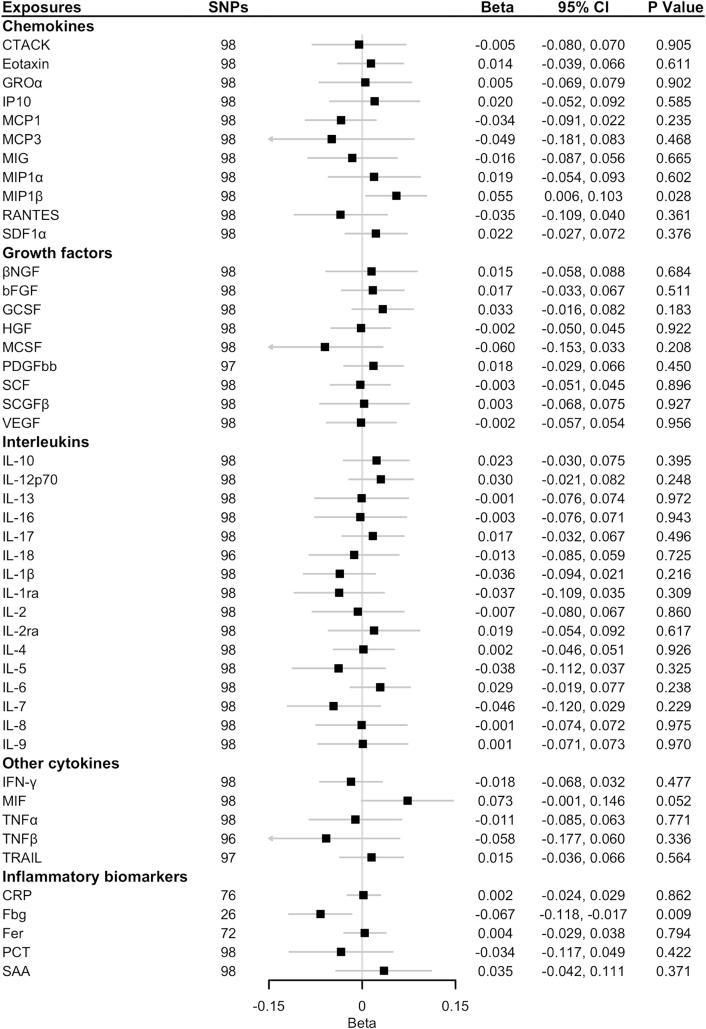
In our initial MR analyses, we observed suggestive associations of genetically predicted interleukin-17 (IL-17), interleukin-2 receptor subunit alpha (IL-2rα), and procalcitonin (PCT) with AF. One standard deviation (SD) increase in IL-17, IL-2rα, and PCT caused an increase in AF risk by 6.3 % (OR 1.063, 95 %CI 1.011---1.118, p = 0.018), 4.9 % (OR 1.049, 95 %CI 1.007---1.094, p = 0.023) and 3.4 % (OR 1.034, 95 %CI 1.005---1.064, p = 0.022), respectively. Furthermore, our reverse MR analyses indicated that genetically predicted AF contributed to a suggestive increase in the levels of macrophage inflammatory protein-1β (MIP1β) (β 0.055, 95 %CI 0.006 to 0.103, p = 0.028), while a decrease in the levels of fibrinogen (Fbg) (β -0.091, 95 %CI -0.140 to -0.041, p < 0.001), which remained significant after multiple test correction.
CONCLUSIONS
Our MR study identified several inflammatory biomarkers with suggestive causal associations regarding the upstream and downstream regulation of AF occurrence, offering new insights for therapeutic exploitation of AF. Further research is required to validate the underlying link between systemic inflammation and AF in larger cohorts.
背景
系统性炎症被认为与房颤(AF)的发生有关,但它是AF的原因还是结果仍不确定。我们试图通过双向孟德尔随机化(MR)分析来探讨系统性炎症与AF之间的因果关系。
方法
从最大的全基因组关联研究(GWAS)中选择与AF密切相关的独立基因变异作为工具变量,该研究涉及多达1,030,836名个体。关于炎症特征,从其相应的GWAS数据库中获得了与41种炎症细胞因子和5种炎症生物标志物的基因关联。效应估计主要使用逆方差加权(IVW)方法进行评估,并辅以使用MR-Egger、加权中位数和MR-PRESSO方法的敏感性分析。
结果
在我们最初的MR分析中,我们观察到基因预测的白细胞介素-17(IL-17)、白细胞介素-2受体亚基α(IL-2rα)和降钙素原(PCT)与AF之间存在提示性关联。IL-17、IL-2rα和PCT每增加一个标准差(SD),AF风险分别增加6.3%(OR 1.063,95%CI 1.011---1.118,p = 0.018)、4.9%(OR 1.049,95%CI 1.007---1.094,p = 0.023)和3.4%(OR 1.034,95%CI 1.005---1.064,p = 0.022)。此外,我们的反向MR分析表明,基因预测的AF导致巨噬细胞炎性蛋白-1β(MIP1β)水平有提示性升高(β 0.055,95%CI 0.006至0.103,p = 0.028),而纤维蛋白原(Fbg)水平降低(β -0.091,95%CI -0.140至-0.041,p < 0.001),在多次检验校正后仍具有显著性。
结论
我们的MR研究确定了几种炎症生物标志物,它们在AF发生的上游和下游调节方面存在提示性因果关联,为AF的治疗开发提供了新的见解。需要进一步的研究来在更大的队列中验证系统性炎症与AF之间的潜在联系。


 Zotero 插件