
塑料,成了它们的盘中餐:宽吻海豚及其猎物摄入颗粒物的初步比较
Plastic, It's What's for Dinner: A Preliminary Comparison of Ingested Particles in Bottlenose Dolphins and Their Prey.
作者信息
Hart Leslie B, Dziobak Miranda, Wells Randall S, McCabe Elizabeth Berens, Conger Eric, Curtin Tita, Knight Maggie, Weinstein John
机构信息
Department of Health and Human Performance, School of Health Sciences, College of Charleston, Charleston, SC 29424, USA.
Center for Coastal Environmental and Human Health, College of Charleston, Charleston, SC 29424, USA.
出版信息
Oceans (Basel). 2023 Dec;4(4):409-422. doi: 10.3390/oceans4040028. Epub 2023 Dec 7.
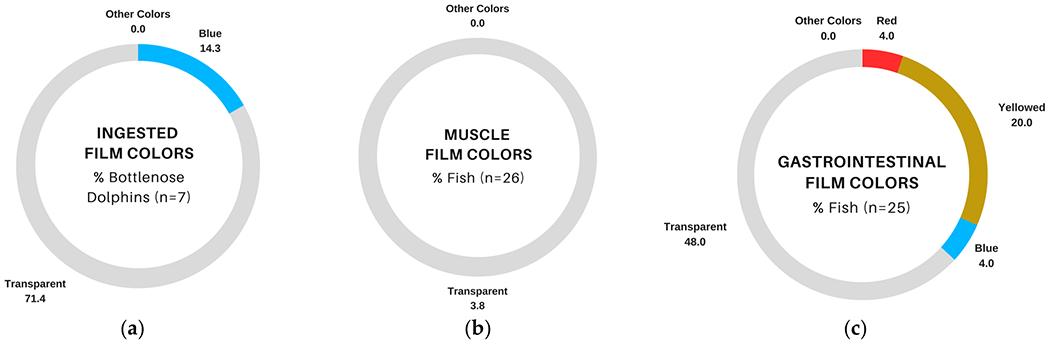
Microplastic ingestion was reported for common bottlenose dolphins () inhabiting Sarasota Bay, FL, USA, a community that also has prevalent exposure to plasticizers (i.e., phthalates) at concentrations higher than human reference populations. Exposure sources are currently unknown, but plastic-contaminated prey could be a vector. To explore the potential for trophic exposure, prey fish muscle and gastrointestinal tract (GIT) tissues and contents were screened for suspected microplastics, and particle properties (e.g., color, shape, surface texture) were compared with those observed in gastric samples from free-ranging dolphins. Twenty-nine fish across four species (hardhead catfish, ; pigfish, ; pinfish, ; and Gulf toadfish, ) were collected from Sarasota Bay during September 2022. Overall, 97% of fish ( = 28) had suspected microplastics, and GIT abundance was higher than muscle. Fish and dolphin samples contained fibers and films; however, foams were common in dolphin samples and not observed in fish. Suspected tire wear particles (TWPs) were not in dolphin samples, but 23.1% and 32.0% of fish muscle and GIT samples, respectively, contained at least one suspected TWP. While some similarities in particles were shared between dolphins and fish, small sample sizes and incongruent findings for foams and TWPs suggest further investigation is warranted to understand trophic transfer potential.
据报道,生活在美国佛罗里达州萨拉索塔湾的普通宽吻海豚摄入了微塑料,该地区的海豚群体还普遍暴露于浓度高于人类参考群体的增塑剂(即邻苯二甲酸盐)中。目前尚不清楚暴露源,但受塑料污染的猎物可能是一个传播途径。为了探索营养级暴露的可能性,对猎物鱼的肌肉、胃肠道(GIT)组织和内容物进行了疑似微塑料筛查,并将颗粒特性(如颜色、形状、表面纹理)与在自由放养海豚的胃样本中观察到的特性进行了比较。2022年9月从萨拉索塔湾采集了四个物种的29条鱼(硬头鲶、猪鱼、尖嘴鱼和海湾蟾鱼)。总体而言,97%的鱼(n = 28)含有疑似微塑料,胃肠道中的微塑料含量高于肌肉。鱼和海豚样本中都含有纤维和薄膜;然而,泡沫在海豚样本中很常见,在鱼样本中未观察到。疑似轮胎磨损颗粒(TWP)在海豚样本中未出现,但分别有23.1%和32.0%的鱼肌肉和胃肠道样本含有至少一个疑似TWP。虽然海豚和鱼的颗粒有一些相似之处,但样本量小以及泡沫和TWP的不一致结果表明,有必要进一步调查以了解营养级转移潜力。


 Zotero 插件