
抗逆转录病毒疗法治疗下的艾滋病毒感染者青少年中病毒载量抑制的障碍:坦桑尼亚坦噶的一项回顾性研究。
Barriers to viral load suppression among adolescents living with HIV on anti-retroviral therapy: a retrospective study in Tanga, Tanzania.
机构信息
Muhimbili University of Health and Allied Sciences, Dar es Salaam, Tanzania.
Dar Es Salaam Institute of Technology, Dar es Salaam, Tanzania.
出版信息
AIDS Res Ther. 2024 May 22;21(1):35. doi: 10.1186/s12981-024-00622-7.
BACKGROUND
Despite the decreased incidence of the human immunodeficiency virus (HIV) in Tanzania, the number of adolescents living with HIV is increasing. This study aimed to describe factors independently associated with viral load non-suppression among adolescents living with HIV (ALHIV) on ART in the Tanga region.
METHODS
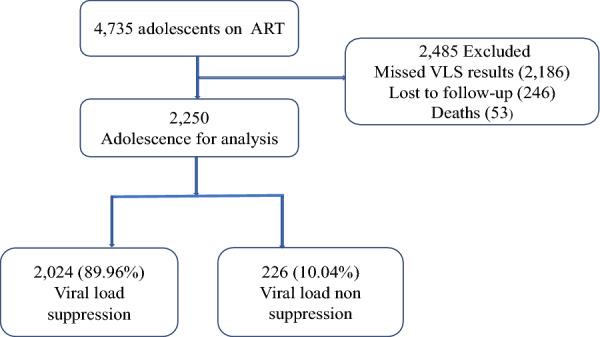
We conducted a retrospective study of routinely collected data from ALHIV on ART from October 2018 to April 2022. We extracted data from the Care and Treatment Clinics form number 2 (CTC2) database that included age, sex, BMI, World Health Organization HIV clinical disease stage, marital status, ART duration, viral load suppression, facility level, and Dolutegravir (DTG)-based regimen. We did descriptive analysis using frequencies to describe the study participants' socio-demographic and clinical characteristics. The Cox proportional hazard regression model was used to identify factors associated with viral load non-suppression (VLS). Viral load non-suppression was defined as viral load ≥ 1000 copies/ml. A total of 4735 ALHIV on ART were extracted from CTC2, then 2485 were excluded (2186 missed viral load results, 246 were lost to follow-up, and 53 deaths).
RESULTS
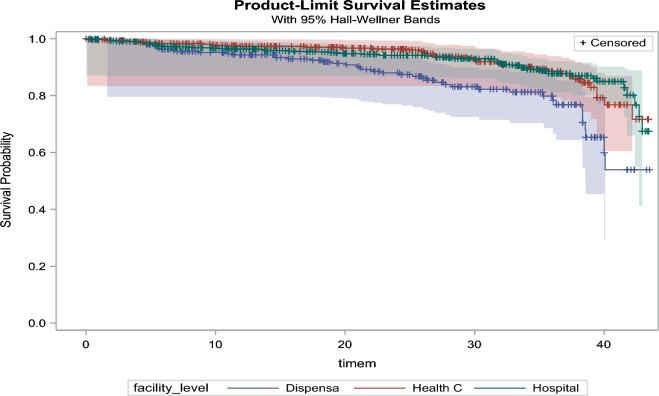
2250 ALHIV on ART were tested for viral load, of whom 2216 (98.62%) adolescents were on first-line ART, and 2024 (89.96%) participants were virally suppressed, while 226 (10.04%) were virally non-suppressed. In addition, 2131 (94.71%) of participants were using a DTG-based regimen; of them, 1969 (92.40%) were virally suppressed. Not using a DTG-based regimen (HR: 9.36, 95% CI 3.41-15.31) and dispensary facility level (HR: 3.61, 95% CI 1.44-7.03) were independently associated with increased hazard for viral load non-suppression. In addition, adolescents aged between 15 and 19 years are less likely to be virally suppressed (HR: 0.55, 95% CI 0.30-0.99).
CONCLUSIONS
The dispensary facility level and not using a DTG-based regimen were significantly associated with viral load non-suppression. HIV intervention strategies should ensure a DTG-based regimen utilization in all adolescents living with HIV, and techniques used by higher-level health facilities should be disseminated to lower-level facilities.
背景
尽管坦桑尼亚的人类免疫缺陷病毒(HIV)发病率有所下降,但感染 HIV 的青少年人数仍在增加。本研究旨在描述坦噶地区接受抗逆转录病毒疗法(ART)的 HIV 阳性青少年(ALHIV)中与病毒载量未抑制相关的独立因素。
方法
我们对 2018 年 10 月至 2022 年 4 月接受 ART 的 ALHIV 的常规收集数据进行了回顾性研究。我们从护理和治疗诊所表格 2(CTC2)数据库中提取数据,其中包括年龄、性别、BMI、世界卫生组织 HIV 临床疾病阶段、婚姻状况、ART 持续时间、病毒载量抑制、设施级别和多替拉韦(DTG)为基础的方案。我们使用频率进行描述性分析,以描述研究参与者的社会人口统计学和临床特征。使用 Cox 比例风险回归模型确定与病毒载量未抑制(VLS)相关的因素。病毒载量未抑制定义为病毒载量≥1000 拷贝/ml。从 CTC2 中提取了 4735 名接受 ART 的 ALHIV,然后排除了 2485 名(2186 名未检测到病毒载量结果,246 名失访,53 名死亡)。
结果
2250 名接受 ART 的 ALHIV 接受了病毒载量检测,其中 2216 名(98.62%)青少年接受了一线 ART,2024 名(89.96%)参与者的病毒载量得到抑制,而 226 名(10.04%)的病毒载量未得到抑制。此外,2131 名(94.71%)参与者正在使用基于 DTG 的方案;其中 1969 名(92.40%)病毒载量得到抑制。未使用基于 DTG 的方案(HR:9.36,95%CI 3.41-15.31)和诊所设施级别(HR:3.61,95%CI 1.44-7.03)与病毒载量未抑制的风险增加独立相关。此外,15 至 19 岁的青少年不太可能被病毒抑制(HR:0.55,95%CI 0.30-0.99)。
结论
诊所设施级别和不使用基于 DTG 的方案与病毒载量未抑制显著相关。艾滋病毒干预策略应确保所有感染 HIV 的青少年都能使用基于 DTG 的方案,并且应将较高级别卫生机构使用的技术推广到较低级别设施。

 Zotero 插件