
血清AIM2作为急性幕上脑出血后卒中相关性肺炎及预后不良预测生物标志物的可用性:一项前瞻性纵向队列研究。
Usability of serum AIM2 as a predictive biomarker of stroke-associated pneumonia and poor prognosis after acute supratentorial intracerebral hemorrhage: A prospective longitudinal cohort study.
作者信息
Zhang Chengliang, Wang Chuanliu, Yang Ming, Wen Han, Li Ping
机构信息
Department of Neurology, The Quzhou Affiliated Hospital of Wenzhou Medical University, Quzhou People's Hospital, 100 Minjiang Road, Quzhou, 324000, Zhejiang Province, People's Republic of China.
Department of Pulmonary and Critical Care Medicine, The Quzhou Affiliated Hospital of Wenzhou Medical University, Quzhou People's Hospital, 100 Minjiang Road, Quzhou, 324000, Zhejiang Province, People's Republic of China.
出版信息
Heliyon. 2024 May 10;10(10):e31007. doi: 10.1016/j.heliyon.2024.e31007. eCollection 2024 May 30.
BACKGROUND
Absent in melanoma 2 (AIM2) is implicated in inflammatory processes. We measured serum AIM2 with intent to unveil its predictive significance for stroke-associated pneumonia (SAP) and functional prognosis following acute intracerebral hemorrhage (ICH).
METHODS
In this prospective cohort study, serum AIM2 concentrations of 163 ICH patients were gauged upon admission and 57 of them also consented for measurements at days 1, 3, 5, 7, 10 and 14. Coupled with 57 individuals without health conditions, dynamic change of serum AIM2 levels were uncovered. National Institutes of Health Stroke Scale (NIHSS) scores and hematoma volume were identified as the dual indicators of severity. Poststroke six-month modified Rankin Scale (mRS) scores ranging from 3 to 6 indicated an unfavorable outcome. SAP was observed during the first seven days after ICH. Sequential univariate and multivariate analyses were performed to discern predictors of SAP and adverse prognosis.
RESULTS
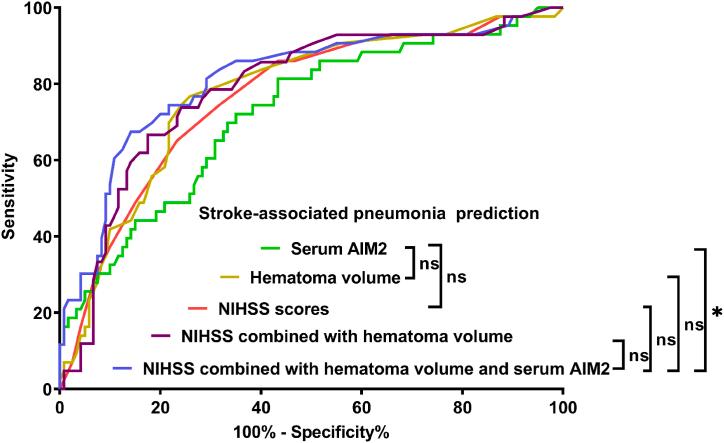
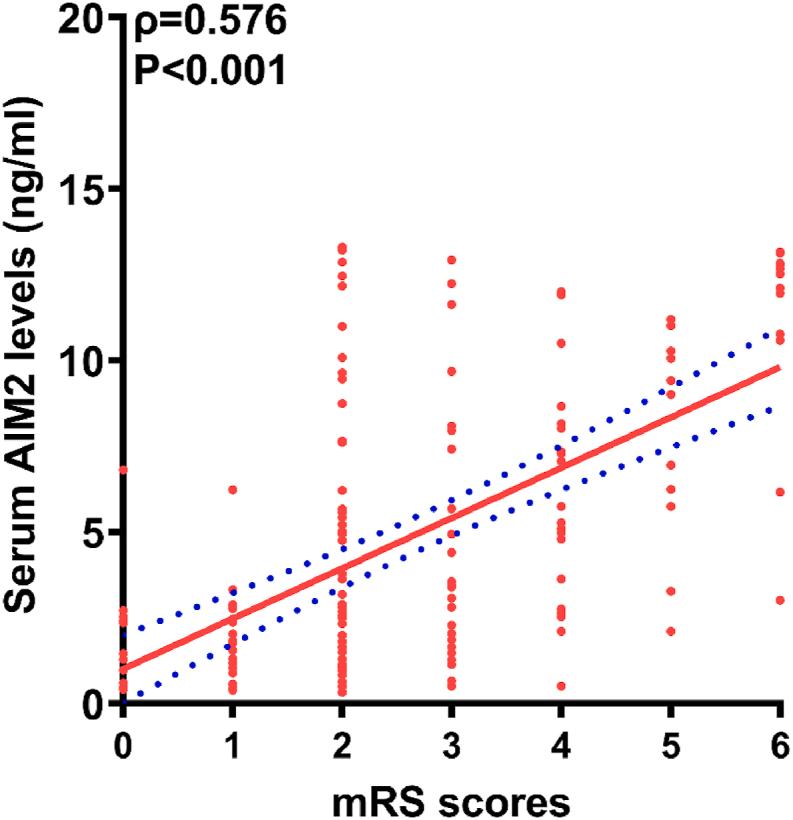
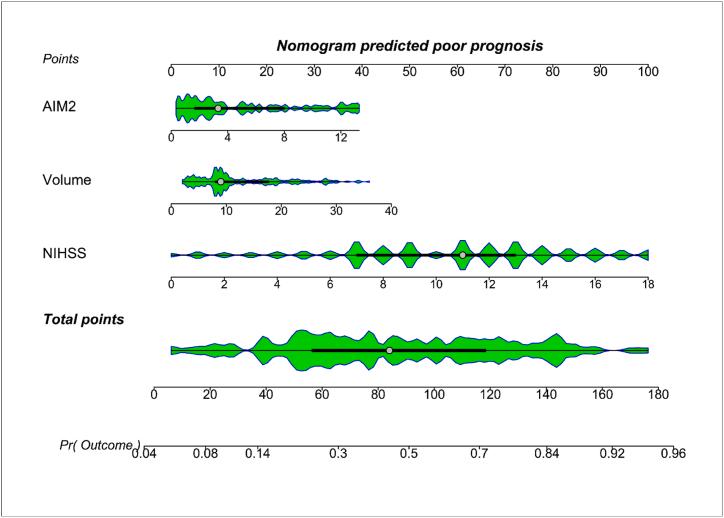
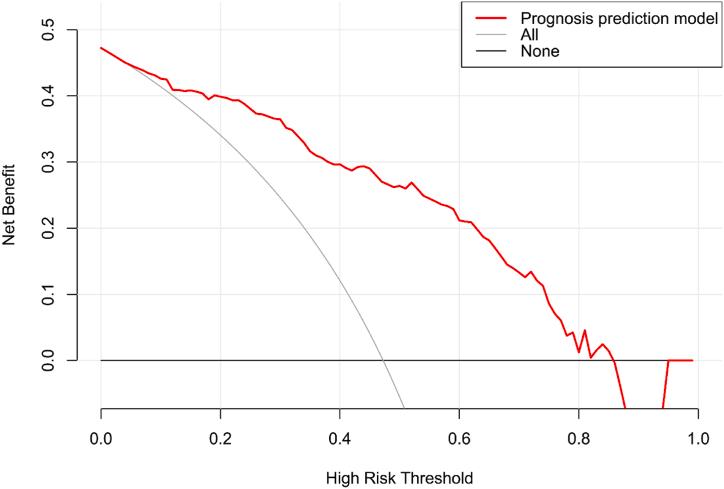
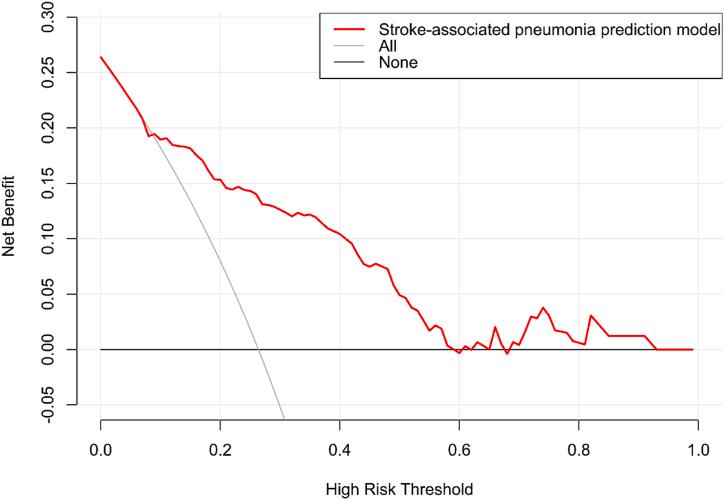
The serum levels of AIM2 in patients exhibited a marked elevation upon admission, reaching peak levels on the third and fifth days, and remained notably elevated until day 14 compared to those of the control group. Serum AIM2 levels showed independent correlations with both NIHSS scores and the volume of hematoma. Additionally, AIM2 concentrations were independently associated with a poor prognosis and SAP at the six-month mark. Within the framework of restricted cubic spline analysis, serum AIM2 concentrations exhibited a linear correlation with the likelihood of developing SAP and experiencing a poor prognosis. In the context of receiver operating characteristic (ROC) curve analysis, serum AIM2 concentrations effectively differentiated risks of SAP and poor prognosis. By employing segmented analysis, serum AIM2 concentrations showed negligible interactions with several traditional variables, such as age, gender, smoking habits, alcohol consumption, and more. The integrated model incorporating serum AIM2, NIHSS scores, and the volume of hematoma was depicted by employing a nomogram and demonstrated strong predictive performance for poor prognosis or SAP across various evaluation metrics, including ROC curve analysis, calibration curve analysis, and decision curve analysis.
CONCLUSION
Serum AIM2 levels show a marked increase shortly after intracerebral hemorrhage (ICH), which may accurately reflect stroke severity, and effectively predict SAP and poor neurological outcomes, and therefore serum AIM2 stands out as an encouraging predictive indicator for ICH.
背景
黑色素瘤缺失2(AIM2)与炎症过程有关。我们检测血清AIM2,旨在揭示其对急性脑出血(ICH)后卒中相关性肺炎(SAP)及功能预后的预测意义。
方法
在这项前瞻性队列研究中,对163例ICH患者入院时的血清AIM2浓度进行检测,其中57例患者还同意在第1、3、5、7、10和14天进行检测。同时纳入57名健康个体,以揭示血清AIM2水平的动态变化。将美国国立卫生研究院卒中量表(NIHSS)评分和血肿体积作为严重程度的双重指标。卒中后6个月改良Rankin量表(mRS)评分在3至6分表明预后不良。在ICH后的前7天观察是否发生SAP。进行单因素和多因素序贯分析以识别SAP和不良预后的预测因素。
结果
患者血清AIM2水平在入院时显著升高,在第3天和第5天达到峰值,并与对照组相比直到第14天仍显著升高。血清AIM2水平与NIHSS评分和血肿体积均呈独立相关。此外,在6个月时AIM2浓度与预后不良和SAP独立相关。在受限立方样条分析框架内,血清AIM2浓度与发生SAP和预后不良的可能性呈线性相关。在受试者工作特征(ROC)曲线分析中,血清AIM2浓度能有效区分SAP和预后不良的风险。通过分段分析,血清AIM2浓度与年龄、性别、吸烟习惯、饮酒等多个传统变量之间的相互作用可忽略不计。通过绘制列线图展示了包含血清AIM2、NIHSS评分和血肿体积的综合模型,该模型在包括ROC曲线分析、校准曲线分析和决策曲线分析等各种评估指标下,对预后不良或SAP均表现出强大的预测性能。
结论
脑出血(ICH)后血清AIM2水平迅速显著升高,这可能准确反映卒中严重程度,并有效预测SAP和不良神经结局,因此血清AIM2是一种令人鼓舞的ICH预测指标。







 Zotero 插件