
姜黄素对肝纤维化啮齿类动物模型的干预作用:系统评价和荟萃分析。
The intervention of curcumin on rodent models of hepatic fibrosis: A systematic review and meta-analysis.
机构信息
College of Traditional Chinese Medicine, Changchun University of Traditional Chinese Medicine, Changchun, China.
Department of Hepatology, The Affiliated Hospital of Changchun University of Traditional Chinese Medicine, Changchun, China.
出版信息
PLoS One. 2024 May 23;19(5):e0304176. doi: 10.1371/journal.pone.0304176. eCollection 2024.
OBJECTIVE
This study aimed to evaluate the intervention effect of curcumin on hepatic fibrosis in rodent models through systematic review and meta-analysis, in order to provide meaningful guidance for clinical practice.
METHODS
A systematic retrieval of relevant studies on curcumin intervention in rats or mice hepatic fibrosis models was conducted, and the data were extracted. The outcome indicators included liver cell structure and function related indicators, such as alanine aminotransferase (ALT), aspartate aminotransferase (AST), alkaline phosphatase (ALP), albumin (ALB), ratio of albumin to globulin (A/G), total bilirubin (TBIL), bax protein, bcl-2 protein and index of liver, as well as the relevant indicators for evaluating the degree of hepatic fibrosis, such as hyaluronic acid (HA), laminin (LN), type I collagen (Collagen I), type III collagen (Collagen III), type III procollagen (PCIII), type III procollagen amino terminal peptide (PIIINP), type IV collagen (IV-C), interleukin-6 (IL-6), tumor necrosis factor-α (TNF-α), α-Smooth muscle actin (α-SMA), hydroxyproline (HYP), platelet derived factor-BB (PDGF-BB), connective tissue growth factor (CTGF) and transforming growth factor-β1 (TGF-β1), and oxidative stress-related indicators, such as superoxide dismutase (SOD), malondialdehyde (MDA) and glutathione peroxidase (GSH-Px). These results were then analyzed by meta-analysis. Studies were evaluated for methodological quality using the syrcle's bias risk tool.
RESULTS
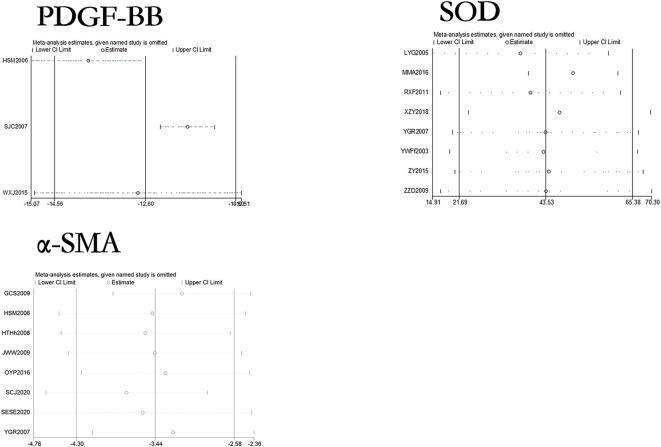
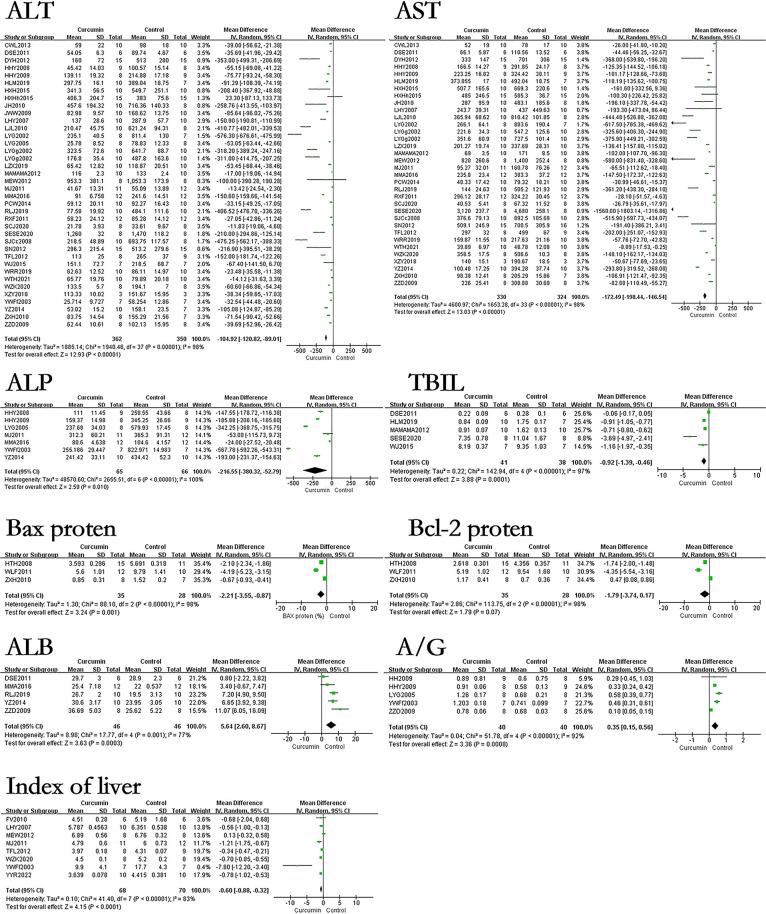
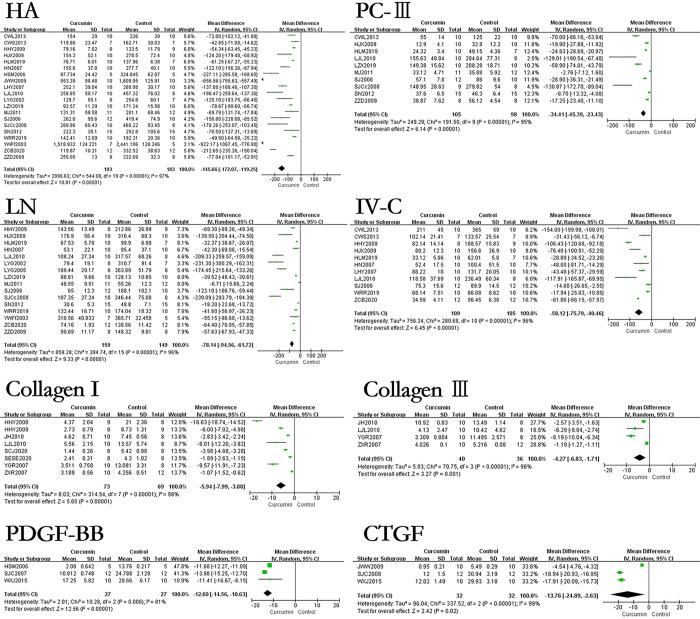
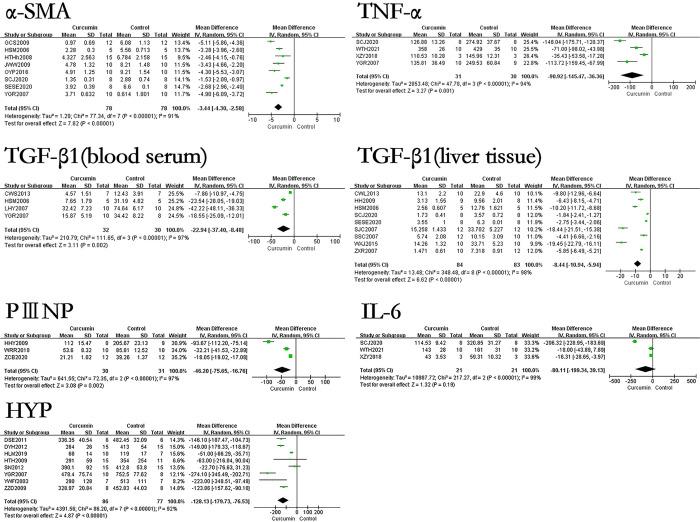
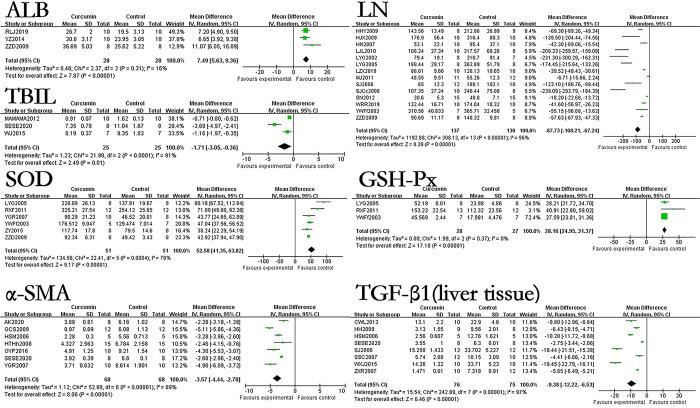
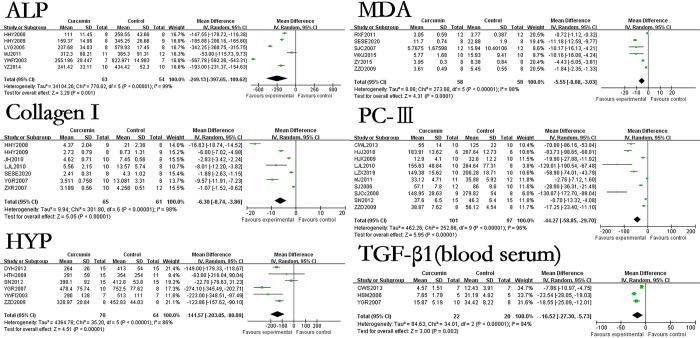
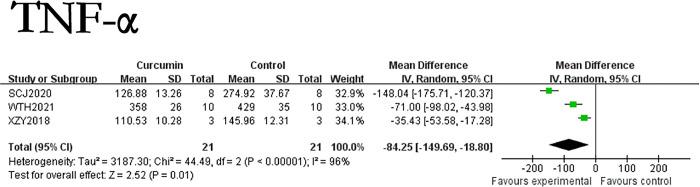
A total of 59 studies were included in the meta-analysis, and the results showed that curcumin can reduce the levels of ALT, AST, ALP, TBIL, bax protein, and index of liver in hepatic fibrosis models. It can also reduce HA, LN, Collagen I, Collagen III, PCIII, PIIINP, IV-C, TNF-α, α-SMA, HYP, PDGF-BB, CTGF, TGF-β1 and MDA, and increase the levels of ALB, A/G, SOD, and GSH-Px in the hepatic fibrosis models. However, the effects of curcumin on bcl-2 protein, IL-6 in hepatic fibrosis models and index of liver in mice were not statistically significant.
CONCLUSION
The analysis results indicate that curcumin can reduce liver cell apoptosis by maintaining the stability of liver cell membrane, inhibit the activation and proliferation of hepatic stellate cells by reducing inflammatory response, and alleviate tissue peroxidation damage by clearing oxygen free radicals.
目的
通过系统评价和荟萃分析评估姜黄素对啮齿动物模型肝纤维化的干预效果,为临床实践提供有意义的指导。
方法
系统检索姜黄素干预大鼠或小鼠肝纤维化模型的相关研究,并提取数据。结局指标包括丙氨酸氨基转移酶(ALT)、天冬氨酸氨基转移酶(AST)、碱性磷酸酶(ALP)、白蛋白(ALB)、白蛋白与球蛋白比值(A/G)、总胆红素(TBIL)、bax 蛋白、bcl-2 蛋白和肝指数,以及评估肝纤维化程度的相关指标,如透明质酸(HA)、层粘连蛋白(LN)、I 型胶原(Collagen I)、III 型胶原(Collagen III)、III 型前胶原(PCIII)、III 型前胶原氨基端肽(PIIINP)、IV 型胶原(IV-C)、白细胞介素-6(IL-6)、肿瘤坏死因子-α(TNF-α)、α-平滑肌肌动蛋白(α-SMA)、羟脯氨酸(HYP)、血小板衍生生长因子-BB(PDGF-BB)、结缔组织生长因子(CTGF)和转化生长因子-β1(TGF-β1),以及氧化应激相关指标,如超氧化物歧化酶(SOD)、丙二醛(MDA)和谷胱甘肽过氧化物酶(GSH-Px)。然后通过荟萃分析对这些结果进行分析。使用 syrcle 的偏倚风险工具对研究进行方法学质量评估。
结果
荟萃分析共纳入 59 项研究,结果表明,姜黄素可降低肝纤维化模型中 ALT、AST、ALP、TBIL、bax 蛋白和肝指数。它还可以降低 HA、LN、Collagen I、Collagen III、PCIII、PIIINP、IV-C、TNF-α、α-SMA、HYP、PDGF-BB、CTGF、TGF-β1 和 MDA,并增加肝纤维化模型中 ALB、A/G、SOD 和 GSH-Px 的水平。然而,姜黄素对肝纤维化模型中 bcl-2 蛋白、IL-6 和小鼠肝指数的影响没有统计学意义。
结论
分析结果表明,姜黄素通过维持细胞膜稳定性减少肝细胞凋亡,通过降低炎症反应抑制肝星状细胞的激活和增殖,并通过清除氧自由基缓解组织过氧化损伤。





 Zotero 插件